
In this article 8
“Drought-resistant” does not refer to a single quality. Plants that get through a dry summer do so through five different strategies, and knowing which one is at work completely changes how to manage them.
Some escape drought instead of resisting it. Others cope provided they have been established for a long time. Still others resist poorly in the first year and perfectly by the third. This article begins with the mechanisms, then lists the species.
This article deals with species selection. For soil techniques—mulching, covering, and water retention—see Creating a garden without irrigation, and for field diagnosis, see Which seeds for poor, dry soil?.
The five resistance strategies
1. Evasion—completing the cycle before summer
These plants do not resist: they have finished. Poppy, cornflower, pea, fava bean, lentil, and most bulbs complete their cycle on spring rains and are dead or dormant when drought arrives.
Practical consequence: sow them early—very early. A pea sown in March makes it through; the same one sown in May fails. It is a matter of timing, not variety.
2. Deep rooting
They seek out water where it remains. Alfalfa descends more than a meter, parsnips, salsify, and scorzonera grow deep, while trailing squash plants explore widely.
Consequence: these plants need water at the beginning to build this root system. Water generously for the first two months, then stop completely. This is exactly the opposite of what we instinctively do.
3. Limiting water loss
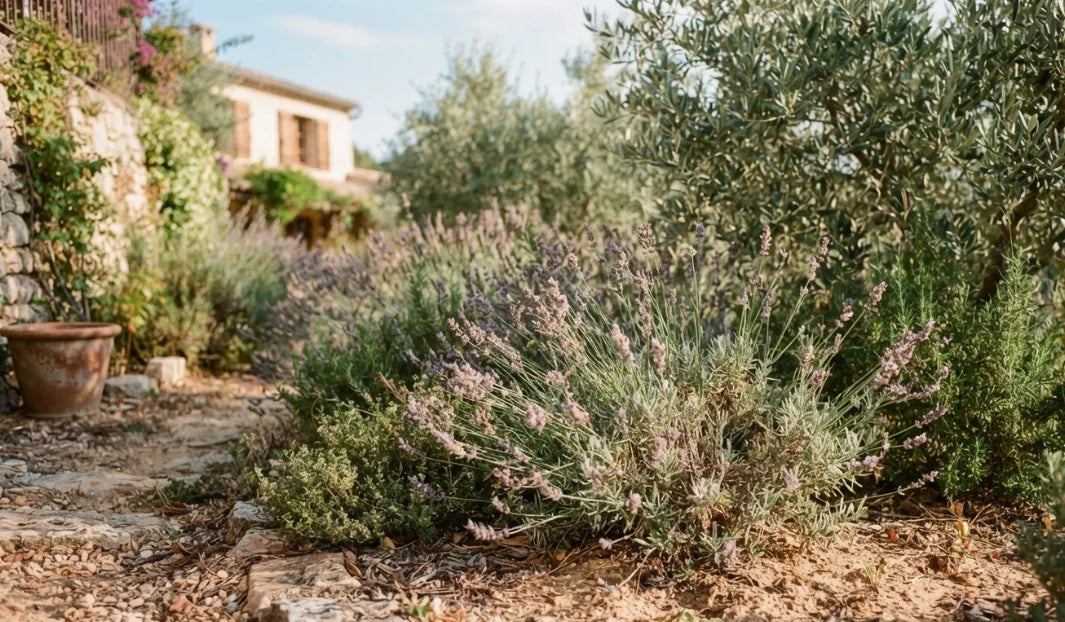
Narrow, tough, waxy, or silver-haired leaves: these are the visual signatures of a water-conserving plant. Lavender, thyme, sage, rosemary, white horehound. The hairs create a layer of still air that slows evaporation; the light color reflects radiation.
Consequence: these plants require well-drained, poor soil. In rich, damp soil, they rot—their weak point is not drought but excess water.
4. Storage
Reserves stored in a fleshy root, a bulb, or thick tissues: onion, garlic, artichoke, cardoon, and, ornamentally, houseleeks and sedums. They draw on their reserves during critical periods.
5. Water-efficient photosynthesis
Some plants of tropical or subtropical origin — amaranth, corn, sorghum, purslane — use a metabolism that allows them to fix carbon while losing much less water. That is why amaranth and purslane thrive in the middle of August when lettuce bolts.
In the vegetable garden: what holds up
| Crop | Strategy | Good to know |
|---|---|---|
| Squash, pumpkins, watermelons | Rooting + ground cover | Their foliage protects the soil. Water during establishment, then ease off |
| Dry beans, chickpeas, lentils | Avoidance + nitrogen fixation | Cycle timed to spring, harvested dry |
| Dry-farmed tomatoes | Deep rooting | Thick mulch, water only when planting. Less bulk, more concentrated flavors |
| Amaranth, Swiss chard, New Zealand spinach | Water-efficient metabolism | Replace lettuce in July–August |
| Beetroot, parsnip, salsify | Deep roots | Sow early so the taproot is established before summer |
| Onion, garlic, shallot | Storage | Little water once the bulb has formed — excess moisture causes it to rot |
| Artichoke, cardoon | Storage + taproot | Very hardy once established; allow two years of patience |
| Purslane | Water-efficient metabolism | Self-seeding, excellent edible ground cover |
Do not tolerate it: summer lettuce, celery, cucumber, radishes, spinach, cauliflower. These are spring and autumn crops — forcing them in July uses a great deal of water for mediocre results.
Herbs and flowers
Mediterranean herbs
Thyme, common sage, true lavender, oregano, savory, white horehound. Once established — allow a full season — they need nothing more. They are also excellent bee plants.
Dryland flowers
- California poppy — probably the most reliable: long flowering, self-seeding, and no maintenance.
- Yarrow — a very hardy perennial, with flat flower heads that feed hoverflies.
- Purple coneflower — a prairie perennial, spectacular and undemanding.
- Poppy and cornflower — an avoidance strategy: sow in autumn, bloom in spring.
- Nasturtium — undemanding and frugal, it actually requires poor soil to flower well.
- Sunflower — a powerful taproot, remarkable in deep soil.
Ground Covers and Green Manures
Alfalfa, white clover, phacelia, flax. They protect the soil as they grow—a double benefit on dry land. See Sowing Green Manures.
Care Makes All the Difference
A poorly managed hardy plant will not withstand difficult conditions. Five rules, and the first is the most counterintuitive.
- Water generously during the first year, then stop. Lavender and artichokes are low-water plants only once they are well rooted. Many so-called hardy plants die in their first season because they were treated from the outset as if they were established.
- Water rarely but deeply. Light daily watering keeps roots in the first five centimeters, where the soil dries out first. Substantial watering once a week makes them grow deeper.
- Plant in autumn. This is the most effective step on this list. A perennial planted in October has the whole winter and spring to establish its roots; the same plant put in the ground in May faces summer with shallow roots.
- Do not fertilize. Nitrogen produces tender, abundant foliage that demands a lot of water—the exact opposite of what we are looking for. It also dilutes the flavor of herbs.
- Always mulch. The best variety choice cannot make up for bare soil.
Adaptation, the Often-Forgotten Lever
A reproducible variety resown every year in the same place undergoes natural selection: the individuals that have best withstood the site's water conditions are the ones that produce the most viable seeds. After three or four cycles, you are growing a strain adapted to your land.
A repurchased F1 hybrid that is identical every spring will never benefit from this mechanism. In an increasingly unstable climate, this is probably the strongest argument in favor of reproducible seeds—and it is cumulative: each year builds on the previous one.
Mistakes That Cost a Season
- Planting Mediterranean plants in rich, wet soil. They do not die of thirst but of suffocation. Well-drained, poor soil is essential.
- Sowing drought-avoidance species too late. A May pea will not catch up with a March pea.
- Watering a little every day. This is the best way to create a dependent plant.
- Confusing drought resistance with heat resistance. Above 35 °C, tomato pollen becomes sterile even when the soil is moist. Shade during the hottest hours solves what watering cannot.
- Giving up on mulching because “it attracts slugs.” In dry conditions, slugs are a minor problem, while mulch is essential.
Frequently asked questions
Can you have a productive vegetable garden without watering at all?
Not entirely: seedlings and young plants always need water because their roots are shallow. The realistic goal is to eliminate maintenance watering once the crops are established—which already accounts for most of the water consumption.
Do heirloom varieties withstand drought better?
Often yes, because they were selected without systematic irrigation and develop more extensive root systems. But this is not an absolute rule: the variety’s geographical origin matters most.
Do you need succulents?
For ornamental purposes, sedums and houseleeks are unbeatable on low walls or in rock gardens. In the vegetable garden, they have no practical use—the useful strategies are root establishment and drought avoidance.
Does it work in a pot?
Only partly: a pot has a limited water reserve and dries out through its sides. Mediterranean herbs cope well with this; other plants still require regular watering. See Balcony vegetable garden.
When should you sow to limit water needs?
Early in spring for drought-avoidance species, and especially in autumn for perennials and herbs. Autumn is the most effective planting season in dry climates, and the least practiced.
Key takeaways
Identify the strategy before choosing the plant: drought avoidance depends on timing, root establishment is built with water at the start, and minimizing foliage requires well-drained soil. Plant in autumn, water rarely and deeply, do not fertilize—and let your varieties adapt from one year to the next.
Going further
- Creating a garden without irrigation: mulch, ground cover, and mulching
- Which seeds for poor, dry soil?
- The different types of soil
- The month-by-month sowing calendar
For a water-efficient garden: our Mediterranean herbs, our green manures, and our heirloom varieties.

Leave a comment
This site is protected by hCaptcha and the hCaptcha Privacy Policy and Terms of Service apply.