
In this article 9
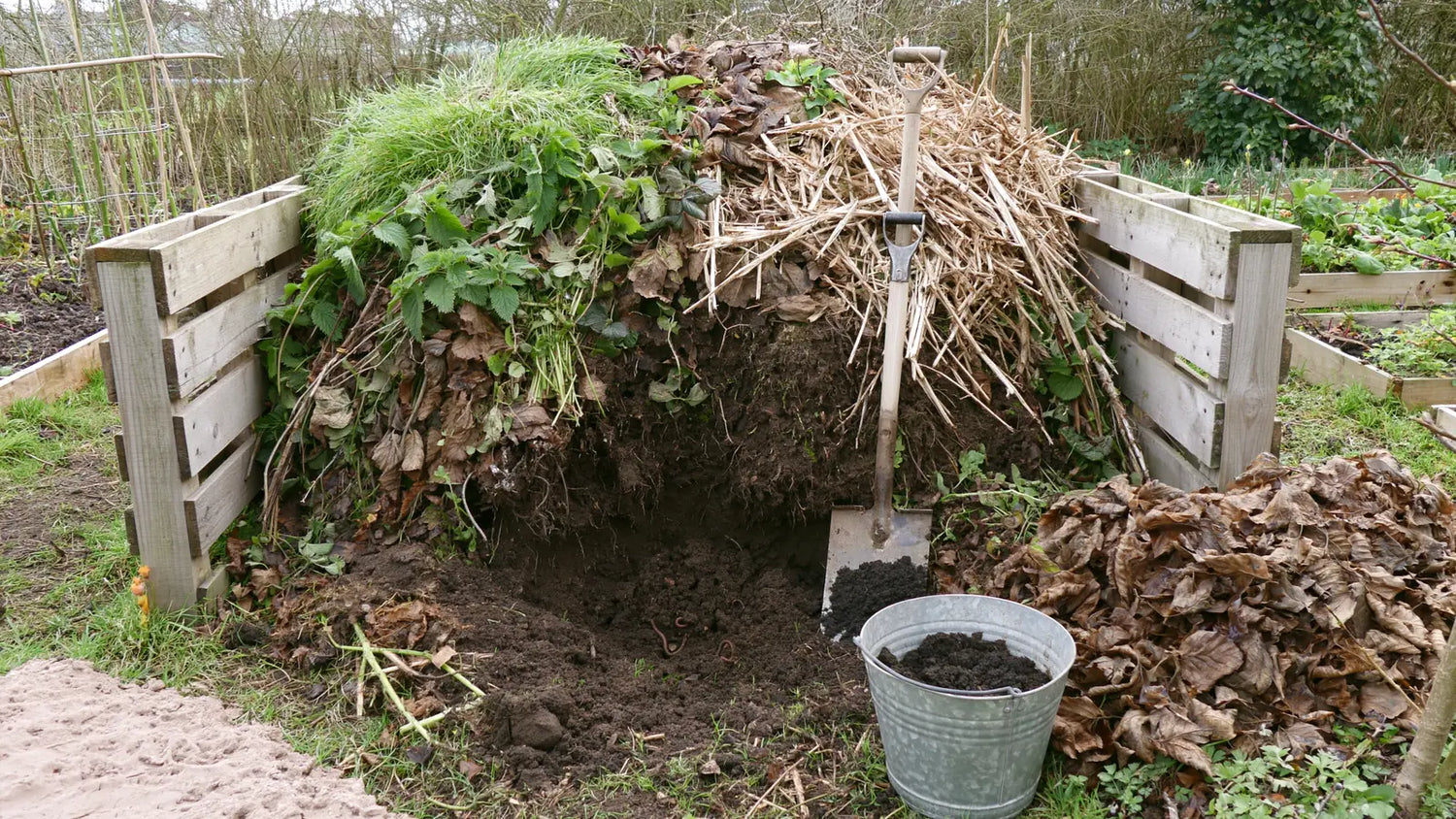
Compost that smells bad, does not heat up, or takes two years to form: in almost every case, the cause is the same and comes down to three parameters—the carbon/nitrogen ratio, moisture, and oxygen. Understanding how these three interact is enough to diagnose any problem and correct it in a single step.
This guide starts with how it works, then moves on to practical matters: what to add, in what proportions, how to tell whether it is working, and how to use the result.
What really happens in a compost pile
Composting is not passive decomposition: it is a succession of microbial populations replacing one another, each consuming what the previous one has made accessible. Three phases follow one another.
Phase 1 — the temperature rise (a few days to a few weeks)
Mesophilic bacteria first attack sugars and proteins, the easiest molecules to break down. Their activity releases heat; the pile warms up, and above 40 °C they give way to thermophilic bacteria, which take over up to 55–65 °C.
This heat is not merely cosmetic. Maintained above 55 °C for several days, it destroys most weed seeds and a large proportion of plant pathogens. That is the whole difference between hot compost and cold compost.
To heat up, a pile must reach a critical volume of about 1 m³. Below that, heat dissipates faster than it is produced: the compost will still form, but slowly and without a sanitizing effect. This is the main limitation of small balcony composters.
Phase 2 — active decomposition (several months)
The temperature drops as thermophiles run out of easily available material. Fungi and actinomycetes take over: they are the only organisms capable of breaking down cellulose and lignin, the tough molecules in wood and stems. Invertebrates arrive—worms, woodlice, springtails—and mechanically fragment the material.
This is the longest phase, and turning the pile usefully reactivates the process.
Phase 3 — maturation (2 to 4 months)
The humification processes come to an end: the remaining molecules recombine into stable humic components that will persist in the soil for years. The compost develops a crumbly texture, a uniform dark brown color, and a distinct woodland smell.
Compost used before this phase is complete remains biologically active—with the consequences described below.
The C/N ratio: the only figure you need to know
Microorganisms need carbon as an energy source and nitrogen to build their proteins. They consume approximately 25 to 30 parts carbon for 1 part nitrogen. This is the famous C/N ratio, and it is the parameter behind 80% of failed composting.

| Material | Approximate C/N ratio | Category |
|---|---|---|
| Fresh grass clippings | 15–20 | Green |
| Kitchen peelings | 15–20 | Green |
| Coffee grounds | 20 | Green |
| Poultry manure | 7–10 | Very nitrogen-rich green material |
| Dead leaves | 40–80 | Brown |
| Straw | 80–100 | Brown |
| Brown cardboard | 300–400 | Very carbon-poor brown material |
| Sawdust and wood chips | 400–500 | Very carbon-poor brown material |
In practice, there is no need to calculate: aim for about two-thirds brown material by volume to one-third green, bearing in mind that brown materials are much more voluminous at the same weight. A pile receiving only kitchen peelings will always be too nitrogen-rich — hence the value of keeping a bag of dead leaves next to the composter and adding a handful with each addition.
Quick diagnosis
| Symptom | Cause | Correction |
|---|---|---|
| Smell of ammonia | Too much nitrogen | Add brown materials and turn |
| Smell of rotten eggs or stagnant water | Lack of oxygen (anaerobic) | Turn it without fail and add coarse materials |
| Nothing is happening; pile is cold and dry | Too much carbon or too dry | Add green materials and water |
| Swarm of fruit flies | Fresh waste exposed on the surface | Cover each addition with a layer of brown material |
| Ant colony established | Pile too dry | Water thoroughly |
Moisture and oxygen: the other two levers
The classic guideline — as damp as a wrung-out sponge — corresponds to approximately 50–60% moisture. The test: a squeezed handful should release one or two drops, not run.

These two parameters are linked: above 65% moisture, water displaces air from the gaps and the pile switches to anaerobic fermentation — odors, acidification, and the process stops. This is why structure matters as much as the ratio: fine branches, hollow stems, or wood chips create voids that maintain air circulation, even when the pile is damp.
Turning — every 4 to 6 weeks is sufficient for garden compost. It re-oxygenates and homogenizes the compost, and brings peripheral materials that never heated back to the center. Compost that is never turned will still develop, but in twice the time and in a very uneven way.
Which method suits your situation
| Method | Who it is for | What you need to know |
|---|---|---|
| Open pile | Large garden | The only one that easily reaches one cubic meter and therefore heats up. Free. |
| Closed composter | Urban garden, close neighbors | Discreet, protects from rain. Heats little: cold compost; weed seeds are not destroyed. |
| Surface composting | Permaculture, living soil | Spread the waste directly under the mulch. No handling, but no rise in temperature either. |
| Integrated into the mounds | Gardens using mound culture | The material decomposes in situ, at the heart of the mound. |
| Vermicomposting | Apartment, balcony | Produces very rich compost and liquid worm tea. Requires regular monitoring and tolerates neither large quantities of citrus nor overloading. |
| Bokashi | Kitchen, very small volumes | This is not composting: it is lactic fermentation in a closed environment. The resulting product must still be buried or composted before use. |
What can be added — and the real exceptions
Lists of prohibited items circulate without nuance. Here is what really justifies them.
- Meat, fish, dairy products — the problem is not decomposition (it occurs very well) but attracting rodents and causing odors. In closed, well-managed hot compost, it is possible; in an open garden pile, avoid it.
- Citrus fruits — tolerated in small quantities. The real issue concerns vermicompost, where acidity bothers the worms.
- Diseased plants — acceptable only in verified hot compost (55 °C for several days). When in doubt, set them aside: downy mildew and clubroot survive in lukewarm compost.
- Weeds gone to seed — same principle. In cold compost, you will reseed your weeds the following year.
- Treated wood, glossy paper, cigarette butts, “biodegradable” bags — no, in all cases. Industrially compostable bags require temperatures that domestic compost never reaches.
- Eggshells — of no real benefit if they are not finely ground: they reappear intact several years later.
How to recognize mature compost

| Criterion | Mature compost | Unfinished compost |
|---|---|---|
| Appearance | Dark brown, homogeneous, crumbly | Heterogeneous, identifiable pieces |
| Smell | Forest floor, potting soil | Sour, ammoniacal, fermenting |
| Core temperature | Ambient | Still lukewarm or hot |
| Earthworms | Present and established | Absent (too hot for them) |
The cress test, more reliable than visual inspection: sow a pinch of garden cress seeds in a dish of moist compost, and the same quantity in some control potting soil. If germination and growth are comparable, the compost is mature. If they are noticeably lower, it still contains phytotoxic compounds.
Unfinished compost applied to young plants causes nitrogen hunger: the microorganisms that continue their work draw nitrogen from the soil for their own benefit, and the crops turn yellow. The phenomenon is temporary but can cost you a season.
Use compost at the right time
- Autumn—the main period. Spread 2 to 5 cm over the surface without burying it, then cover with mulch. Soil organisms will incorporate it themselves during the winter.
- Spring—before planting nutrient-hungry crops (tomatoes, squash, cabbages), at the bottom of the planting hole or lightly scratched into the surface.
- During the growing season—as a light mulch around plants, using mature compost only.
Do not bury it deeply. Compost is an aerobic product: buried 20 cm deep, it ends up in a low-oxygen zone where its decomposition slows and deteriorates. Its place is on the surface or in the top five centimeters, where the microorganisms that will use it live.
Mature compost is not actually a fertilizer: it is a soil amendment. It provides few immediately available nutrients, but it permanently improves the soil structure and nourishes soil life—see The different types of soil.
Frequently asked questions
How long does it take to make compost?
From 3 to 4 months for hot compost turned regularly, up to 18 months for a cold pile that is never turned. The difference is almost entirely due to the initial volume and the frequency of turning.
My compost never heats up—is that a problem?
No, it will still compost. You simply lose the disinfecting effect, so do not add diseased plants or weeds that have gone to seed.
Do you need a compost activator?
Unnecessary in the vast majority of cases. What compost activators provide—nitrogen and microorganisms—is already supplied free of charge by a handful of fresh nettles, grass clippings, or simply a shovelful of mature compost from the previous cycle.
Can you compost in winter?
Yes, but activity slows considerably below 10 °C. Keep feeding the pile; it will start up again in spring. A large pile, well insulated with a layer of leaves, also maintains a surprisingly stable internal temperature.
Compost or manure?
Fresh manure is too rich and too “hot” for direct use: it must be composted for at least six months. Properly managed homemade compost is more balanced and free from the risk of veterinary drug residues.
Key takeaway
Just three parameters, and nothing else: two-thirds brown material to one-third green material, the moisture level of a wrung-out sponge, and air. When compost isn’t working, simply ask yourself which of the three is missing—the answer is always there.
To take things further
- The basics of living soil: bacteria, fungi, and microorganisms
- Sowing green manure: benefits, types, and schedule
- Mound cultivation
- How to create a permaculture vegetable garden?
To complement composting: our green manure seeds, which nourish and structure the soil between two crops.

Leave a comment
This site is protected by hCaptcha and the hCaptcha Privacy Policy and Terms of Service apply.