Eschscholzia californica
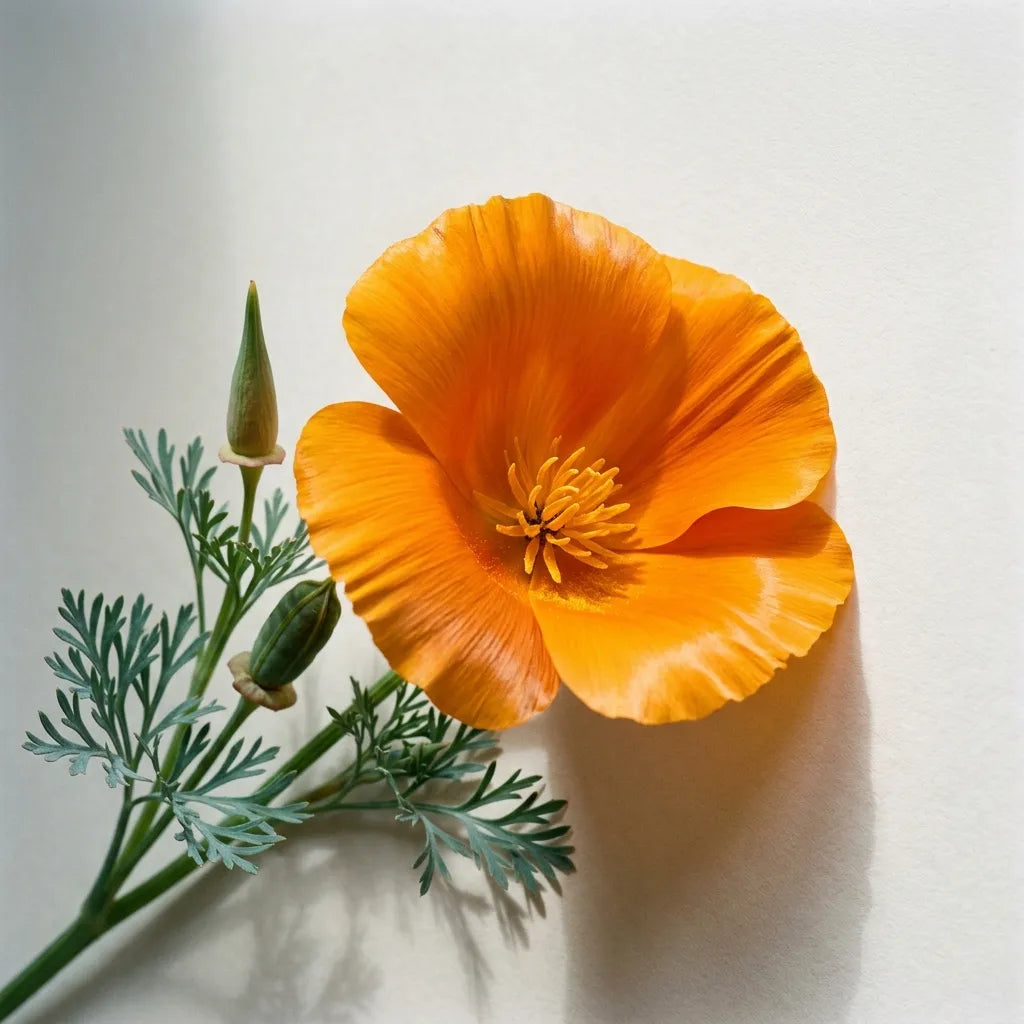
Golden poppy, California poppy: it is no coincidence that this flower bears gold in several of its nicknames. It has been the official emblematic flower of the state of California since 1903, chosen for its sun-colored petals that once carpeted the hills of the American West.
Characteristics:
-
Perennial grown as an annual: native to the western United States, it produces vibrant yellow, orange, and sometimes pink flowers.
-
Light foliage: finely divided, it adds an airy touch to borders and rock gardens.
-
Drought-resistant: once established, it requires almost no watering.
Sowing advice:
-
Exposure: full sun is essential — its flowers close in the shade and in cloudy weather.
-
Soil: poor, dry, sandy, or stony, and above all well drained. It dislikes heavy, clay-rich, and damp soils, where its roots rot. There is no need to amend or fertilize the soil: soil that is too rich produces lots of foliage and few flowers.
-
Method: sow directly in place, broadcasting the seeds, in spring or autumn. Like other poppies, its taproot does not tolerate transplanting well: avoid starting it in pots. Barely cover the seeds and thin to 20 cm apart.
- No prior soaking is necessary. For more information, see our guide: how to sow your seeds in cotton, in pots, or directly in the ground.
Care advice:
- Almost none: no watering once established and no fertilizing. Remove faded flowers to extend flowering, or let them go to seed for natural self-sowing.
Beneficial combinations:
- It pairs perfectly with other flowers suited to dry, poor soils, such as the wild poppy or the cornflower, to create a maintenance-free flower meadow. Discover other suitable varieties in our article about seeds for poor, dry soil.
Benefits for biodiversity:
- Like other poppies, its flowers provide abundant pollen that is highly sought after by bees and hoverflies.
- Sown along the edge of a vegetable garden, it attracts pollinators to nearby crops — a strategy detailed in our article about combining flowers with a vegetable garden.
Uses:
- Primarily ornamental, it has also traditionally been used in herbal tea in some cultures for a long time. Do not confuse it with the opium poppy: its seeds are not commonly used as food.
Symbolism:
As the official flower of the state of California, the golden poppy is celebrated each year with its own unofficial holiday, California Poppy Day, on April 6.
Harvesting your own seeds:
Leave the long pods to turn brown and dry on the plant until they split open lengthwise, then shake them over a bag. The California poppy also readily self-seeds, and can cover an entire flower bed over the seasons. To keep the seeds safely until the next sowing, see how to store your seeds from one year to the next.
Commitment to Quality: at SemiSauvage - Permaculture, we grow and select our seeds with respect for all living things as our guiding principle. Based near the Auvergne Volcanoes, we choose reproducible, non-hybrid varieties, tested for their germination rate, carefully sorted and packaged, with no chemical treatment. Our belief: to give gardeners back the ability to resow, year after year, seeds that truly belong to them.
Add a touch of vibrant color to your garden with these California poppy seeds.