Briza maxima
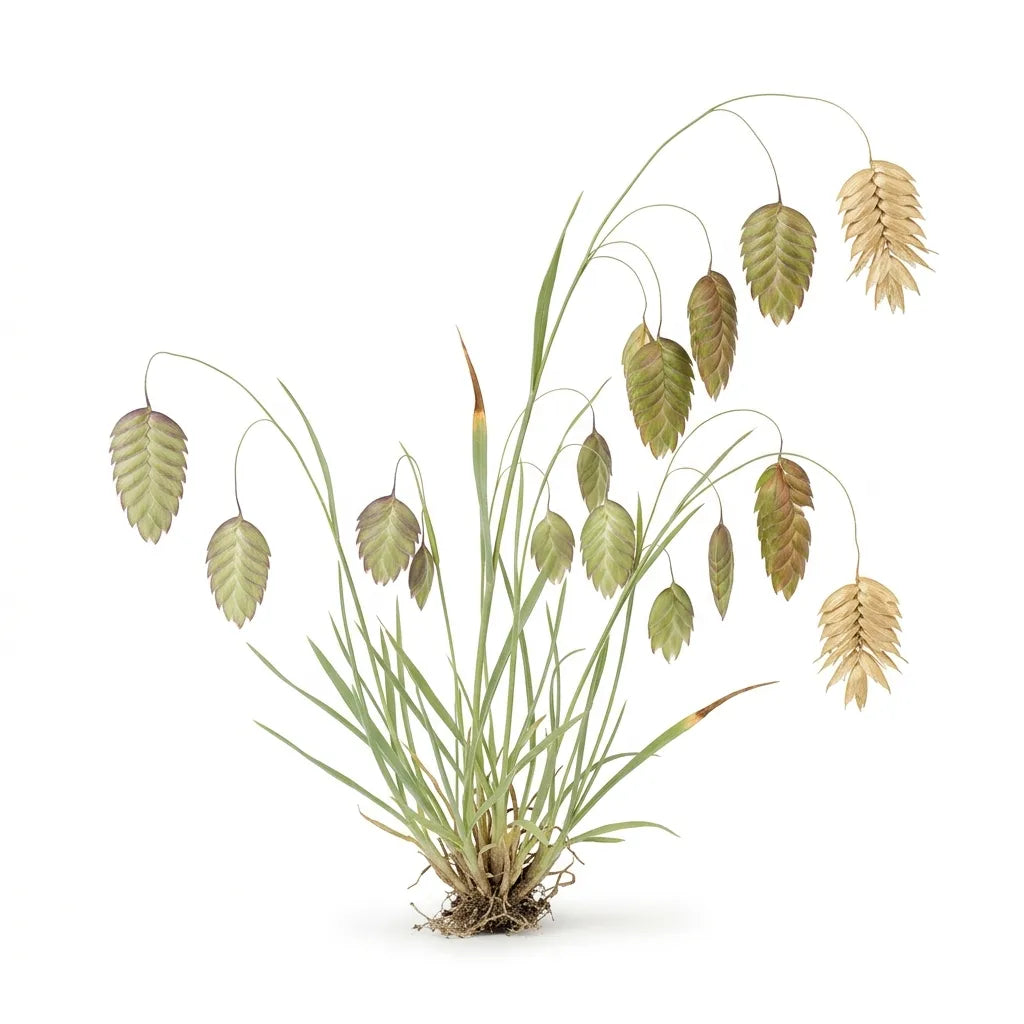
Greater quaking grass, love grass, cuckoo bread, trembler grass: its flattened spikelets hang from such fine pedicels that they quiver at the slightest breeze—hence its name, “trembler grass.” When dry, they produce a soft, continuous rustling that adds a sound dimension to the garden, something rare among ornamental plants.
Characteristics:
-
Pendulous spikelets: initially green tinged with purple, they turn straw yellow as they dry.
-
Elegant clump: blue-green linear leaves topped with fine, graceful stems.
-
Excellent for dried bouquets: remarkably long-lasting, it keeps for years without losing its shape.
-
Self-seeding: once established, it returns year after year.
Sowing advice:
-
Exposure: full sun.
-
Soil: light, sandy, well-drained and rather poor—this is a grass of dry Mediterranean meadows. It tolerates drought well and dislikes stagnant moisture. Do not amend the soil: in rich soil, its slender stems will flop.
-
Method: no stratification required. Sow in spring or autumn, directly in place, broadcast or in small clumps, barely covering the seeds. See how to sow your seeds.
Care advice:
- None. Watering is unnecessary once established. Leave a few spikes to produce seed for natural self-seeding.
Harvest advice:
- For dried bouquets, cut the stems when the spikelets are still green tinged with purple, before they are fully mature: they will turn golden as they dry without breaking apart. If harvested too late, they shed their seeds.
Beneficial pairings:
Benefits for biodiversity:
- Its seeds feed small granivorous birds in late summer and autumn.
- Its clump provides low shelter for beneficial insects, while its roots help stabilize light soils.
Uses:
- Wildlife gardens, rock gardens, borders and pots. Above all, it is indispensable for dried bouquets, wreaths and handmade arrangements.
Symbolism:
Its nickname, “love grass,” comes from an old tradition: young people would give one another a quivering spike as a discreet declaration, the plant’s trembling evoking the emotion of love.
Harvesting your own seeds:
Leave a few spikes to turn completely golden on the plant, then shake them over a container: the seeds will fall off on their own. It also self-seeds spontaneously in the garden. See how to store your seeds.
Commitment to Quality: at SemiSauvage - Permaculture, we grow and select our seeds with respect for living things as our guiding principle. Based near the Auvergne Volcanoes, we choose open-pollinated, non-hybrid varieties, tested for their germination rate, carefully sorted and packaged, with no chemical treatment. Our conviction: to give gardeners back the ability to sow, year after year, seeds that truly belong to them.
Add movement and sound to your garden with this quivering grass.