

Permaculture suffers from two symmetrical misunderstandings. For some, it is a gardening technique — mounds, mulching, and a little disorder. For others, it is a vague philosophy with no clear practical application. In reality, it is a design method, formalized in Australia in the 1970s by Bill Mollison and David Holmgren, whose name is a contraction of permanent agriculture — and later, by extension, permanent culture.
Its central proposition can be summed up in one sentence: rather than fighting a site's constraints, design a system that uses them. A slope becomes a water-management feature, a south-facing wall becomes a microclimate, and green waste becomes fertility. This article sets out the foundations — the ethics, the design principles, and the three practical pillars in the garden.
The three founding ethics
They are deliberately brief, and everything else follows from them. They are not decorative moral principles: each has a direct operational application.
- Care for the earth. Preserve and regenerate living systems, starting with the soil. In practice: no tilling, no bare soil, and no input that destroys underground life.
- Care for people. A system that exhausts the person maintaining it is not sustainable, whatever its ecological merits. In practice: zoning — place what requires daily attention close by, and what can manage on its own farther away.
- Share fairly. Redistribute surplus rather than accumulating it, and limit consumption. In the garden, this means exchanging seeds and plants, seed swaps, and passing on knowledge and skills.
This third ethic also explains why the question of reproducible seeds is central to permaculture: a seed that cannot be replanted or passed on closes the loop of sharing.
Pillar 1 — living soil
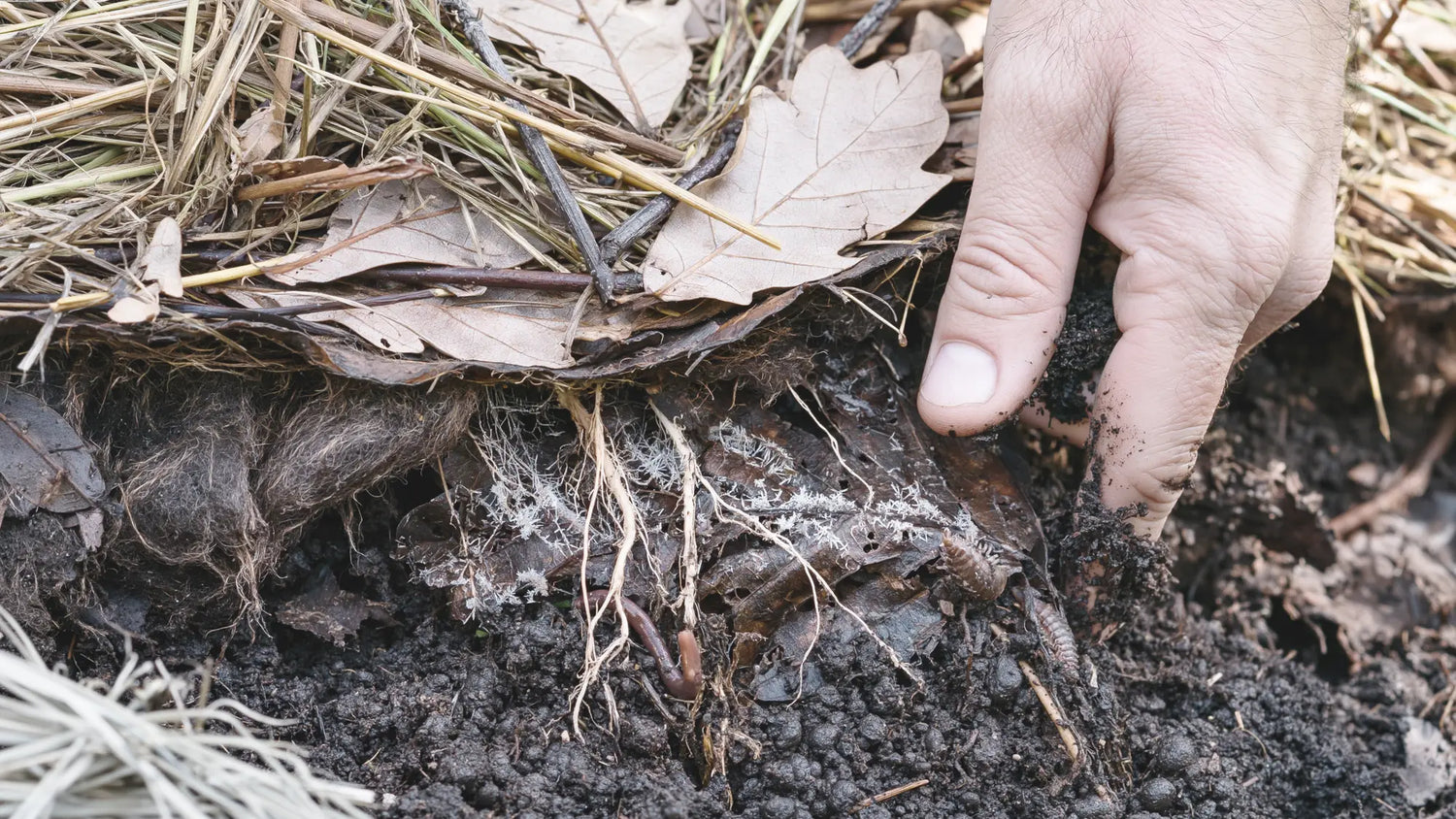
Permaculture reverses a deeply rooted habit: we do not feed the plants; we feed the soil, and the soil feeds the plants. This is not a poetic phrase but a description of the actual mechanism. A plant does not absorb organic matter; it absorbs mineral elements that only microorganisms make available by breaking down that matter.
A stratification that must not be reversed
Healthy soil is organized into biologically distinct layers. The first few centimetres are home to aerobic organisms—bacteria and fungi that need oxygen. Anaerobic organisms live deeper down and die on contact with it. Turning the soil with a spade reverses these two layers and kills both populations at once.
The soil then takes several months to rebuild, during which it abruptly releases its reserves of organic matter. This creates the illusion of a “boost” after ploughing—followed, the following year, by genuine depletion.
The mycorrhizal network
Mycorrhizal fungi form a network of filaments around and inside roots, considerably extending their absorption surface. The plant supplies the sugars produced through photosynthesis, while the fungus provides water and minerals gathered from well beyond the root zone. This network takes several years to develop and only a few minutes with a rototiller to destroy.
The three practices that follow from this
- Do not turn the soil. Aerate it with a broadfork, which loosens the soil without reversing the layers.
- Never leave the soil bare. Exposed soil loses nitrogen with every rainfall, becomes compacted under the impact of raindrops, and bakes in the sun. Use mulch or maintain permanent plant cover.
- Apply organic matter on the surface, never bury it deeply: the organisms that break it down live on the surface. Buried at twenty centimetres, it ferments instead of decomposing.
The biological details are covered in The Basics of Living Soil, Composting, and The Different Types of Soil.
Pillar 2 — biodiversity as stability
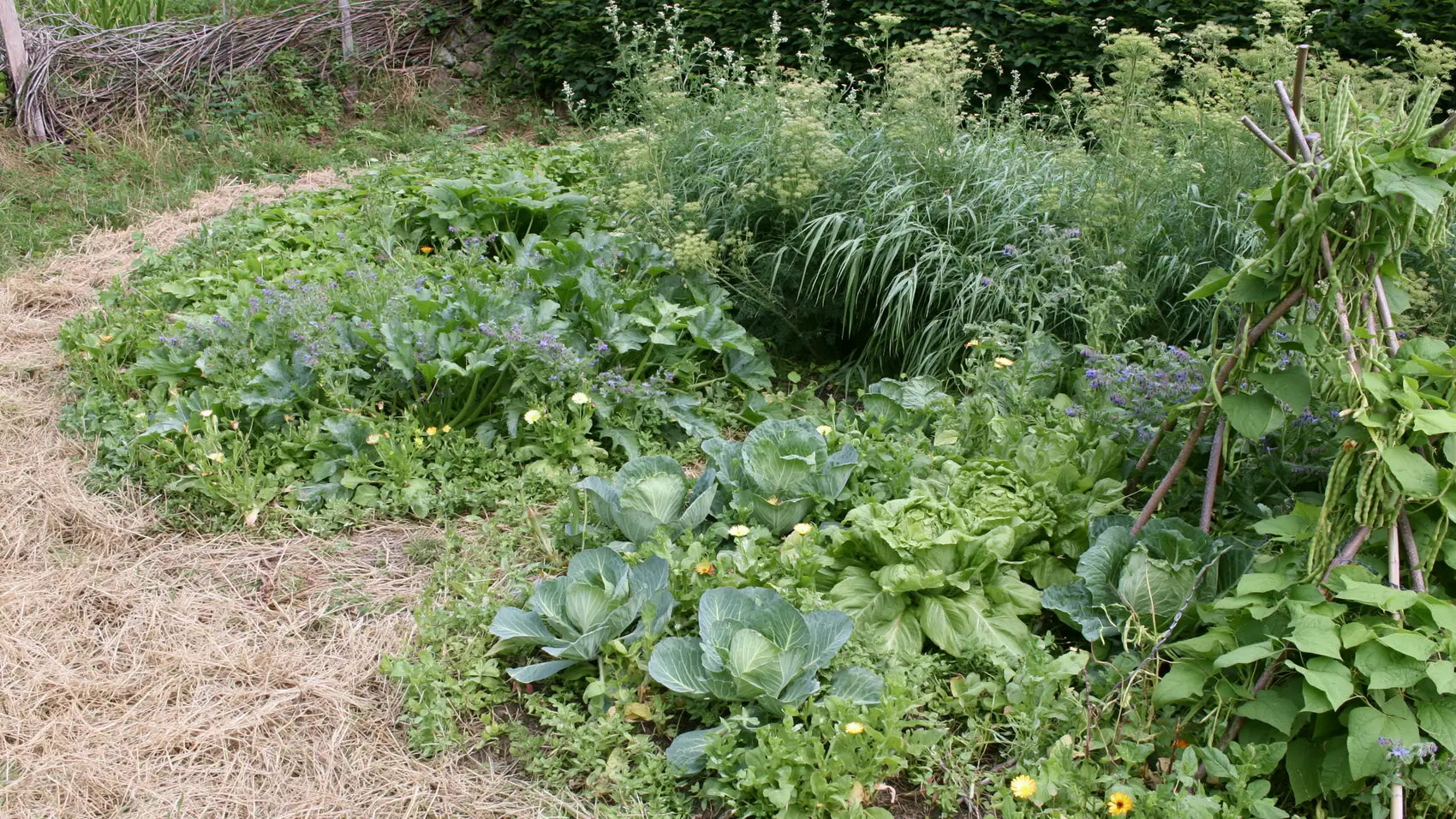
A permaculture garden is not disorderly through neglect. Its diversity serves a precise purpose, and that purpose is stability. In ecology, a diverse system better absorbs disturbances: a pest attack, drought, or late frost never destroys everything, because the species do not all respond in the same way.
A monoculture, by contrast, puts everything on a single roll of the dice: whatever affects it affects the entire crop.
Diversify on three scales
- Between species — the obvious principle: do not fill a bed with a single crop.
- Between varieties of the same species — much less commonly practised, yet decisive. Three tomato varieties respond differently to blight in any given year. It is free insurance.
- Over time — staggered blooms from March to October, so beneficial insects can find food throughout the season.
Feeding adult beneficial insects
This is the point most often missed. Ladybirds, hoverflies, and lacewings consume large quantities of aphids, but only in their larval stage. Adults feed on nectar and pollen. Without flowers nearby, they will not settle or lay eggs — so you will never have larvae.
The most effective families are the Apiaceae with flat-topped umbels (dill, coriander, fennel, flowering carrot) and the Asteraceae (marigold, cosmos, cornflower). See our bee-friendly plants.
The wild zone is not wasteland
Leaving an uncultivated corner is not neglect: it is the reservoir from which beneficial organisms recolonize the vegetable garden after each disturbance. A pile of dead wood, a few nettles, and an untrimmed hedge provide shelter for hedgehogs, ground beetles, spiders, and parasitoid micro-wasps. A few square metres are enough.
The details of the mechanisms of mutual aid between plants are in The best vegetable pairings for the kitchen garden.
Pillar 3 — self-sufficiency as a direction
Self-sufficiency is not autarky, nor can it be decreed. It is built by closing loops, one after another, over several seasons.
The seed loop — one season
The quickest to close and the most rewarding. Open-pollinated varieties that you harvest and reseed, with the added benefit of gradual adaptation to the local soil and climate. Start with self-pollinating species — tomatoes, beans, peas, lettuce — where accidental cross-pollination is rare. See How to save your seeds.
The fertility loop — two to three years
Compost made from household and garden waste, green manures sown between crops, and mulch produced on site. The goal is to no longer buy anything to nourish the soil — achievable in a family vegetable garden, but more difficult on large areas.
The water loop — three to five years
Rainwater harvesting, but above all improving the soil’s water-retention capacity, which is the real reservoir. See Creating a vegetable garden without irrigation.
The energy loop — ongoing
Hand tools, a design that limits movement and interventions, and choosing perennials over annuals wherever possible. This loop never closes completely, but every action eliminated is permanent.
Design principles to know
Holmgren formulated twelve. Five are enough to transform the way you garden.
- Observe and interact. One season of observation prevents three years of mistakes in placement. Note the path of the sun, prevailing winds, where water collects, and which plants grow spontaneously.
- Each element performs several functions. A hedge breaks the wind, shelters beneficial insects, produces fruit, mulch wood, and biomass. If an element in your garden has only one function, there is probably something better to put in its place.
- Each function is supported by several elements. This is the principle of redundancy: water comes from rain, the tank, and soil retention. If one of the three is missing, the system holds.
- Use edges. Life is densest and most diverse at the boundary between two environments — hedge and meadow, pond and land. A winding edge produces more than a straight line over the same area.
- Apply self-regulation and accept feedback. A garden that is telling you something — a crop that fails two years in a row, an area that remains untidy — is asking you to change the design, not insist.
Frequently asked questions
Permaculture and organic farming: what’s the difference?
Organic farming is a regulated set of specifications covering permitted inputs, with certification and inspection. Permaculture is a design method, with no label or certifying body. You can design a permaculture garden without being certified organic, and farm organically in a very conventional way — monoculture, plowing, intensive irrigation, bare soil between rows.
Are raised mounds mandatory?
No, and that is the most common misconception. A raised mound is one technique among others, useful for heavy, poorly drained soil or in a wet climate; counterproductive in a dry climate or sandy soil, where it dries the soil out. See Growing on raised mounds.
Is it less productive?
Yield per plant is sometimes lower—we plant more densely and do not force growth. But yield per square metre is often higher thanks to density, companion planting, and vertical layering. Above all, working time and inputs decrease significantly after the first two years of establishment, which are demanding.
How long before it starts working?
Allow two years for the soil to show the first signs—many earthworms, a crumbly structure, and a woodland-floor smell—and three to five years for biological balances to become established enough to visibly reduce pest problems.
Can you do it on a balcony?
Design principles apply at every scale: observation, zoning, companion planting, ground cover, and recycling organic matter. “Living soil” in a pot remains limited, but a worm composter and surface mulching are useful approximations. See Creating a permaculture garden in a small space and Balcony vegetable garden.
Key takeaway
Living soil, biodiversity, self-sufficiency: these three pillars are not techniques but directions. You don't “switch to permaculture” overnight—you close loops, one by one, by observing what the site already offers. And you start with the soil, because everything else depends on it.
Going further
- How do you create a permaculture vegetable garden? Complete guide
- Planning your garden according to zones and exposure
- Permaculture gardener's glossary
- What equipment should you choose to get started with a natural vegetable garden?
To get started: our open-pollinated heritage varieties, our green manures, and our starter kits.


Jätä kommentti
Tämä sivu on suojattu hCaptcha-tunnistuksella, ja hCaptchan tietosuojakäytäntöjä ja käyttöehtoja sovelletaan.