

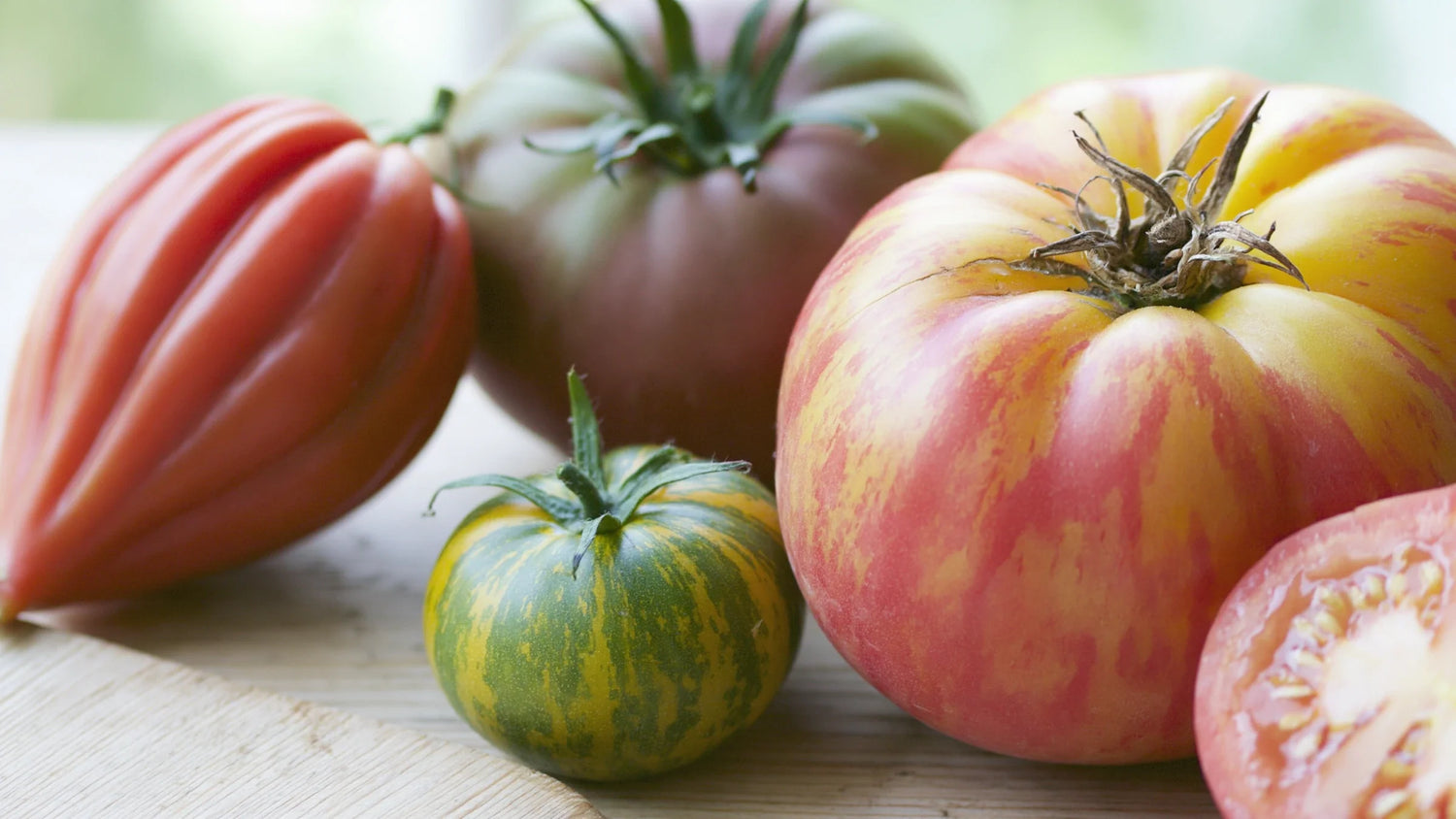
An heirloom tomato is not simply a tomato with more pronounced flavor: it is a stable variety whose offspring remain true to type. You sow it, harvest it, save its seeds, and the following year you get the same tomato — just a little better adapted to your garden. That is what radically distinguishes it from an F1 hybrid.
This guide covers choosing a variety according to its use, sowing step by step, caring for the plants, and the problems encountered by 90% of gardeners.
What defines an heirloom variety
Two concepts that should not be confused.
A stable variety (or open-pollinated variety) is stable: its traits are passed down from generation to generation. Because tomatoes are self-pollinating — they fertilize themselves even before the flower opens — accidental crosses are rare, making them one of the easiest species to reproduce in the garden.
An F1 hybrid results from the controlled crossing of two pure lines. The first generation is vigorous and uniform, but its seeds produce a segregating, unpredictable offspring. See the difference between F1, hybrid, and reproducible seeds.
Practical consequence: a few packets of heirloom varieties are enough to make you self-sufficient, provided you know how to harvest and store your seeds.
Choose your variety according to its use
This is where satisfaction is determined. A stuffing tomato in a salad disappoints, while a cherry tomato in a coulis wastes hours.
For eating raw, in salads
- Rose de Berne — very thin skin, melting, sweet flesh. A benchmark for flavor, but delicate: it does not travel well and splits at the slightest rain after a dry spell.
- Noire de Crimée — deep, slightly salty flavor. Good tolerance to heat and drought.
- Ananas — very large yellow-and-red marbled fruits with low acidity. Long growing cycle: best suited to regions with hot summers or to greenhouse cultivation.
For cooking, stuffing, and making sauces
- San Marzano — the benchmark sauce tomato: dense flesh, few seeds, little water. It reduces quickly and concentrates well.
- Roma — same use, but more productive and hardier.
- Beefsteak — dense flesh with few seed chambers: ideal for stuffing. Be careful: it is susceptible to blossom-end rot if watering is irregular.
For a challenging garden or a beginner
- Marmande and Saint-Pierre — the two reliable staples of the French vegetable garden. Hardy, dependable, and tolerant.
- Moneymaker — highly productive, with no special requirements.
For a balcony or small space
Cherry tomatoes, without hesitation: short growing cycle, less sensitive to irregular watering, and staggered production.
- Black Cherry — the most flavorful of the cherry tomatoes, sweet and complex.
- Yellow Pear — highly decorative, mild, and popular with children.
- Red Cherry — the easiest to grow, and highly prolific.
See also Balcony vegetable garden.
For originality
- Green Zebra — green and yellow striped, with a tangy flavor. Its ripeness is judged by touch, not color.
- Tigerella — red and orange striped, early and highly productive.
- Banana Legs — elongated yellow fruits with firm flesh, excellent when dried.
The full range can be found in our tomato, chili and pepper seed collection.
Sowing: warmth first, light second
Tomato sowing rarely fails through lack of care, but often because of a timing mistake.
When
Count on 6 to 8 weeks before your last frost date. For much of France, this means sowing between mid-March and early April. Sowing in February without grow lights does not save time: you will get leggy plants that will stall after transplanting.
How
- Fine, moist seed-starting compost, in pots or a seed tray.
- Seeds barely covered with 5 mm of soil, lightly firmed.
- Maintain 20 to 25 °C until emergence — below 15 °C, germination is very slow and irregular. The top of a refrigerator or a heating mat will work.
- As soon as they emerge (5 to 10 days), the priority reverses: lower the temperature to 18 °C and provide as much light as possible. This is the most common mistake — keeping seedlings warm after emergence produces long, fragile stems.
Transplanting
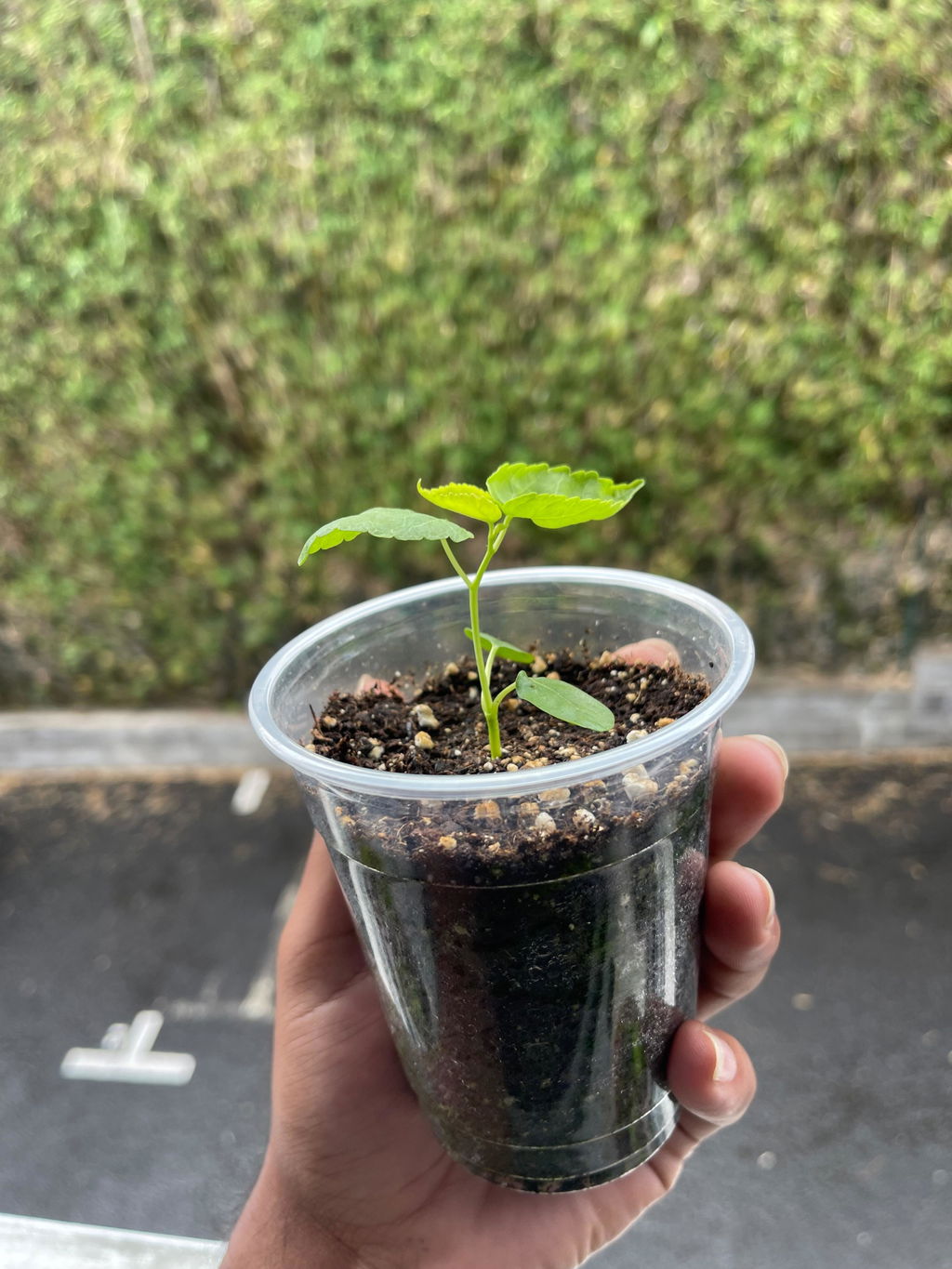
First transplant into an individual pot at the two true-leaf stage (the first two, rounded leaves are the cotyledons). Bury the stem up to the cotyledons: tomatoes produce adventitious roots along their buried stems, creating a much stronger root system. This also helps with plants that have already become slightly leggy.
One week before planting out permanently, harden off the plants: take them outside for a few hours each day, sheltered from the wind, gradually increasing the time.
Planting and training
Planting
- After the last frosts, when the soil reaches 15 °C.
- At least 60 cm between plants, 80 cm for vigorous varieties. This spacing is most often underestimated, and is the primary cause of downy mildew: crowded plants never dry out.
- Plant deeply, with a stake in place from the start so you do not damage the roots later.
- Mulch after the first watering. Mulching limits soil splashing onto the foliage — the main carrier of downy mildew.
Should you prune?
The question is divisive, and the answer depends on the growth type.
- Indeterminate varieties (most heirlooms) grow indefinitely. In a cool climate or short season, remove suckers — shoots that emerge from the leaf axils — to concentrate energy on fewer fruits, which will ripen more reliably.
- In a hot climate, leave the foliage to protect the fruit from sunscald. Light pruning is enough.
- Determinate varieties (such as Roma) stop growing on their own: do not prune them, or you will remove the harvest.
In all cases, remove the lower leaves that touch the ground: this is how downy mildew gets in.
Watering
At the base, never on the foliage, and above all, regularly. Irregular watering is more damaging than the amount: it causes fruit to split and encourages blossom-end rot. Thorough watering twice a week is better than a little every day.
Common problems and their real cause
| Symptom | Cause | What to do |
|---|---|---|
| Brown spots on leaves and fruit, with white fuzzy growth on the undersides | Downy mildew (a fungus encouraged by moisture on the foliage) | Space plants out, mulch, water at the base, and provide ventilation. Remove affected parts immediately. |
| Black, sunken end of the fruit | Blossom-end rot — it is not a disease but a calcium uptake problem caused by irregular watering | Keep watering regular and mulch. There is no need to add calcium: it is almost always already present. |
| Split fruits | Sudden resumption of watering after a dry period | Same advice: regular watering and mulching |
| Many flowers, few fruits | Excessive heat (above 35 °C, pollen becomes sterile) or excess nitrogen | Provide shade during the hottest hours; do not over-fertilize |
| Leaves curling upward | Water or heat stress, usually harmless | Monitor them and mulch. Without any other symptoms, it is not serious. |
Saving your own seeds
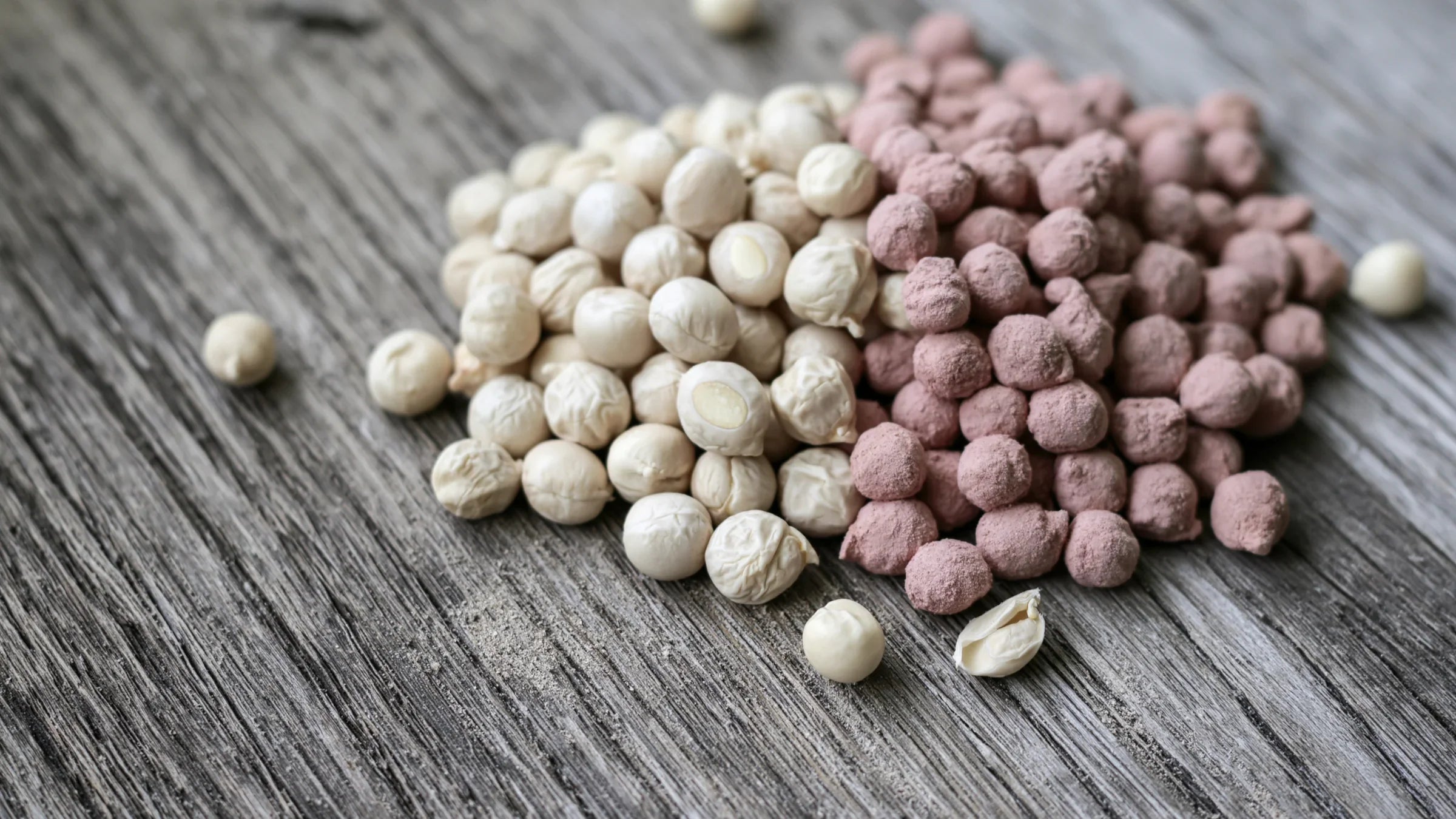
That is the main benefit of heirloom varieties, and it is simple. Take seeds from a fully ripe fruit on the healthiest plant, let them ferment for 2 to 4 days in a little water to dissolve the gelatinous coating that contains germination inhibitors, rinse, and dry them in the shade.
When stored properly, tomato seeds remain viable for 5 to 7 years. The detailed procedure is in How to save your seeds from one year to the next.
Frequently asked questions
Can I plant several varieties side by side and save the seeds?
Yes. Since tomatoes are self-pollinating, cross-pollination is rare. A few meters between seed plants is enough to make it negligible — unlike with squash, where it is a real problem.
Does basil really improve the taste of tomatoes?
No study has established this. However, the pairing does offer real benefits in terms of protection and biodiversity. We addressed the question in Pairing tomatoes and basil: myth or reality?.
How many plants should you plan for?
Plan for 3 to 4 plants per person for fresh consumption, and twice that number if you make preserves. A properly trained plant yields between 2 and 5 kg, depending on the variety and the season.
Can heirloom tomatoes be grown in pots?
Yes, but use a container of at least 30 liters for a large-fruited variety, along with daily watering in summer. Cherry tomatoes cope much better — 15 to 20 liters is enough.
Should you add fertilizer?
A mature compost amendment at planting is generally enough. Beware of nitrogen-rich amendments: they produce magnificent foliage and few fruits.
Key takeaway
First choose according to how you plan to use them, sow neither too early nor in overly hot conditions after germination, space plants generously, and water regularly at the base. These four points cover most of what matters — the rest is simply the pleasure of discovering a new variety each year.
Going further
- Heirloom seeds: what are they? Why grow them?
- The month-by-month sowing calendar
- The best vegetable pairings for the garden
Discover our collection of tomato, chili pepper, and sweet pepper seeds — all open-pollinated, ready to harvest and resow from one year to the next.

Jätä kommentti
Tämä sivu on suojattu hCaptcha-tunnistuksella, ja hCaptchan tietosuojakäytäntöjä ja käyttöehtoja sovelletaan.