

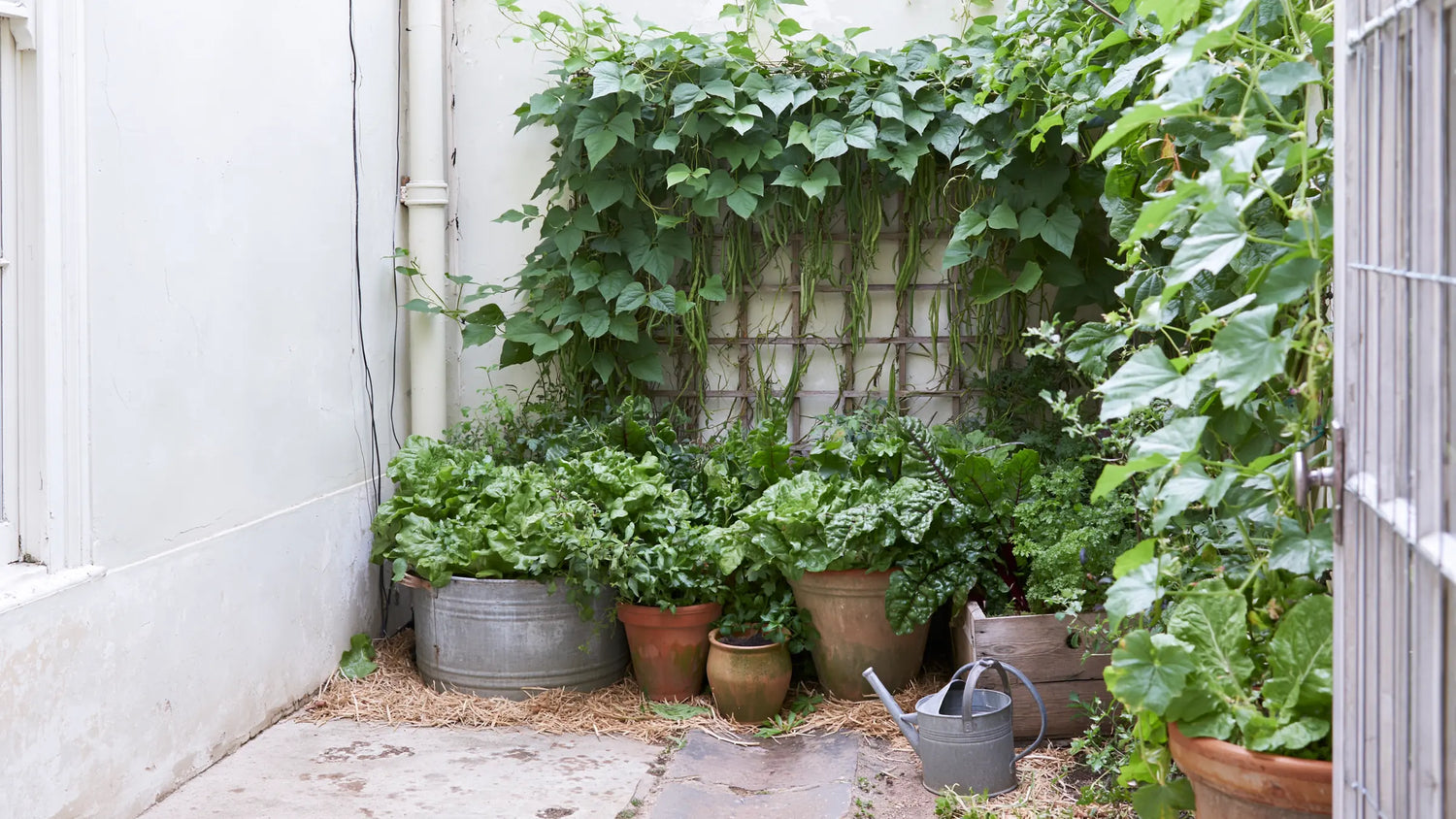
Permaculture was built around images of large plots, forest gardens and ponds. It is often concluded that it does not apply to a 15 m² courtyard or terrace. This is a misconception: permaculture is a design method, and a design method is all the more applicable when space is constrained.
On a large plot, you can afford to waste space. On 15 m², every decision matters — which is exactly the permaculture design playground. This guide covers the design of a small space; for container-growing techniques, see Balcony vegetable garden.
Observe: what changes in a constrained environment
The parameters are the same as in a garden, but their values are more extreme and change quickly over just a few metres.
- Light is the number-one limiting factor. In a courtyard surrounded by walls, count the hours of direct sunlight in several seasons. A space that receives 5 hours in June may receive none in December. Also note reflected light: a light-coloured wall reflects a useful amount of light, while a dark wall absorbs it and releases heat.
- Wind is channelled. Between two buildings, a Venturi effect can double wind speed compared with the nearby open space. Young plants cannot withstand it.
- Heat accumulates. Walls, paving slabs and concrete release heat at night. This is an advantage in spring and autumn — gaining two to three weeks on each side of the season — and a severe constraint in July.
- Water does not arrive by itself. Under a balcony, awning or tree, an area may receive no rain at all. Check this; it is a classic trap.
The preliminary assessment is the same as in a garden — see Planning by zones and exposure — but it must be carried out point by point: in a courtyard, two locations two metres apart can be completely different.
The key principle: think in volumes, not surface area
This is the mental shift that unlocks a small space. You don't have 15 m²: you have 15 m² of ground, plus dozens of square metres of walls, plus all the volume between them.
Layering
In a forest, vegetation occupies several overlapping layers. The same principle, scaled down:
- Climbing layer — walls and trellises: pole beans, peas, climbing nasturtiums, lightweight squash, grapevines, kiwis.
- Upper layer — staked tomatoes, corn, sunflowers, a potted or espaliered fruit tree.
- Middle layer — herbs, chard, cabbages, peppers.
- Low layer and ground cover — lettuces, radishes, strawberries, creeping thyme, purslane.
On a well-exposed wall, a 2 m by 2 m trellis offers as much productive surface as half your courtyard—with the footprint of a single pot.

Density and staggering
Two techniques double the yield from the same area without any magic:
- Combining different cycles — radishes and carrots in the same furrow: the radishes are harvested before the carrots need the space.
- Succession planting — a bed should never remain empty. As soon as one crop is removed, the next is already ready in a plug, to be transplanted that same day.
See The best vegetable combinations for the kitchen garden.
Zoning a small space
Zoning remains fully relevant, even when compressed—it simply plays out in metres instead of tens of metres.
- Zone 1 — along the path from the door to the rest of the garden: herbs, cut-and-come-again lettuces, radishes. Things you pick while cooking.
- Zone 2 — the main containers or beds: tomatoes, courgettes, beans.
- Zone 3 — the pots at the back and climbers on the opposite wall: things that need managing once a week.
- Compressed Zone 5 — an insect hotel, a wildflower pot left to go to seed, and a small container pond. Even half a square metre makes a real difference for beneficial organisms.
Reduce circulation routes to the bare minimum. A 40 cm passage is enough where we instinctively plan for 80, and every centimetre gained on the path can be cultivated.
Closing cycles on a small scale
Self-sufficiency is more difficult in a small space, but two cycles can be closed very effectively.
The material cycle
A worm composter processes a household’s kitchen waste within the volume of a bin, without odors, indoors or outdoors. It produces very rich compost and a liquid to be diluted. It is the only realistic solution when there is no room for a pile—the classic composting method requiring about one cubic metre to work properly. See Composting.
Supplement it with what the space produces: collected leaves, grass clippings, coffee grounds, and torn brown cardboard used as mulch.
The seed cycle
This is the easiest cycle to close, and paradoxically more easily than in a large garden: with few varieties grown side by side, accidental cross-pollination is rare. One tomato, one bean, one lettuce, and one basil plant are enough to make you self-sufficient in these species from the first year. See How to save your seeds.
The water cycle
More difficult: little collection surface, and containers that dry out quickly. What works: a water butt connected to even a small downspout, systematic mulching of all pots, and grouping containers together — tightly packed pots protect one another from lateral evaporation.
Bringing wildlife to the city
This is the most common objection: “There is no biodiversity where I live.” In reality, beneficial insects quickly colonize a space that offers them three things.
- Flowers spread throughout the season — this is the main requirement. Adult ladybugs and hoverflies feed on nectar and pollen; without flowers, they do not settle or lay eggs. Aim for continuous flowering from March to October: borage, calendula, phacelia, and herbs allowed to flower. See our bee-friendly plants.
- Water — a simple saucer with pebbles for insects to land on without drowning.
- Shelter — grouped hollow stems, a pile of wood, an overturned pot filled with straw, and an area left untidy in winter.

A small, well-designed urban space can be richer in insects than a mowed suburban lawn — the issue is not the surface area, but the diversity of resources available.
Courtyard, terrace, planter: what makes the difference
The enclosed courtyard
Advantages: accumulated heat, wind protection, and a often-mild microclimate. Constraints: low-angle light and stagnant air that encourages fungal diseases. Space plants generously despite the lack of room, water at the base, and make use of light-colored walls.
The terrace or roof
Advantages: maximum light. Constraints: strong winds and scorching summer heat. Plan for a slatted windbreak rather than a solid one.
A 40 L container filled with wet soil weighs around thirty kilos. Distribute containers along load-bearing walls rather than in the centre, and ask your building manager or a professional for advice if in doubt.
The planter and windowsill
This is zone 1 par excellence — the best spot around the home for herbs, the ones you snip while cooking. Don't waste this space on plants harvested once a year.
Frequently asked questions
Can you really talk about permaculture on 10 m²?
Yes, if we are talking about design: observation, zoning, layering, guilds, soil cover, and closing loops. What remains out of reach is food self-sufficiency and living soil in open ground — but these are not defining criteria of the method.
Do you need open ground?
No, but if you have even one square metre, set it aside for the crops that benefit from it most: perennials and long roots, which suffer most from being confined to pots.
Which perennials should you choose for a small space?
They offer the best return for the effort: rhubarb, sorrel, chives, tarragon, mint (always in a pot, as it is invasive), thyme, oregano, and artichokes if space allows. See our perennial plants.
How do you manage green waste without compost?
A worm composter for the kitchen, and surface composting for everything else: finely chopped garden waste decomposes very well directly as mulch in containers. Nothing leaves the garden.
And what should you do with the space in winter?
Don't leave it empty. Lamb's lettuce, spinach, arugula, and perennial herbs can stay outdoors; cover empty containers with mulch or green manure. Bare substrate compacts and becomes depleted over the winter.
Key takeaway
Think in terms of volume rather than surface area, position things according to how often you pass by, and give beneficial insects the three things they seek — flowers, water, and shelter. A small space will not produce all your food, but it can provide all your herbs, some of your salads, and biodiversity that often surprises the gardener themselves.
Going further
- Balcony vegetable garden: suitable techniques and varieties
- The basics of permaculture: living soil, biodiversity, self-sufficiency
- Planning your garden according to zones and exposure
- The month-by-month sowing calendar
To get started in a small space: our culinary herb seeds, our seeds for year-round sowing, and our pollinator-friendly plants.


Jätä kommentti
Tämä sivu on suojattu hCaptcha-tunnistuksella, ja hCaptchan tietosuojakäytäntöjä ja käyttöehtoja sovelletaan.