

People talk about “good soil” as though it were a quality you either have or do not have. In reality, soil is described by three independent characteristics: its texture (the proportion of sand, silt, and clay, which changes very little), its structure (how these particles are assembled, which can change considerably and quickly), and its pH.
This is a fundamental distinction that is rarely made: you do not change a soil's texture; you improve its structure. Adding sand to clay soil to “lighten” it is one of the most widespread and counterproductive gardening recommendations.
Identify your soil: three free tests
The roll test (2 minutes)
Take a handful of slightly damp soil, free of stones, and knead it.
- It does not hold together and crumbles: sandy soil.
- It forms a ball but not a roll: silty soil.
- It forms a roll that breaks when bent: balanced soil (clayey silt).
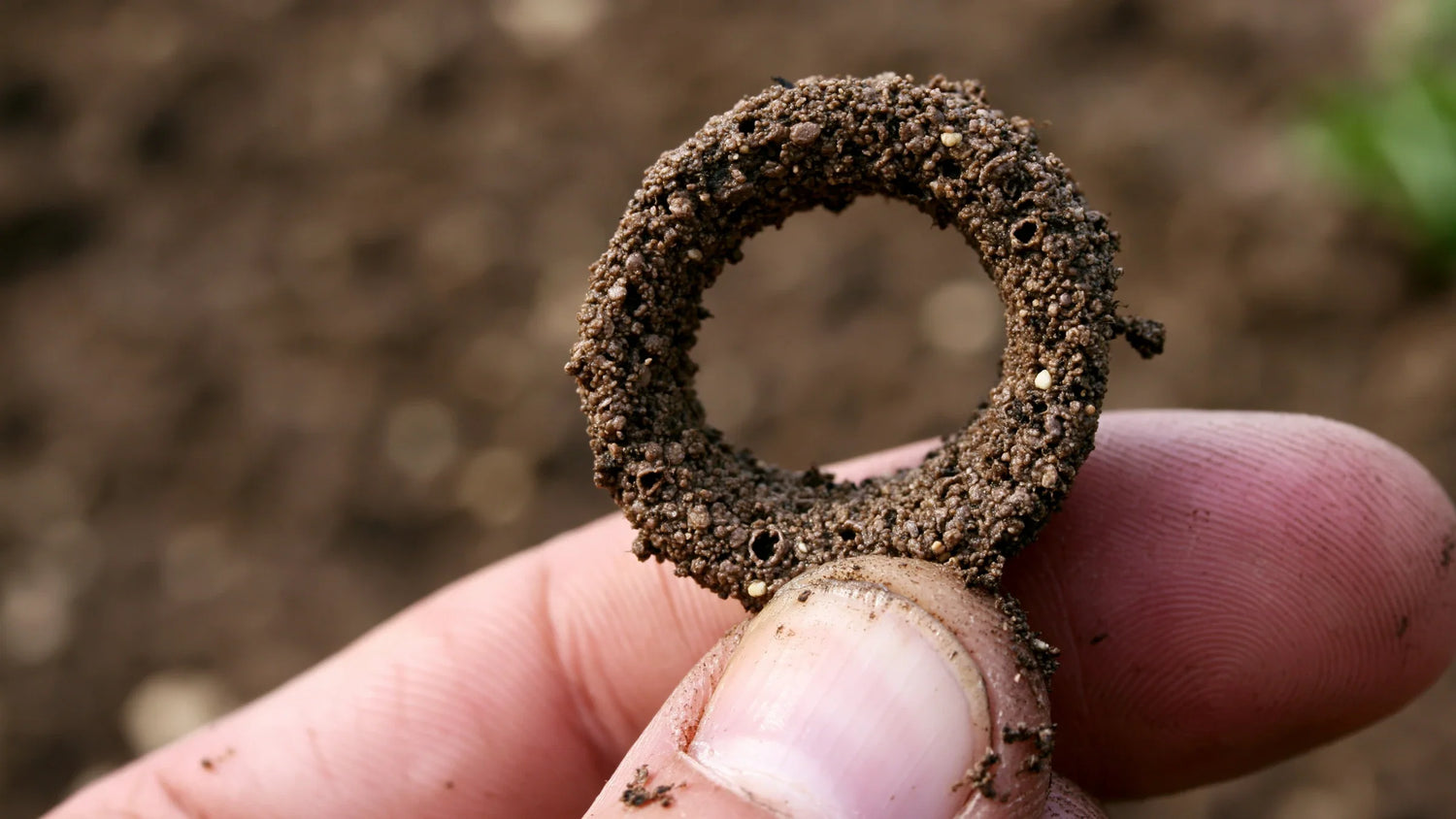
- It forms a roll that can be bent into a ring without breaking: clayey soil.
- It is soft and light, and stains your fingers black: humus-rich soil.
The jar test (24 hours)
- Fill a straight-sided jar one-third full with sifted soil, top it up with water, and add a drop of dish soap (it disperses the aggregates).
- Shake vigorously for two minutes, then let it rest for 24 hours without disturbing it.
- Three layers appear: sand falls to the bottom within a few minutes, silt within a few hours, and clay last, at the very top. Organic matter floats on the surface.

Measure each layer with a ruler to obtain your percentages. A balanced soil contains roughly 40% sand, 40% silt, and 20% clay.
Bio-indicator plants
Spontaneous vegetation is a free, ongoing diagnosis. It indicates the soil’s condition more than its texture — which is often more useful.
| What grows on its own | What it says about the soil |
|---|---|
| Nettle, cleavers, fat hen | Rich in nitrogen and organic matter — good news |
| Horsetail, rush, creeping buttercup | Waterlogged, poorly drained, often compacted at depth |
| Plantain, daisy, cinquefoil | Compacted at the surface (trampling, vehicle traffic) |
| Dock, meadowsweet | Heavy, clayey, wet |
| Poppy, wild mustard | Calcareous, well-aerated |
| Bracken, heather, wild sorrel | Acidic |
It is the dominance of a species in an area that provides a reliable clue, not its mere presence.
The four main types, and what you really need to do with them
Clay soil
Recognition — sticks to shoes in wet weather, hardens and cracks in summer. Heavy to work.
Its real strengths, which are often overlooked: it is the most fertile soil there is. Clay particles carry negative charges that retain nutrients and prevent them from being leached away by rain. It is also the soil that best withstands drought once its structure has been improved.
Its drawbacks — warms up late in spring, becomes waterlogged in winter, and compacts if worked when wet.
What works: apply mature compost to the surface every autumn, use permanent mulch, and sow green manures with taproots (fodder radish, alfalfa) that break through compacted layers. Calcium (slaked lime, small amounts of wood ash) promotes flocculation — clay particles aggregate into clumps, and the soil becomes workable.
This is the most widespread and most harmful piece of gardening advice. Sand + clay + water produces a material similar to concrete. You would need to incorporate considerable quantities to genuinely change the texture; in small amounts, it makes the problem worse. Texture cannot be corrected — it is the structure that must be worked on.
Sandy soil
Recognition — grains are visible to the naked eye, run through your fingers, and never stick.
Advantages — warms up early (early harvests), easy to work in all seasons, ideal for root vegetables, which grow straight in it.
Drawbacks — retains neither water nor nutrients, which move beyond the reach of the roots with every rainfall.
What works: organic matter, regularly and in small quantities rather than one large annual application that will mineralize too quickly. Permanent thick mulch. Green manure crops as continuous cover — bare sandy soil loses its fertility in a single season. See our green manure seeds.
One useful clarification: adding clay (bentonite) really does work in this direction, unlike adding sand to clay. It is costly, but lasting.
Silty soil
Identification — floury texture, soft like talcum powder when dry.
Advantages — on paper, the most fertile and easiest to cultivate: good water retention and good aeration.
Its specific weakness — surface crusting. Under the impact of rain, fine particles rearrange into an impermeable crust on the surface, suffocating seedlings and causing water to run off. This is the number one problem with silty soils, and it has one solution: never leave the soil bare. Mulch, ground cover, green manure crops — anything is better than exposed soil.
Humus-rich soil
Identification — very dark, light, spongy, with a pronounced woodland smell.
Advantages — excellent water retention, intense microbial activity, remarkable structure.
Drawbacks — often acidic, sometimes lacking certain minerals despite its organic richness.
What works: light liming if the pH falls below 5.5, applications of wood ash (potash and calcium), and choosing suitable crops rather than trying to correct the soil at all costs.
pH, the parameter we forget
Texture determines structure; pH determines what the plant can actually absorb. Soil can be rich in iron while the plant lacks it, simply because the pH prevents its uptake.
- pH below 5.5 — acidic. Phosphorus and calcium are less available, and bacterial activity slows.
- pH 6 to 7 — the ideal range for the vast majority of vegetables.
- pH above 7.5 — alkaline. Iron, manganese, and zinc become unavailable: this causes chlorosis (yellow leaves with green veins).
A test kit costs a few euros at a garden center and can be reused. Correcting pH is slow: allow one to two years per half-point, using lime to raise it, and leaf compost or pine needles to lower it slightly.
Potatoes, tomatoes, and raspberries thrive in acidic soil; cabbages, legumes, and onions prefer calcareous soil. Choosing crops costs less and is faster than correcting the pH.
Structure: what you really have control over
Well-structured soil can be recognized by its clods—aggregates a few millimeters wide that crumble between your fingers without turning to dust. Air and water circulate between these clods; microorganisms live inside them.

These aggregates are literally held together by substances produced by soil life: earthworm mucus, fungal filaments and glycoproteins, and bacterial secretions. In other words, structure is not a physical property of soil; it is a product of its biological activity. That is why it deteriorates within minutes of rototilling and takes several years of permanent cover to rebuild.
Three practices, whatever your soil type:
- Never turn the soil over — aerate it with a broadfork without reversing the layers.
- Never leave soil bare — mulch or plant cover at all times.
- Never walk on cultivated areas — hence beds no more than 1.20 m wide, with dedicated paths.
The details of this underground life can be found in The Basics of Living Soil.
Which crops for which soil
| Soil type | Recommended | Avoid without improvement |
|---|---|---|
| Clayey | Cabbages, leeks, beets, spinach, broad beans, artichokes | Long carrots, parsnips (deformed roots) |
| Sandy | Carrots, radishes, parsnips, onions, potatoes, asparagus | Cabbages and squash (too water-hungry) |
| Loamy | Almost everything | Nothing, but be sure to mulch |
| Humus-rich | Squashes, lettuces, herbs, beans, soft fruits | Vegetables requiring a high pH (cabbages without liming) |
For difficult sites, also see Which seeds are suitable for poor, dry soil? and our selection of drought-resistant plants.
Frequently asked questions
My soil is clayey; should I make mounds?
This is indeed the situation in which a mound is most useful: it drains and warms the soil earlier in spring. In sandy soil, it would instead be counterproductive. See Growing on mounds.
How long does it take to improve soil?
The first effects on structure can be noticed as early as the second year of permanent mulching. Organic matter content progresses slowly, at a rate of a few tenths of a percentage point per year under good conditions. This is long-term work, not a quick fix.
Can I mix several soils to obtain a balanced soil?
For a raised bed or planter, yes. For an entire garden, the necessary quantities are disproportionate. It is better to work on the structure of what you have.
Should you have your soil analyzed in a laboratory?
Rarely necessary for a home vegetable garden — the three tests described here are sufficient. Analysis becomes useful if you notice persistent deficiency symptoms despite regular applications, or if pollution is suspected (a former industrial site, proximity to a heavily trafficked road).
Key points
Your soil texture is what it is — accept it and choose your crops accordingly. Its structure, on the other hand, depends entirely on you, and three actions are enough: do not turn it over, do not leave it bare, do not walk on it. Well-managed clay soil outperforms poorly treated loamy soil.
Going further
- Composting: feeding the soil by imitating nature
- Sowing green manures: benefits, types, and schedule
- Creating a vegetable garden without irrigation
- How do you create a permaculture vegetable garden?
To work your soil gently: our green manures and our vegetable seeds, chosen according to your soil.

Jätä kommentti
Tämä sivu on suojattu hCaptcha-tunnistuksella, ja hCaptchan tietosuojakäytäntöjä ja käyttöehtoja sovelletaan.