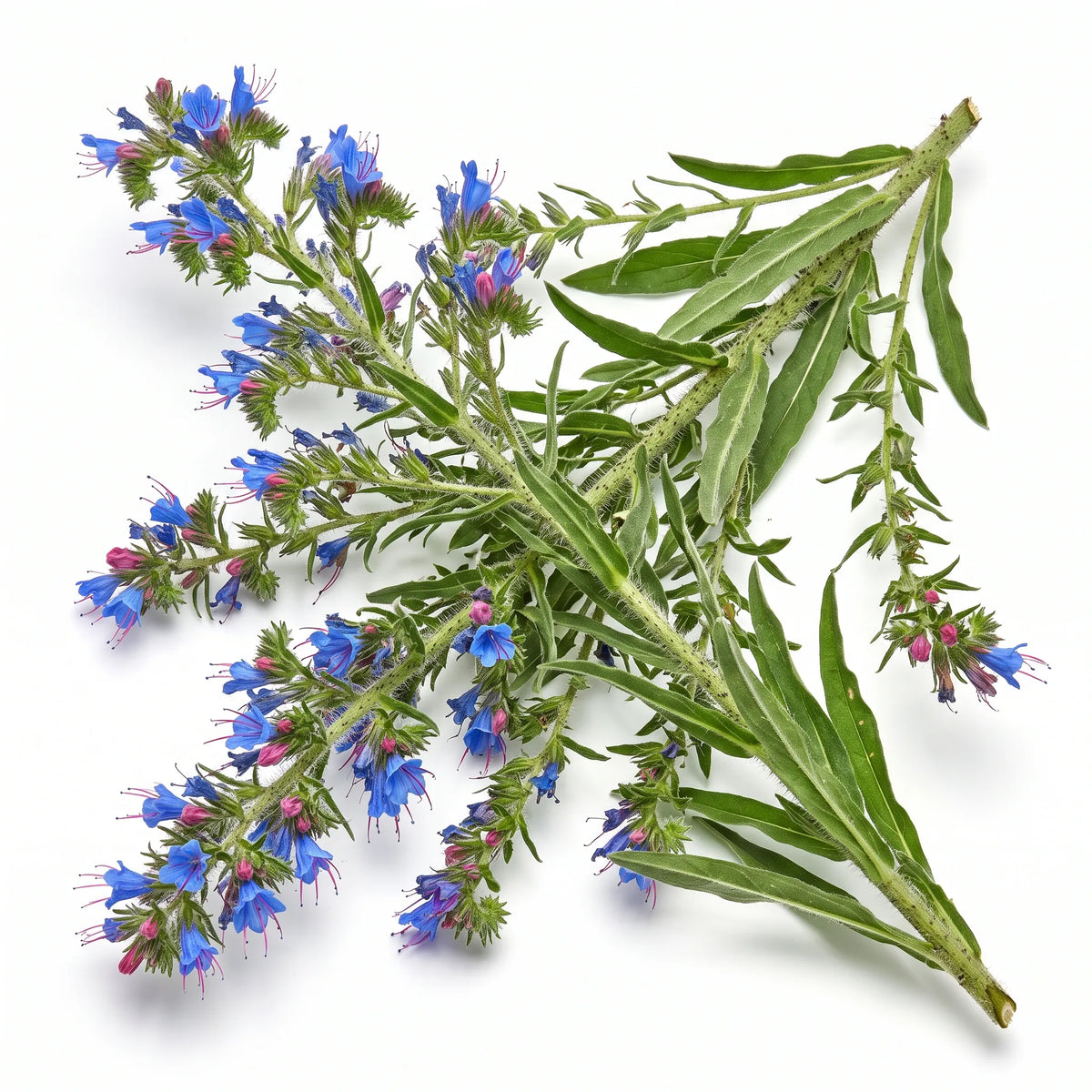
Echium vulgare
Common viper's bugloss, viper's herb, bird's tongue, viper's bugloss: its seeds resemble tiny snake heads, and its protruding stamens evoke a forked tongue—hence its name and the old belief that it protected against bites. In the garden, its flower spikes changing from pink to intense blue are an unmatched magnet for pollinators.
Characteristics:
-
Spectacular flower spikes: upright stems covered with flowers that turn from bud pink to bright blue as they open.
-
Biennial: a rosette in the first year, spectacular flowering in the second, then it self-seeds.
-
Very undemanding: it thrives in poor soil and warm locations, where few plants can survive.
Precautions:
- Its leaves and stems are covered with stiff, prickly hairs that irritate the skin: wear gloves and long sleeves when handling or pulling it out.
- Inedible plant: like other wild plants in the borage family, it contains alkaloids and must not be consumed, either as an infusion or in a salad.
Sowing advice:
-
Exposure: full sun, in a warm location—it is a plant of dry banks and stony wasteland.
-
Soil: poor, dry, sandy or stony, well-drained, preferably alkaline. Crucial point: do not amend it. In rich soil, it produces abundant foliage and flowers poorly. It dislikes stagnant moisture in winter.
-
Method: sow in spring or autumn, directly in place, covering lightly. Its deep taproot does not tolerate transplanting well: avoid pots. Neither soaking nor stratification is necessary. See how to sow your seeds.
Care advice:
- None. Thin to 40 cm apart and leave a few flower spikes to go to seed: it self-seeds and establishes itself permanently.
- In a pot, planter, cold greenhouse or conservatory, it performs very well provided it has excellent drainage.
Beneficial pairings:
Benefits for biodiversity:
- It is one of Europe's most nectar-rich plants: each flower produces nectar continuously throughout the day and replenishes it within minutes after each visit, making it an exceptional resource for bees.
- The change from pink to blue is a signal intended for foraging insects: it tells them which flowers still contain nectar, preventing unnecessary visits.
- It is a host plant for several butterflies and shelters specialized wild bees.
Uses:
- Rock gardens, banks, planters, dry beds and nectar-rich meadows. Strictly ornamental and nectar-producing, not edible.
Symbolism:
Long believed to protect against viper bites—through the doctrine of signatures, as its seeds resemble snake heads—it symbolizes protection and beneficial wariness.
Harvesting your own seeds:
Let the flower spikes dry completely on the plant, then shake them over a container—with gloves, as the stems are prickly. The small gray seeds detach from the calyces. See how to store your seeds.
Commitment to Quality: at SemiSauvage - Permaculture, we grow and select our seeds with respect for all living things as our guiding principle. Based near the Auvergne Volcanoes, we choose open-pollinated, non-hybrid varieties, tested for their germination rate, carefully sorted and packaged, with no chemical treatment. Our belief: to give gardeners back the ability to sow, year after year, seeds that truly belong to them.
Give your bees one of Europe's most nectar-rich plants.