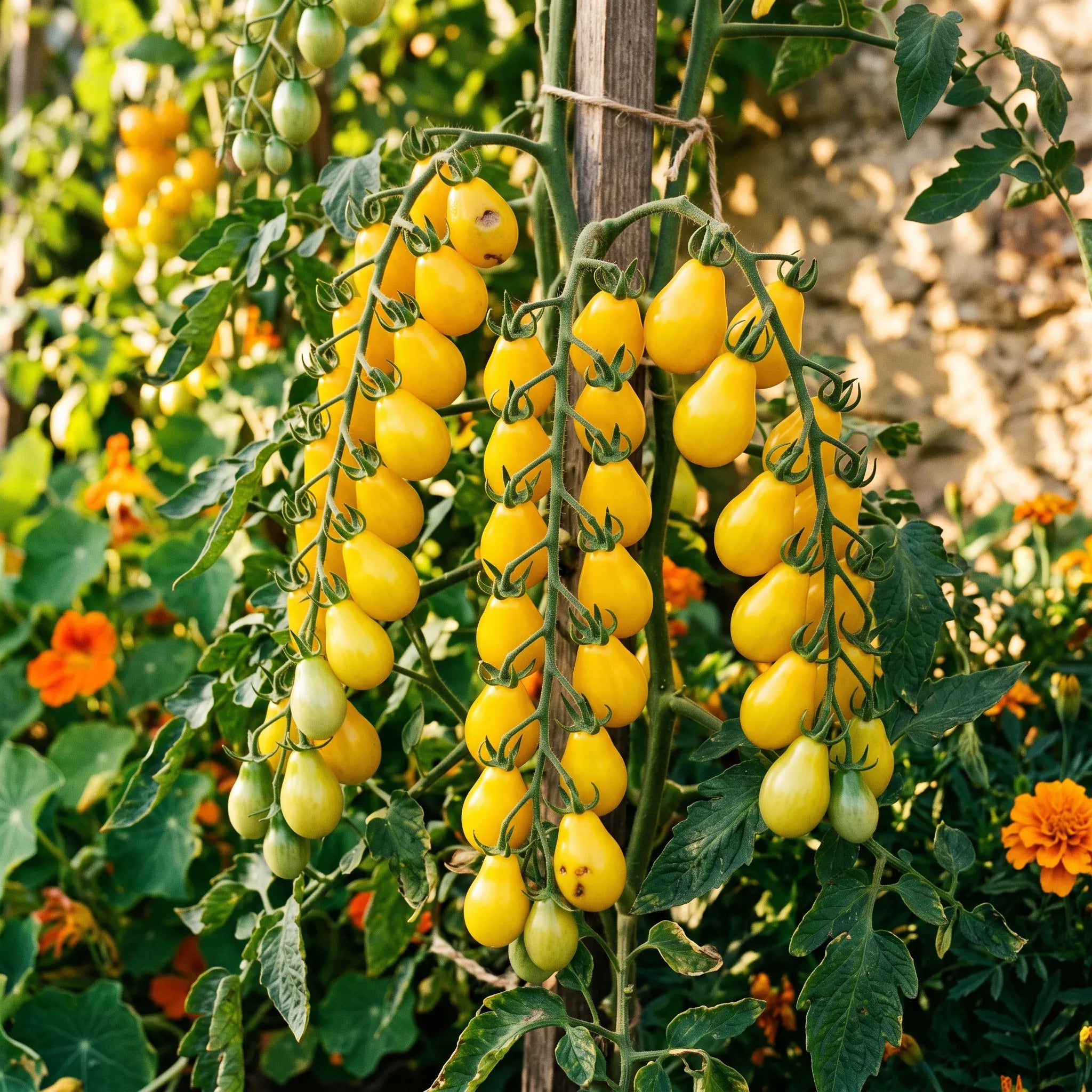
Solanum lycopersicum
Yellow Pear Cherry Tomato, Yellow Pear, yellow pear: cultivated in Europe since the 17th century, it is one of the oldest known cherry tomatoes. Its small yellow, miniature pear-shaped fruits grow in long clusters and produce continuously from July until the first frosts — a cheerful, easy-to-grow plant that children never tire of.
Characteristics:
-
Original shape: small golden-yellow pears measuring 3 to 4 cm, grouped in long clusters.
-
Mild flavor: low in acidity and slightly fruity, it is particularly popular with children.
-
Very easy to grow: much easier to grow successfully than large-fruited varieties, making it ideal for beginners.
-
Suitable for growing in pots: it grows very well on a balcony in a deep container.
Sowing advice:
-
Exposure: full sun, whether in the vegetable garden or on a balcony.
-
Soil: rich, loose, and well drained. Adding compost benefits it, even though it is considerably less demanding than large-fruited varieties.
-
Method: sow from February to April under cover, at a minimum of 20 °C — below this temperature, the seeds will not germinate. Cover with 5 mm of soil. Transplant into pots at the two-true-leaf stage. See how to sow your seeds.
Planting advice:
- Transplant after the last frosts, spacing plants 60 cm apart. Bury the stem up to the first leaves: tomatoes produce roots along the entire buried section, resulting in a more vigorous plant.
- This is an indeterminate variety: it grows indefinitely and easily exceeds 2 meters. Provide a sturdy stake from the time of planting.
Care advice:
-
Always water at the base, never over the foliage, preferably in the morning: water on the leaves creates an entry point for blight. Apply a thick mulch.
- Water regularly and evenly to prevent the fruits from splitting.
- Good news: with cherry tomatoes, removing suckers is optional. Allowing the plant to bush out even increases the number of fruits, as long as you have enough space and adequate support.
- Rotate crops every three to four years.
Harvesting advice:
- Harvest the entire cluster when most of the fruits are fully yellow, or pick them as they ripen. Store at room temperature, never in the refrigerator.
Beneficial companion plants:
Benefits for biodiversity:
- Its flowers are pollinated by vibration: only bumblebees, which can vibrate their flight muscles at the right frequency, fully exploit them. Welcoming bumblebees directly improves your harvest.
- As an heirloom, open-pollinated variety, growing it helps preserve cultivated diversity. See our heirloom tomatoes to sow.
Uses:
- As an appetizer, in salads, on skewers, slow-roasted in the oven, or made into pickles. Its yellow color creates a lovely contrast when mixed with red cherry tomatoes.
Harvesting your own seeds:
Take the pulp from a few fully ripe fruits and let it ferment for two to three days in a little water — this step breaks down the gelatinous coating that inhibits germination — then rinse: the healthy seeds will sink to the bottom. Dry them flat. See how to store your seeds.
Commitment to Quality: at SemiSauvage - Permaculture, we grow and select our seeds with respect for all living things as our guiding principle. Based near the Auvergne Volcanoes, we choose open-pollinated, non-hybrid varieties, tested for their germination rate, sorted, and carefully packaged, without any chemical treatment. Our conviction: to give gardeners back the ability to resow, year after year, seeds that truly belong to them.
Hundreds of small golden pears, from midsummer until the first frosts.