
In this article 7
It is the most famous pairing in the vegetable garden. It appears in every chart, copied for decades, generally accompanied by two claims: basil supposedly keeps tomato pests away, and supposedly improves its flavor.
The first is based on a real but partial mechanism. The second is based on nothing. And the real reason for their compatibility—the one that matters when planting—is almost never mentioned.
The myth: « basil improves the flavor of tomatoes »
No study has established this, and the mechanism that would be needed does not exist: a plant does not transmit its aromas to its neighbor through its roots or through the air. The aromatic compounds in basil are contained in its own tissues.
The belief probably originated in cooking. Tomatoes and basil go so well together on the plate that people extrapolated this harmony to the garden. It is a nice story, but not an agronomic argument.
The variety, harvest maturity, sunlight, and above all regular watering. Mild water stress concentrates sugars; excess nitrogen does the opposite. See Heirloom tomato seeds.
What is real: olfactory confusion
Many insects locate their host plant by smell, sometimes from several dozen meters away. A female searching for a place to lay eggs follows a chemical signal emitted by the foliage. A strongly aromatic plant placed between them disrupts this signal and delays, or even prevents, egg-laying.

Basil is rich in essential oils—linalool, eugenol, and estragole, depending on the variety—and is one of the most effective aromatic plants in this respect. The effect has been documented particularly for the whitefly, a common tomato pest in protected cultivation.
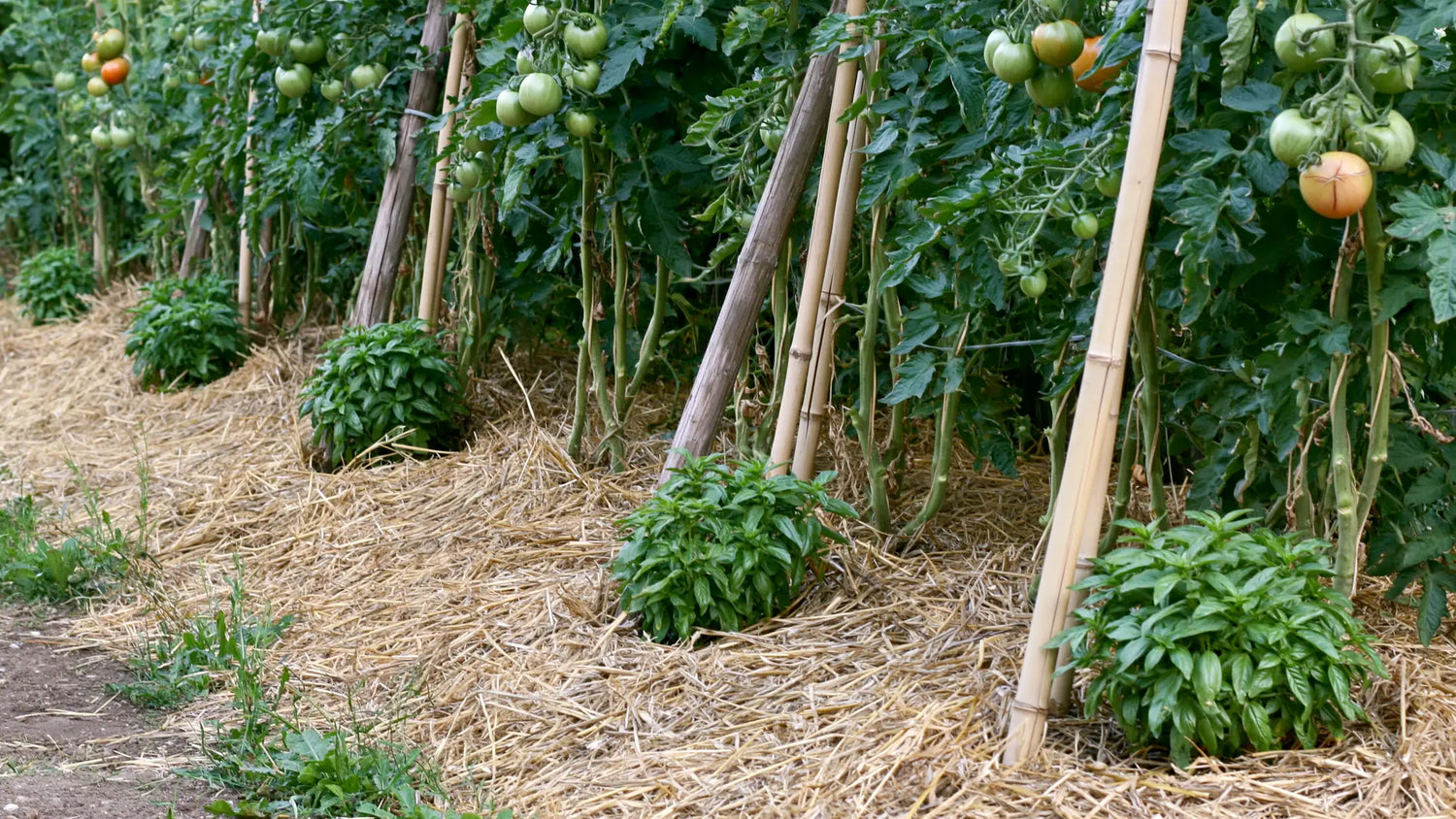
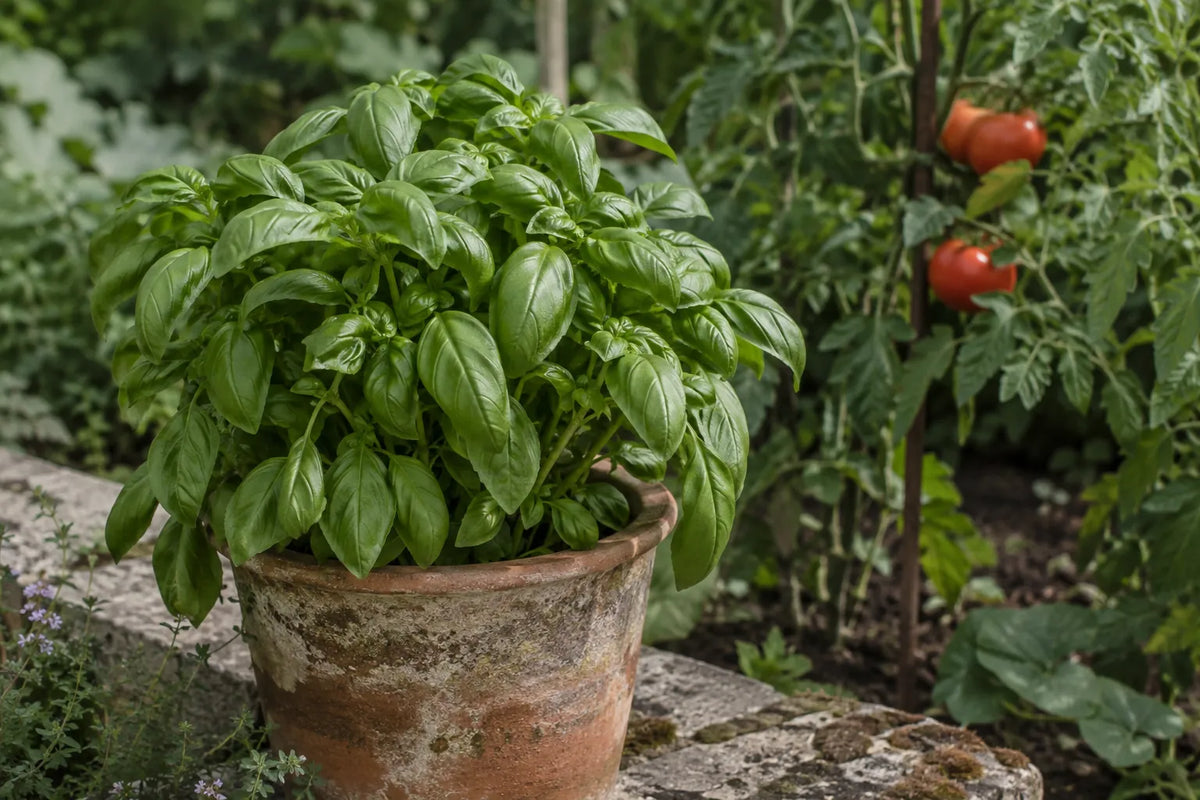
Proximity is essential—olfactory masking works over a short distance. The basil must be at the base, within the same volume of air.
The effect is partial, not absolute—it reduces pest pressure; it does not eliminate it. An established infestation will not be stopped by basil.
It does not concern blight—it is a fungus and cannot be detected by smell: its spores arrive on the wind and rain. No companion plant protects against fungal infection.
The real reason: they are grown the same way
This is the strongest argument, and the one put forward least often. Tomatoes and basil are culturally compatible:
- Same temperature requirements — both originate from warm climates, both are planted after the last frosts, and both are killed by the cold.
- Same exposure — full sun.
- Same watering requirements — regularly, at the base, never on the foliage. This is far from insignificant: most unsuccessful combinations fail because a plant that wants water is placed next to one that does not.
- Different root levels — the tomato grows deep, while the basil stays within the top twenty centimetres. They do not compete for the same soil volume.
- Useful shade — in midsummer, the tomato foliage protects the basil from the hottest hours, delaying its flowering.
In other words: even without any repellent effect, the combination would still be worthwhile. That is the criterion to use when creating your own combinations — see The best vegetable combinations for the garden.
How to implement it properly
- One basil plant for every two tomato plants, planted 20–30 cm from the plant, on the side with the most sun.
- Plant it after the tomato, once the tomato is well established. Young basil planted at the same time will be outcompeted.
- Keep mulch away from the basil's crown by a few centimetres — it is susceptible to rot when in contact with damp material.
- Pinch the basil regularly: the bushier it is, the more essential oils it releases, and the stronger the olfactory effect.
- Let one plant flower at the end of the season, along the edge: the flowers attract hoverflies and bees, whose larvae eat aphids.
- Space the tomatoes generously anyway — 60 to 80 cm. Basil cannot compensate for insufficient air circulation.
The combination works too, but with one caveat: in a confined space, root competition becomes a real issue again. Allow at least 30 litres for a tomato + basil duo, and accept that the basil will remain modest. See Balcony vegetable garden.
Complete the combination
Basil alone does not make a system. Three companions to add around the tomatoes:

- Marigold — the same olfactory effect, and its roots release active substances against certain nematodes. But you have to plant plenty: a few decorative plants have no measurable effect on nematodes.
- Nasturtiums—aphid trap crops, to be planted along the edge rather than in the middle, upwind of the prevailing wind.
- A flowering umbellifer—dill or coriander allowed to flower. It is the best resource for adult hoverflies, whose larvae are formidable aphid predators.
Tomatoes and potatoes side by side. Both are susceptible to late blight, and one can infect the other. Keep them as far apart as your garden allows.
Frequently asked questions
Should basil be planted in the same hole as the tomato?
No. At 20–30 cm, in the same space but not in the same planting hole: both need their own root volume, even though they do not exploit the same depths.
Does basil protect against late blight?
No, and this is the most damaging misconception. Late blight is a fungus spread by wind and rain, unaffected by scents. Against it: spacing, mulch to prevent soil splashes, removing lower leaves, and watering strictly at the base.
Which basil variety is most effective?
The richest in essential oils, and therefore the most fragrant, are classic Genovese basil and Thai basil. Purple basil works too and has the advantage of being highly decorative along the edge. See Basil seeds: how to sow and pair them.
Can you harvest seeds from both?
Yes, and easily: tomatoes and basil are both self-pollinating, so accidental crosses are rare. It's one of the best duos for getting started with saving your own seeds. See How to save your seeds.
Should you believe the other traditional pairings?
Apply the same test: what mechanism is at work? Space, scent, trap crop, beneficial insects, or nitrogen. If none of the five applies, the pairing probably comes from a chart copied without verification.
Key points
A myth when it comes to flavor, partially true for pests, and firmly true for crop compatibility. Plant them together—but for the right reason, and without relying on them to spare you from proper spacing and watering at the base.
To go further
- The best vegetable pairings for the garden
- Basil seeds: how to sow and pair them
- Heirloom tomato seeds: varieties, sowing, and care
- Pairing flowers with the vegetable garden
To create this duo: our tomato seeds and our basil — all open-pollinated.

Leave a comment
This site is protected by hCaptcha and the hCaptcha Privacy Policy and Terms of Service apply.