Genista tinctoria
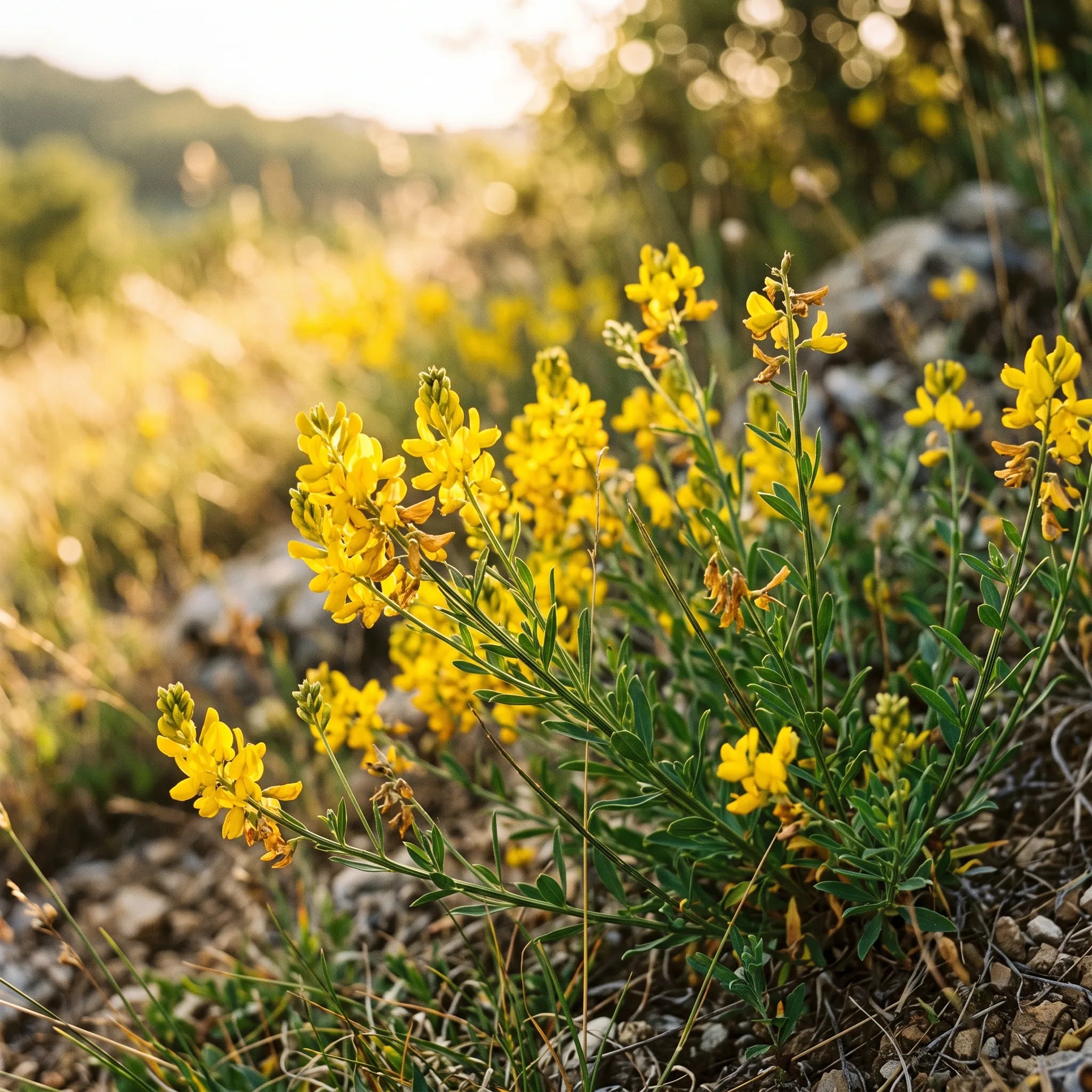
Dyer’s greenweed, dyer’s broom, yellowing herb: its epithet tinctoria says it all—its flowers provided the yellow used in medieval dyes, and when mixed with woad blue, they produced the famous “Kendal green” of English fabrics. A modest shrub that dressed Europe for centuries.
Characteristics:
-
Golden-yellow flowering: luminous clusters from spring to summer, set against fine, bright green foliage.
-
Small shrub: 50 cm to 1 metre, perfect for borders, rock gardens, or slopes.
-
Very hardy: it tolerates heatwaves and poor soils where few plants can survive.
Precautions:
- Like most broom species, its seeds and above-ground parts contain alkaloids and must not be eaten. Its traditional use is for dyeing, not food.
Sowing advice:
-
Exposure: full sun, in warm or temperate climates—this is essential for abundant flowering.
-
Soil: poor, dry, sandy, or stony, well drained, preferably acidic to neutral. As a legume, it fixes nitrogen from the air itself: do not enrich the soil, as rich soil will make it produce leaves without flowering. It dislikes stagnant moisture.
-
Method: its seed coat is very hard. Soak the seeds for 48 hours in cold water, or lightly scarify them with a file, before sowing in spring in a deep pot. See how to sow your seeds.
Planting advice:
- Transplant it while young to its permanent location: like all broom species, it tolerates transplantation very poorly once established. A deep pot is essential for its taproot.
Care advice:
- Minimal care; no watering once established. Prune lightly after flowering, never cutting into old wood, which will not regrow.
Harvesting advice:
- For dyeing, harvest the flowering tops at peak bloom in dry weather, and dry them in the shade.
Beneficial pairings:
- It shares the dry, poor-soil requirements of true lavender and heather, making them suitable companions in a rock garden or on a slope. As a legume, it naturally enriches the soil for its neighbours. See our drought-resistant plants.
Benefits for biodiversity:
- Its flowers have a remarkable explosive mechanism: when a bumblebee lands on them, the stamens suddenly spring up and dust it with pollen. A spectacle that can be observed up close in the garden.
- It is a host plant for the caterpillars of several butterflies, particularly blues.
- Its deep roots stabilize slopes and eroded soils while enriching them with nitrogen.
Uses:
- Borders, rock gardens, slopes, and dry gardens. A historic dye plant producing a clear yellow on wool and silk. Traditional medicinal plant. See our medicinal plants to sow.
Symbolism:
Broom, planta genista in Latin, gave its name to the Plantagenet dynasty: Geoffrey of Anjou wore a sprig of it on his helmet. It symbolizes humility and perseverance.
Collecting your own seeds:
Leave a few pods to turn brown on the plant, but harvest them before they burst: when ripe, they suddenly twist and propel the seeds several metres away. See how to store your seeds.
Commitment to Quality: at SemiSauvage - Permaculture, we grow and select our seeds with respect for all living things as our guiding principle. Based near the Volcanoes of Auvergne, we choose reproducible, non-hybrid varieties, test them for germination rates, and carefully sort and package them without any chemical treatment. Our belief: to give gardeners back the ability to resow, year after year, seeds that truly belong to them.
Grow a historic, hardy, and luminous dye plant.