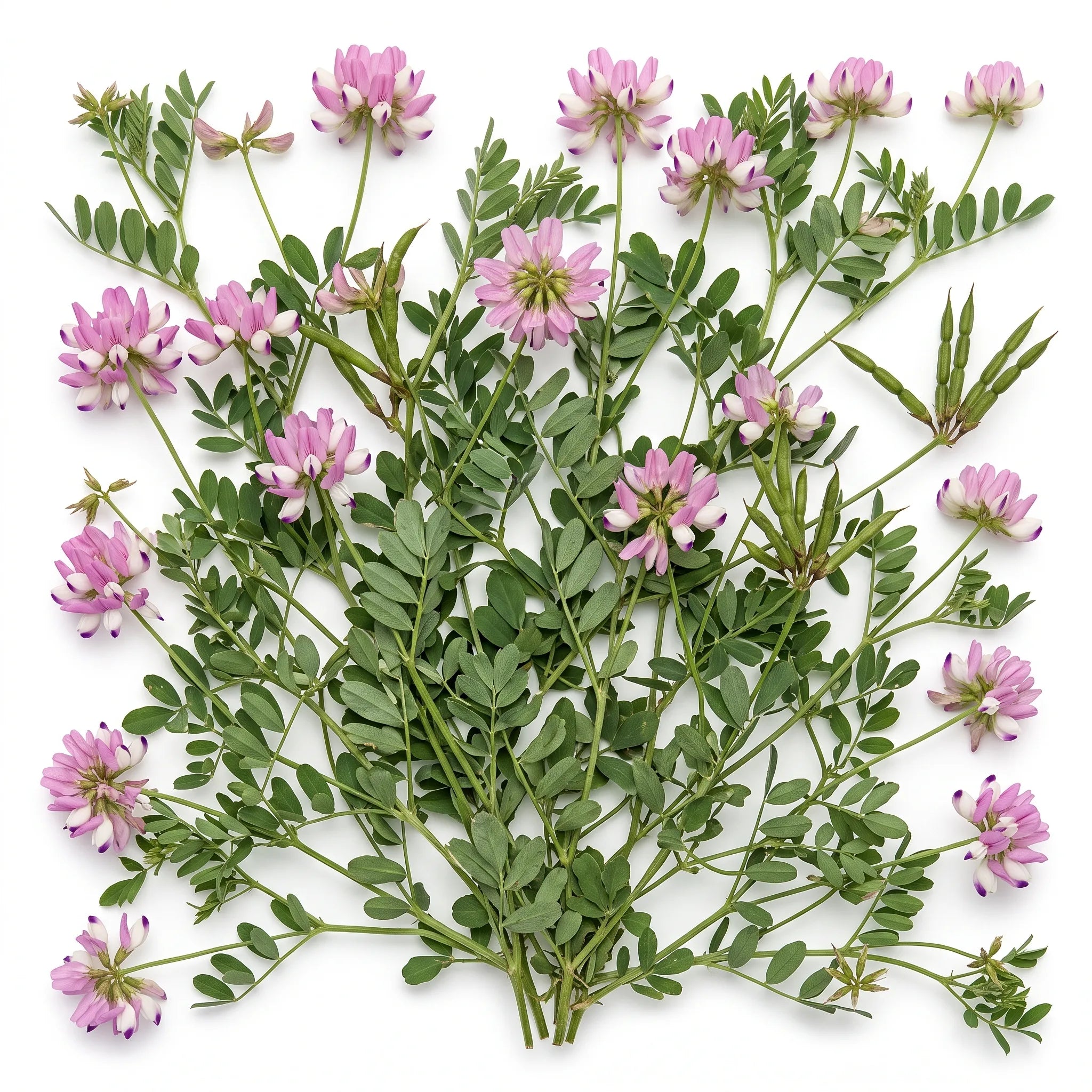
Securigera varia (syn. Coronilla varia)
Common crown vetch, variable crown vetch, variegated crown vetch, variegated sainfoin: its pink-and-white umbels, arranged in perfect crowns—hence the name of the genus, from the Latin corona—cover banks and roadsides all summer long. A remarkably robust ground-covering legume, capable of greening even the most inhospitable ground.
Characteristics:
-
Two-tone umbels: pale pink to bright pink flowers shaded with white, grouped in crowns, all summer long.
-
Dense ground cover: up to 50 cm tall, it spreads generously and carpets the ground.
-
Nitrogen fixer: as a legume, it naturally enriches poor soils.
-
Very hardy: hardy down to -20 °C and remarkably drought-tolerant.
Precautions:
-
All parts of the plant are toxic if ingested, especially the seeds: they contain cardiotonic glycosides. It is particularly dangerous to horses. Do not plant it in pasture or near an equestrian enclosure, and keep the seeds out of children’s reach.
- Its spreading root system makes it highly expansive: reserve it for banks, land to be revegetated, or areas where its spread is desirable.
Sowing advice:
-
Exposure: full sun.
-
Soil: virtually any type, even poor, stony, or chalky soil, as long as it is well drained. As a nitrogen fixer, it needs no fertilizer and thrives where few plants can survive.
-
Method: sow directly in spring or autumn. Cold stratification for 2 to 3 weeks improves germination. Watering is only necessary during establishment.
Care advice:
- None once established. Annual mowing in late summer is enough to contain its spread and rejuvenate it.
Beneficial combinations:
Benefits for biodiversity:
- Highly attractive to pollinators, it draws bees and bumblebees over a very long summer period.
- It is a host plant for the caterpillars of several butterflies, particularly blues.
- Its dense root system effectively stabilizes banks and combats erosion, while enriching the soil with nitrogen.
Uses:
- Green manure on poor or fallow soils, stabilization of sloping ground, wildflower meadows, and country borders. Strictly non-food.
Symbolism:
Through its vigor and ability to take root in the poorest soils, it embodies resilience and the renewal of dormant land.
Harvesting your own seeds:
Allow a few umbels to form their jointed pods, then harvest them when brown and dry, before they split into segments. Clearly label the packet given the toxicity. See saving your seeds.
Commitment to Quality: at SemiSauvage - Permaculture, we grow and select our seeds with respect for all living things as our guiding principle. Based near the Volcanoes of Auvergne, we choose open-pollinated, non-hybrid varieties, tested for their germination rate, carefully sorted and packaged, with no chemical treatment. Our belief: to give gardeners back the ability to resow, year after year, seeds that truly belong to them.
Green up an inhospitable bank with this tireless legume.