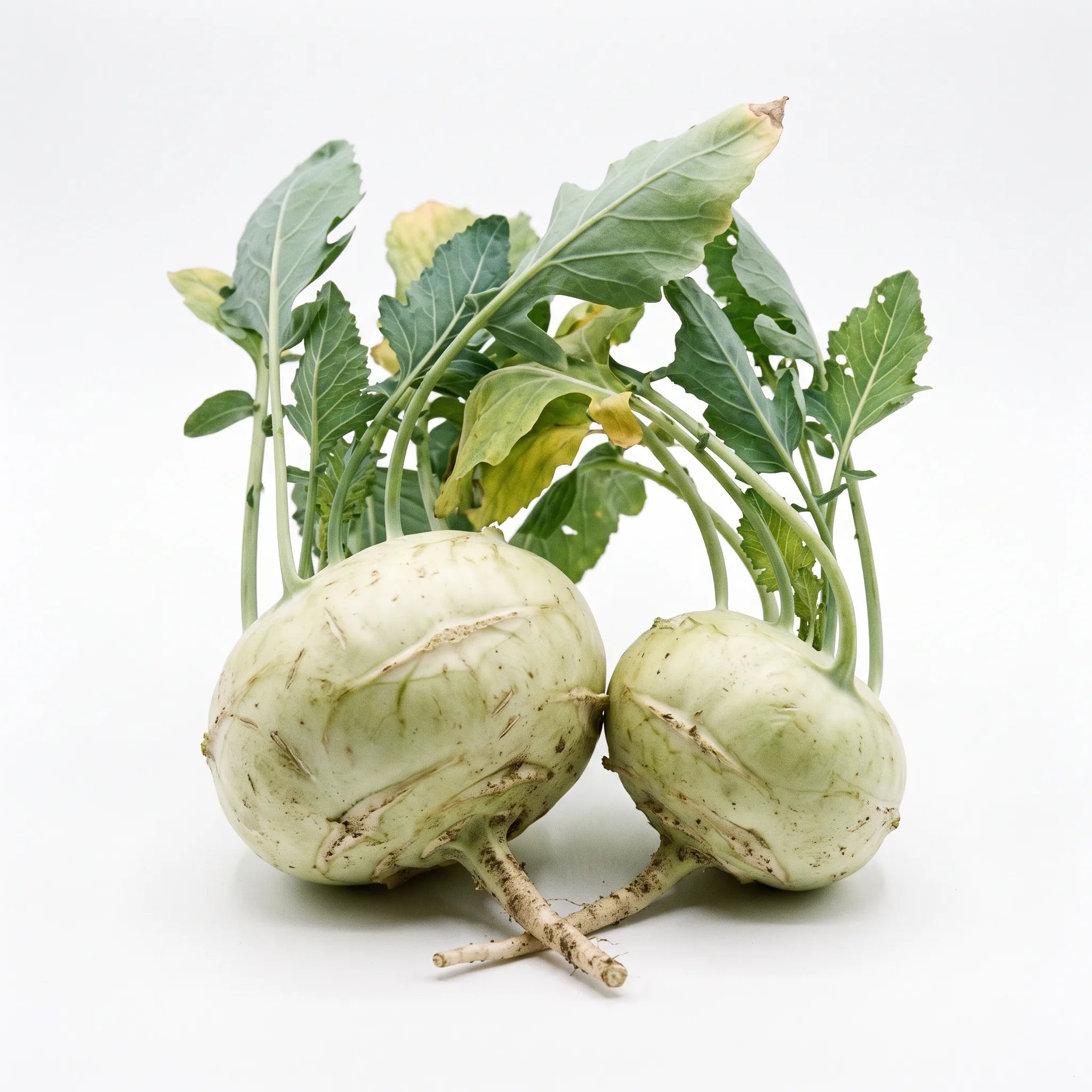
Brassica oleracea var. gongylodes
White kohlrabi, turnip cabbage, stem turnip, kohlrabi: this is the ultimate forgotten vegetable, very popular in Alsace and Central Europe but shunned elsewhere. What we eat is neither a root nor a cabbage head, but a swollen stem that forms at ground level, crisp and slightly nutty.
Characteristics:
-
Nutty flavor: subtle and mild, without the bitterness of other cabbages.
-
Two possible harvests: in spring, when orange-sized, or in autumn for larger specimens.
-
Rapid growth: 4 to 6 weeks between sowing and obtaining the plant.
-
Low maintenance: one of the easiest cabbages to grow successfully.
Sowing advice:
-
Exposure: sunny.
-
Soil: well-drained, moist and rich in nutrients. As with all cabbages, adding well-rotted compost is beneficial. Consistent watering is essential: drought causes the bulb to split.
-
Method: sow from March to August, in a nursery bed or directly in place, at a depth of 1 cm. Stagger sowings to spread the harvest from spring to autumn. See how to sow your seeds.
Planting advice:
- Transplant at 4 or 5 leaves, spacing plants 25 cm apart. Do not bury it: unlike other cabbages, the crown must remain at the surface, otherwise the bulb will not form.
Care advice:
- Water regularly and evenly. Mulch around the base.
- An insect-proof mesh placed immediately after planting prevents flea beetles and cabbage whites without any treatment.
Harvest advice:
- Harvest in spring when orange-sized. Autumn sowings produce larger specimens, but remain reasonable: beyond 10 cm in diameter, the flesh becomes fibrous.
- The young leaves can be cooked like kale, so do not throw them away.
Beneficial companions:
Benefits for biodiversity:
- Its short cycle allows it to occupy an empty bed between two crops rather than leaving the soil bare.
- If allowed to flower in its second year, it produces clusters of highly nectar-rich yellow flowers, valuable in spring.
Uses:
- Raw, grated into remoulade or cut into sticks for snacking; steamed, baked in a gratin, mashed or stir-fried in a wok. Peel before use.
Saving your own seeds:
As a biennial, it produces seeds in its second year: leave one plant in the ground over winter, then harvest the brown, dry seed pods. Be careful: Brassica oleracea varieties cross very easily with one another, so isolate your seed plant. See saving your seeds.
Commitment to Quality: at SemiSauvage - Permaculture, we grow and select our seeds with respect for all living things as our guiding principle. Based near the Auvergne Volcanoes, we choose reproducible, non-hybrid varieties, tested for their germination rate, carefully sorted and packaged, with no chemical treatment. Our belief: to give gardeners back the ability to resow, year after year, seeds that truly belong to them.
The forgotten vegetable of Alsace's kitchen gardens, quick-growing and flavorful.