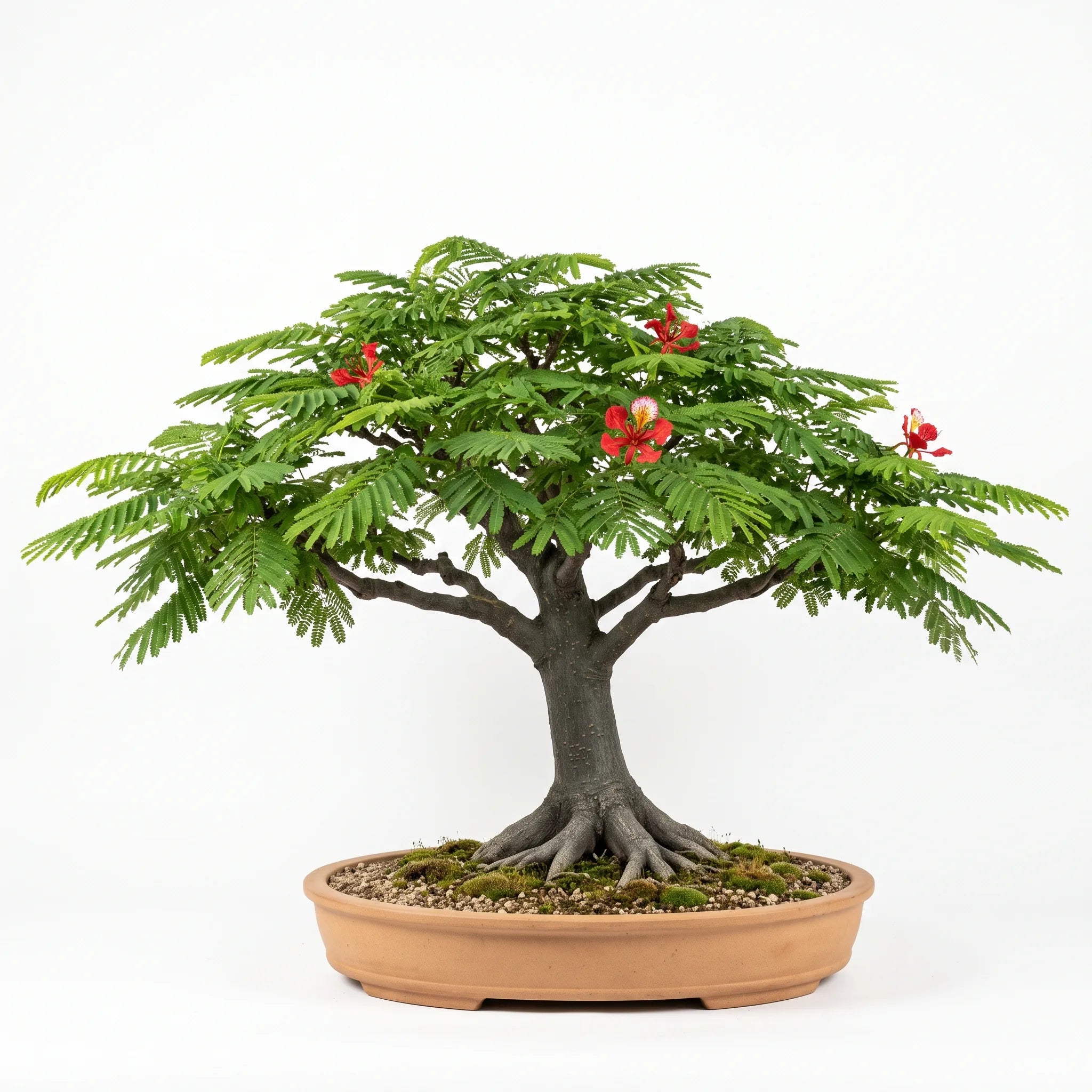
Delonix regia
Royal poinciana, flame tree, flamboyant tree, poinciana: native to Madagascar, where it is now threatened in the wild, it has become one of the most widely planted ornamental trees in tropical regions around the world. Its scarlet-red flowering is so dense that it completely covers the canopy, transforming the tree into a living flame.
Characteristics:
-
Spectacular flowering: scarlet-red clusters that cover the tree during the warm season.
-
Umbrella-shaped habit: up to 10 meters tall, with a broadly spreading canopy providing wonderful shade.
-
Light foliage: finely divided bipinnate leaves with a fern-like appearance.
Precautions:
- Strictly tropical tree: it cannot tolerate any frost. In mainland France, it must be grown in a pot and overwintered indoors in a heated space or in a greenhouse. Flowering in a pot remains exceptional and requires considerable patience.
Sowing advice:
-
Exposure: very sunny, with as much heat and light as possible.
-
Soil: light, sandy, and well-drained. It tolerates poor soils—as a legume, it fixes nitrogen from the air itself—but it absolutely cannot tolerate standing water. A potting-soil and sand mixture works well in containers.
-
Method: no cold stratification—on the contrary, a thermal treatment is required. The seed coat is extremely hard: soak the seeds for 24 hours in warm water (lightly scarifying them with a file improves the results further), then sow them 1–2 cm deep in a deep cell or pot, in spring or summer, at 25–30 °C. See how to sow your seeds.
Planting advice:
- Plant in the ground only in frost-free areas. Elsewhere, use a large, deep pot and bring it indoors as soon as temperatures begin to drop, placing it in a bright room above 15 °C.
- It is remarkably well suited to bonsai, thanks to its fine foliage and trunk, which thickens quickly—see our guide creating a bonsai from a seed.
Care advice:
- Water regularly during summer growth, then greatly reduce watering in winter during dormancy, when it loses its leaves.
Benefits for biodiversity:
- Its nectar-rich flowers are highly valued by pollinating insects throughout its growing range.
- As a legume, it fixes atmospheric nitrogen and naturally enriches the soil around it.
Uses:
- Ornamental tree grown as a specimen or in rows in frost-free areas; grown in pots or as bonsai in cooler climates. Combine it with palms, bougainvilleas, or hibiscus in a tropical garden.
Symbolism:
The flamboyant tree is associated with passion and prosperity. In many tropical regions, its flowering marks the arrival of summer and the end of the school year—in Vietnam, it is also known as “the schoolchildren’s flower.”
Harvesting your own seeds:
Its spectacular woody pods can reach 60 cm in length. Harvest them when they are thoroughly dry on the tree, open them, and store the seeds in a dry place: their hard seed coat gives them a shelf life of several years. See how to store your seeds.
Commitment to Quality: at SemiSauvage - Permaculture, we grow and select our seeds with respect for living things as our guiding principle. Based near the Auvergne Volcanoes, we choose reproducible, non-hybrid varieties, tested for their germination rate, carefully sorted and packaged, without any chemical treatment. Our conviction: to restore gardeners’ ability to sow, year after year, seeds that truly belong to them.
Sales reserved for amateur gardeners seeking quality and authenticity.