Lunaria annua
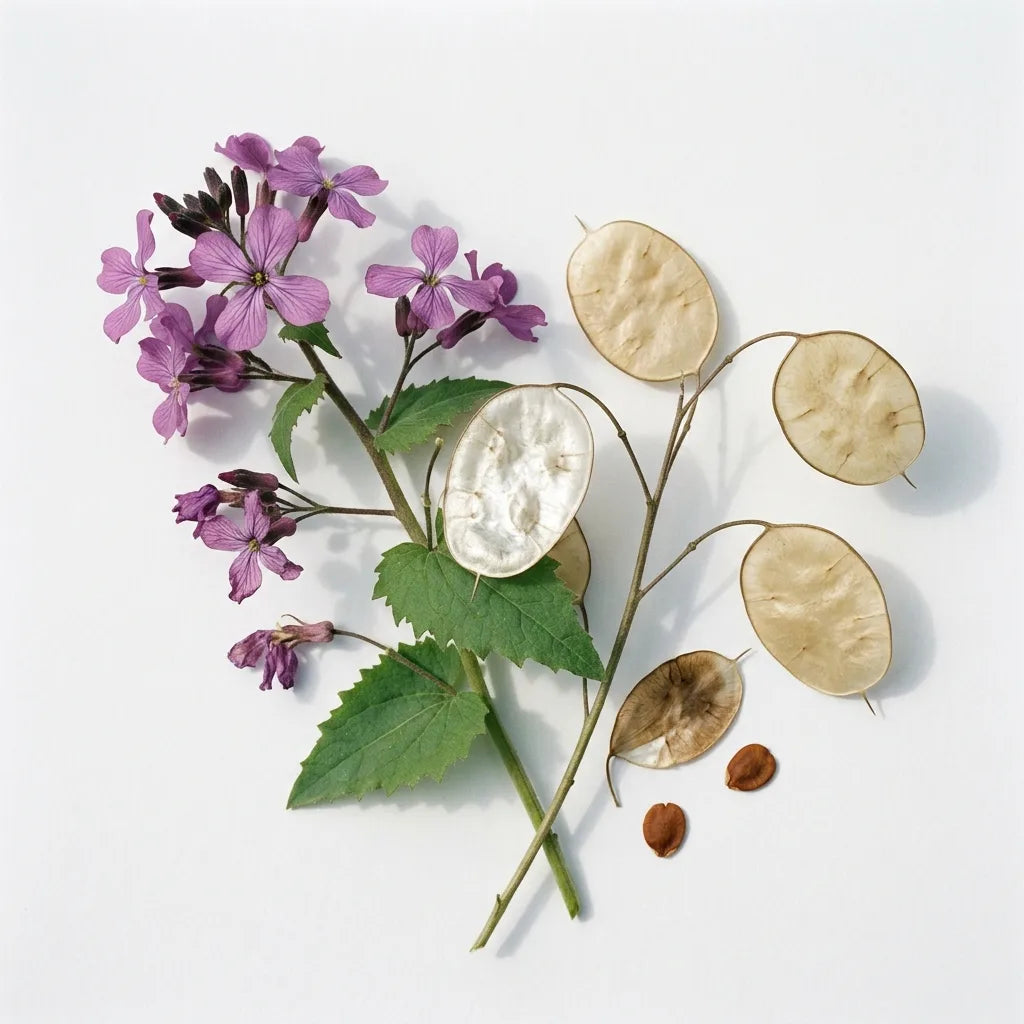
Honesty, annual honesty, silver dollar plant, Judas's penny: all these names describe the same marvel, its flat, translucent fruits which, once stripped of their outer coverings, resemble mother-of-pearl coins. Its botanical name comes from luna, the moon, evoked by these silvery discs that persist throughout winter on the dry stems.
Characteristics:
-
Double appeal: fragrant mauve flowers in spring, followed by spectacular pearly fruits in late summer.
-
Biennial: sown one year, it flowers the next, then self-seeds and returns effortlessly.
-
Shade plant: one of the few plants to flower generously in shady conditions.
Sowing advice:
-
Exposure: preferably partial shade; it does not tolerate scorching full sun well. It is a plant of woodland edges and open undergrowth.
-
Soil: humus-rich, light, moist and well drained. It grows in most soils but performs best in soil rich in organic matter, such as woodland soil. Avoid dry, scorching soils.
-
Method: cold stratification improves germination. Then sow in place in spring or late summer, lightly covering the large, flat seeds. Expect flowering the following spring.
Care advice:
- Virtually none. Leave a few stems to go to seed: the plant self-seeds and establishes itself permanently.
Harvesting advice:
- For dried bouquets, cut the stems when the siliques turn brown, then gently rub them between your thumb and forefinger to remove the two outer membranes and reveal the pearly partition.
Beneficial combinations:
- It pairs well with other partial-shade plants such as forget-me-nots, with which it shares spring flowering and a preference for cool conditions.
Value for biodiversity:
- Its early, fragrant flowers feed the first pollinators of spring, at a time when food sources are scarce.
- Like all brassicas, it is a host plant for butterfly caterpillars, notably the Orange-tip, whose females readily lay their eggs on its flowering stems.
Uses:
- Shady beds, woodland edges, pots. Its pearly siliques are indispensable in dried bouquets, where they keep for years.
Symbolism:
Its silvery discs, reminiscent of coins, have made it a symbol of prosperity and honesty — in English, the plant is in fact called “honesty”, referring to the transparency of its partitions.
Harvesting your own seeds:
The flat, brown seeds are arranged on either side of the pearly partition: they detach on their own when you remove the membranes to prepare your dried bouquets. One action, two harvests. See storing your seeds.
Commitment to Quality: at SemiSauvage - Permaculture, we grow and select our seeds with respect for all living things as our guiding principle. Based near the Volcanoes of Auvergne, we choose open-pollinated, non-hybrid varieties, tested for their germination rate, carefully sorted and packaged, with no chemical treatment. Our conviction: to give gardeners back the ability to resow, year after year, seeds that truly belong to them.
Add a touch of old-world charm to your garden with these honesty seeds.