

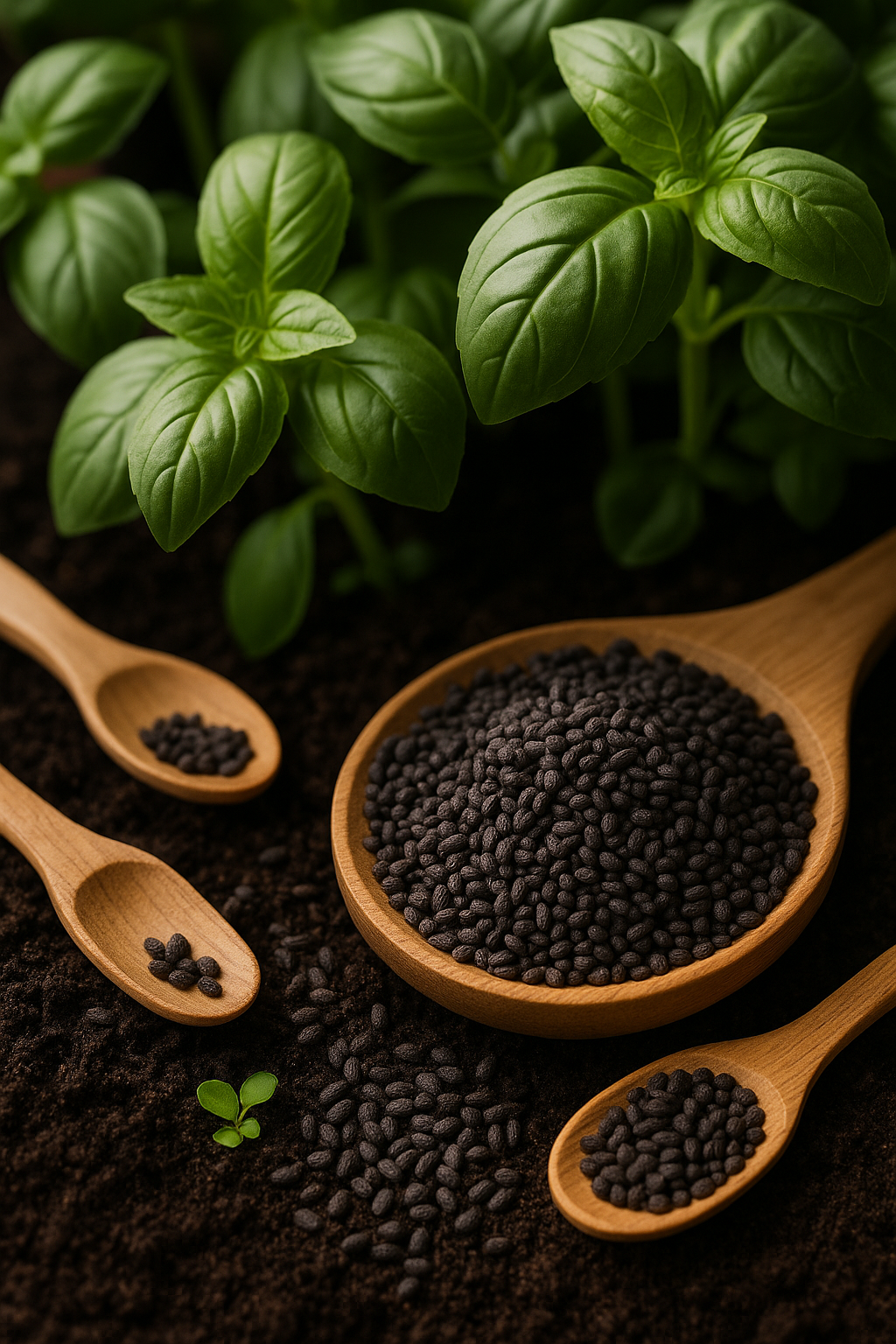
Basil is the best-selling and most frequently lost culinary herb. You buy it in a pot at the supermarket, and it declines within ten days; you sow it in March, and it does not emerge. Both failures have the same cause: it is a tropical plant, and we treat it like a plant from our gardens.
Native to South Asia, basil tolerates neither cold, sudden changes, nor excess water. Once you understand these three points, it becomes easy—and generous for six months.
Sowing: warmth above all
When
Basil germinates at a soil temperature of 18–20°C, with the optimum around 22–25°C. Below 15°C, germination is erratic and slow, and often fails altogether.
- Under cover—from March onward, on a warm windowsill or with a heating mat.
- In the ground—not before mid-May in most regions, and only once the soil has reached 18°C. Sowing earlier gives no advantage.
- Indoors—all year round, provided there is enough light.
How
- Fine, moist seed-starting compost, in pots or a seed tray.
- Barely cover them—3 to 5 mm. The seed is small and light promotes germination: do not bury it.
- Mist rather than water, so as not to displace the seeds.
- Cover with film until emergence—5 to 10 days at the right temperature.
- As soon as they emerge, remove the film and give them as much light as possible. Otherwise, the seedlings become leggy and will not recover.
One useful peculiarity: basil seeds become mucilaginous when they come into contact with water—they become surrounded by a translucent gel. This is normal, and is even a good sign of freshness. Simply avoid soaking them before sowing, as they would become impossible to handle.
Transplanting and planting out
Transplant at the two-true-leaf stage, into an individual pot. Wait until all risk of frost has passed before planting out permanently: basil exposed to 5°C turns black and will not recover. Space plants 25 to 30 cm apart in the ground.
The game-changing technique: pinching
That is what separates a spindly basil plant from a bushy one, and almost no one does it.
Basil naturally grows as a single upright stem that rises, flowers, and then stops. By cutting off the tip above a pair of leaves, you remove apical dominance: the plant then produces two side stems instead of one. Repeat this on each new shoot, and you get a bush instead of a single stem.
- First pinching at 4 or 6 true leaves, above the second pair.
- Always harvest from the top, never by picking the lower leaves — they are the ones that feed the plant.
- Remove the flower buds as soon as they appear. Flowering signals to the plant that its cycle is ending: the leaves become smaller, tougher, and more bitter.
- You can let one or two plants flower at the end of the season — for pollinators and to harvest your seeds.
Watering and feeding
- At the base, never on the foliage — wet leaves turn black and attract fungal diseases.
- In the morning preferably, so everything has dried by evening.
- Regularly but sparingly — basil dislikes drought just as much as waterlogged roots. In a pot, let the top centimeter dry out between waterings.
- No nitrogen fertilizer. Excess nitrogen produces large, soft, bland leaves: the essential oils that create the aroma become concentrated in a slightly stressed plant. Well-rotted compost at planting is more than enough.
The varieties
- Sweet basil (Ocimum basilicum) — the classic, used in pesto and tomato salad. Broad leaves, a straightforward aroma. Start with this one.
- Thai basil (var. thyrsiflora) — anise and licorice notes, with purple stems. Essential in Asian cuisine, and it holds up better during cooking than sweet basil.
- Lemon basil (var. citriodorum) — highly aromatic, excellent with fish, summer fruit, and in infusions.
- Purple basil (‘Purpurascens’) — highly decorative dark foliage, with a stronger, slightly clove-like flavor. Superb along the edge of a vegetable garden.
- Holy basil Tulsi (Ocimum tenuiflorum) — a distinct species, traditionally used in infusions. Hardier than the others and perennial in mild climates.
The full range is available in our aromatic and medicinal seeds.
Pairing basil
With tomatoes: what is true and what is not
This is the most famous pairing in the vegetable garden, and the most poorly explained. Two claims circulate:
- “Basil improves the taste of tomatoes” — no study establishes this. It is probably an extrapolation from their pairing in cooking.
- “Basil keeps pests away” — here, the mechanism does exist: basil’s essential oils disrupt the scent detection of certain insects, particularly whiteflies. The effect is real but partial, and it requires immediate proximity — basil two metres away is useless.
There is another rarely mentioned benefit: the two plants have the same needs — warmth, sunlight, and regular watering at the base — and different root levels. That is the real reason for their compatibility. Allow one basil plant for every two tomato plants.
We discuss this topic in detail in Pairing tomatoes and basil: myth or reality?.
Other good pairings
- Peppers and eggplants — the same requirements, the same aromatic effect.
- Zucchini — basil occupies the space before the foliage closes in.
- Asparagus — a traditional pairing, against asparagus beetles.
- At the edge of the bed — basil left to flower attracts bees and hoverflies, whose larvae feed on aphids.
Avoid
Rue and cucumber, traditionally discouraged. Above all, do not plant it in the shade of a tall crop: this is the leading cause of decline in the vegetable garden.
Common problems
| Symptom | Cause | Correction |
|---|---|---|
| Blackened leaves | Cold, or water on the foliage | Bring indoors or protect; water strictly at the base |
| Plant growing into a single stem | Never pinched | Pinch above a pair of leaves |
| Small, bitter leaves | Flowering in progress | Remove the flower buds |
| Soft, bland leaves | Excess nitrogen or lack of light | Do not fertilize; move into the sun |
| Purchased plant that is declining | Twenty seedlings crowded into a tiny pot | Divide the root ball into three or four sections and repot separately |
| Small holes in the leaves | Slugs or flea beetles | Dry barrier, evening harvest |
Harvest, preserve, reseed
- Harvest in the morning, when the concentration of essential oils is highest.
- Basil dries poorly — it loses most of its fragrance. Freezing is preferable: whole leaves in a bag, or chopped in an ice cube tray with a little olive oil.
- Pesto freezes very well, and it is the best way to use up a large harvest.
- Taking cuttings — a 10 cm stem in a glass of water will root in seven to ten days. The simplest way to propagate a plant you like, or to extend the season indoors.
- Harvesting seeds — basil is self-pollinating: let one plant flower, wait until the calyces turn brown, then rub them over a bowl. See How to store your seeds.
Frequently asked questions
Why does my supermarket basil always die?
Because it is not one plant but around twenty seedlings packed into a pot that is too small, forced to grow quickly for sale. They compete with and exhaust one another. The solution: remove them from the pot, divide the root ball into three or four sections, and repot them separately in a well-draining growing medium.
Can basil be grown in winter?
Indoors, yes, provided it has a very bright window or supplemental lighting. Without enough light, it becomes spindly. Holy basil Tulsi is the most tolerant of relatively low light.
Does it need to be watered every day?
In a pot and during summer, often yes. In mulched open ground, two to three times a week is enough. The real test is to push your finger 2 cm into the soil.
How many plants should you grow?
Three to four plants, well cared for, will meet a household’s needs for fresh basil. Plan on twice as many if you make pesto to freeze.
Is basil perennial?
It is perennial in the tropics but annual in our climates — the first frost kills it. Only holy basil Tulsi can survive the winter in very mild climates or in a conservatory.
Key points
Warmth to germinate, light to grow, pinched to become bushy, watered at the base, and never fertilized. Treat it like the tropical plant it is, and a May sowing will provide for you until the first cool weather in October.
For further reading
- Growing tomatoes and basil together: myth or reality?
- Heirloom tomato seeds: varieties, sowing, and care
- Balcony vegetable garden: suitable techniques and varieties
- The month-by-month seed-sowing calendar
Discover our five basils and all our culinary and medicinal herb seeds — all open-pollinated.

留下评论
此站点受 hCaptcha 保护,并且 hCaptcha 隐私政策和服务条款适用。