Allium tuberosum
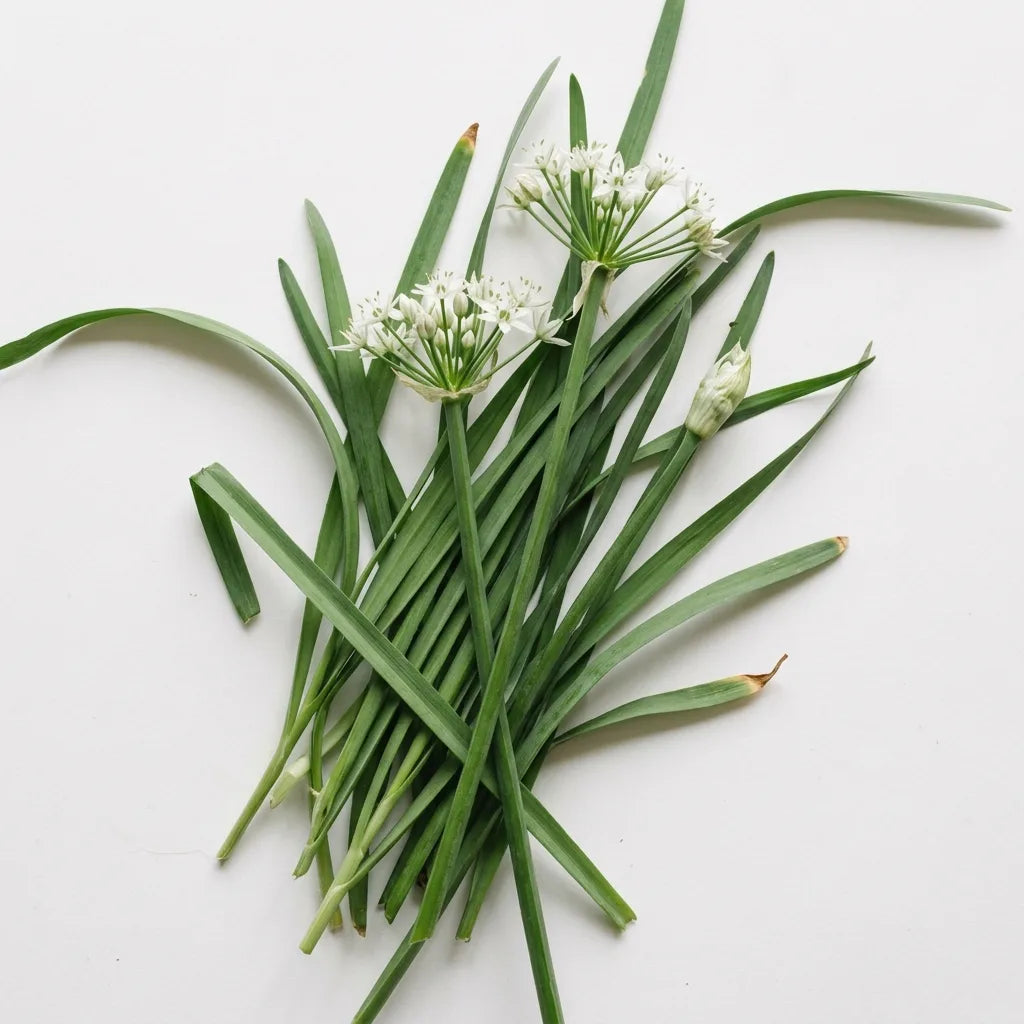
Chinese chives, garlic chives, fragrant garlic, nira: a relative of chives but with a mild garlic flavor, it stands out at first glance with its flat, rather than tubular, leaves. Its remarkably decorative white umbels in late summer make it as beautiful in flower beds as it is useful in the kitchen.
Characteristics:
-
Mild garlic flavor: rounder and less pungent than garlic, it is used like chives.
-
Flat leaves: its distinctive feature, unlike chives, which have hollow, round stems.
-
Spectacular flowering: abundant, lightly scented white umbels in late summer.
-
Hardy perennial: it forms dense clumps that return every year.
Sowing advice:
-
Exposure: sunny, or partially shaded in southern regions.
-
Soil: light, cool, and rich in humus. It appreciates well-nourished soil, unlike bulb garlic—adding compost produces fuller clumps.
-
Method: sow from February to April for a harvest three to four months later, or in July and August for a spring harvest. Sow 1 cm deep, in pots or directly in the ground. See how to sow your seeds.
Planting advice:
- Transplant in clumps spaced 25 cm apart, along the edge of a flower bed or in the vegetable garden. In pots, choose a well-drained container at least 25 to 30 cm in diameter.
Care advice:
- Water regularly to keep the soil cool. Cut the clump back after each harvest; it will regrow with fresh foliage.
- Divide every 3 to 4 years to rejuvenate it. Be careful, as it self-seeds easily: cut off the faded umbels if you do not want it to spread.
Harvesting advice:
- Cut the leaves with scissors 3 cm above the soil, as needed. They regrow within a few weeks, allowing several harvests per season.
- Harvest the flower buds before they open and sauté them—they are a much-loved delicacy in Asia.
Beneficial plant combinations:
Benefits for biodiversity:
- Its late-summer flowering arrives during a lean period for pollinators: its white umbels are then literally covered with bees and butterflies.
- Its sulfur compounds naturally reduce pest pressure on neighboring crops.
Uses:
- Raw, snipped leaves in salads, sauces, omelets, and mayonnaise; cooked in quiches, stews, and vegetable stir-fries. A must-have in Chinese dumplings and Asian stir-fried dishes. Its flowers, with a delicate garlic flavor, decorate raw vegetables and salads.
Harvesting your own seeds:
Leave a few umbels to dry completely on the plant, then shake them over a container: the angular black seeds will be released from the capsules. It does not cross with common chives, which simplifies seed production. See how to store your seeds.
Commitment to Quality: at SemiSauvage - Permaculture, we grow and select our seeds with respect for all living things as our guiding principle. Based near the Auvergne volcanoes, we choose open-pollinated, non-hybrid varieties, tested for their germination rate, carefully sorted and packaged, with no chemical treatment. Our belief: to give gardeners back the ability to sow, year after year, seeds that truly belong to them.
The taste of garlic without the bulb, and flowers that make a sensation in late summer.