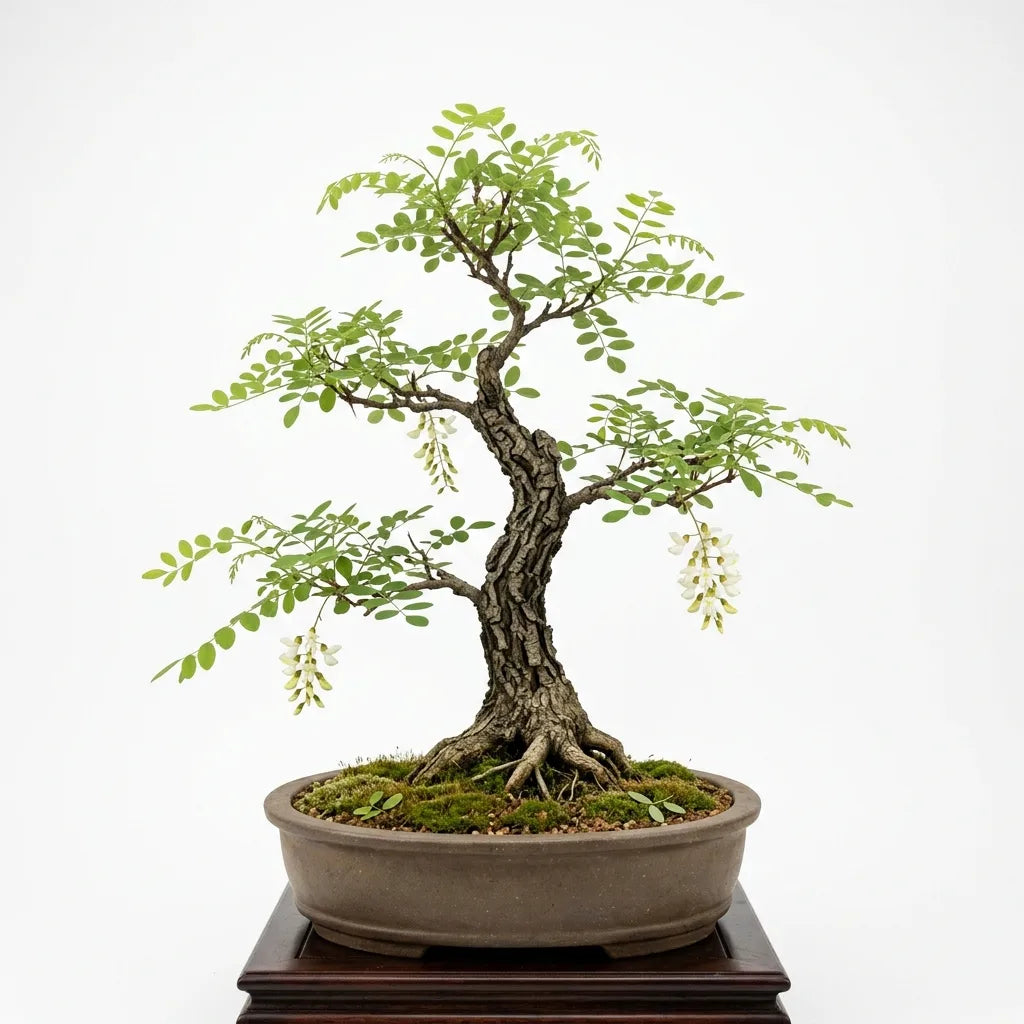
Robinia pseudoacacia
Black locust, false acacia, acacia (incorrectly), carob tree, bastard locust: imported from North America at the beginning of the 17th century by Jean Robin, gardener to Henry IV, it gave its name to the genus. One of the trees he planted in Paris is still alive in René-Viviani Square — it is the oldest tree in the capital. It is also the tree behind the famous “acacia honey,” which therefore has nothing to do with true acacias.
Characteristics:
-
Major nectar-producing bloom: long, highly fragrant white clusters in May–June, which produce acacia honey.
-
Very rapid growth: it reaches 20 to 30 metres and produces usable wood in just a few years.
-
Rot-resistant wood: naturally resistant to decay without any treatment, it is the European alternative to exotic woods.
-
Nitrogen fixer: as a legume, it enriches the poor soils where it becomes established.
Precautions — read before planting:
-
Invasive non-native species: black locust spreads very vigorously through root suckers and quickly colonises open habitats. It appears on the lists of species requiring monitoring in several French regions. Do not plant it near natural areas, meadows or wild woodland edges, and plan to install a rhizome barrier or regularly monitor suckers if you grow it in the garden.
-
Toxicity: the bark, leaves, roots and seeds are toxic if ingested. Only the flowers are edible (as fritters). Keep the seeds out of reach of children and pets.
- Its branches bear sharp thorns: gloves are essential for pruning.
Sowing advice:
-
Position: full sun for rapid growth.
-
Soil: virtually any type, including poor, sandy, stony or degraded soils, provided they are well drained. As a nitrogen fixer, it needs no fertiliser and thrives where other species fail. It mainly dislikes waterlogged soils.
-
Method: the seed coat is extremely hard. Lightly scarify the seeds with a file, or soak them in very hot water (not boiling) for 12 to 24 hours: the seeds that swell are ready to sow; repeat the process for the others. Cold stratification can supplement the treatment. Then sow in spring in a deep pot.
Planting advice:
- Choose the final location carefully, taking its mature size and suckering into account: away from property boundaries, pipes and natural areas.
- It reaches its full potential in short-rotation coppice for producing stakes: cut every 5 to 10 years, it regrows vigorously from the stump.
Care advice:
- Water moderately during the growth phase; afterward, it tolerates drought very well.
- Monitor and remove suckers every year: this is the key to keeping it in place.
Benefits for biodiversity:
- Its bloom is among the most nectar-rich of all: a single day of nectar flow can yield several kilograms of honey per hive, making it a key tree for beekeepers.
- Like all legumes, it fixes atmospheric nitrogen and restores poor or eroded soils — see the basics of living soil.
- Its vigour, an advantage in controlled planting, is also what makes it problematic in natural environments: reserve it for sites where you can contain it.
Uses:
-
Wood: rot-resistant without treatment, it is ideal for fence posts, outdoor structures, decks and garden furniture — a local alternative to exotic woods.
-
Beekeeping: a leading honey tree in France.
-
Soil restoration: planting on degraded land, embankments and former quarries, where it fixes nitrogen and stabilises the ground.
- Its flowers are enjoyed as fritters, a traditional recipe from the countryside.
Symbolism:
As a symbol of vigour and adaptability, black locust embodies the ability to thrive on the most barren land. The tree planted by Jean Robin in 1601 is also a living witness to four centuries of Parisian history.
Harvesting your own seeds:
Its flat pods turn brown in autumn and often remain on the tree throughout the winter. Harvest them when dry, open them and store the seeds in a dry place: their hard seed coats ensure they remain viable for several years. Clearly label the packet, as these seeds are toxic. See storing your seeds.
Commitment to Quality: at SemiSauvage - Permaculture, we grow and select our seeds with respect for living things as our guiding principle. Based near the Auvergne Volcanoes, we choose reproducible, non-hybrid varieties, tested for their germination rate, carefully sorted and packaged, without any chemical treatment. Our conviction: to give gardeners back the ability to resow, year after year, seeds that truly belong to them.
Sale reserved for knowledgeable amateur gardeners capable of establishing this tree in a controlled setting.