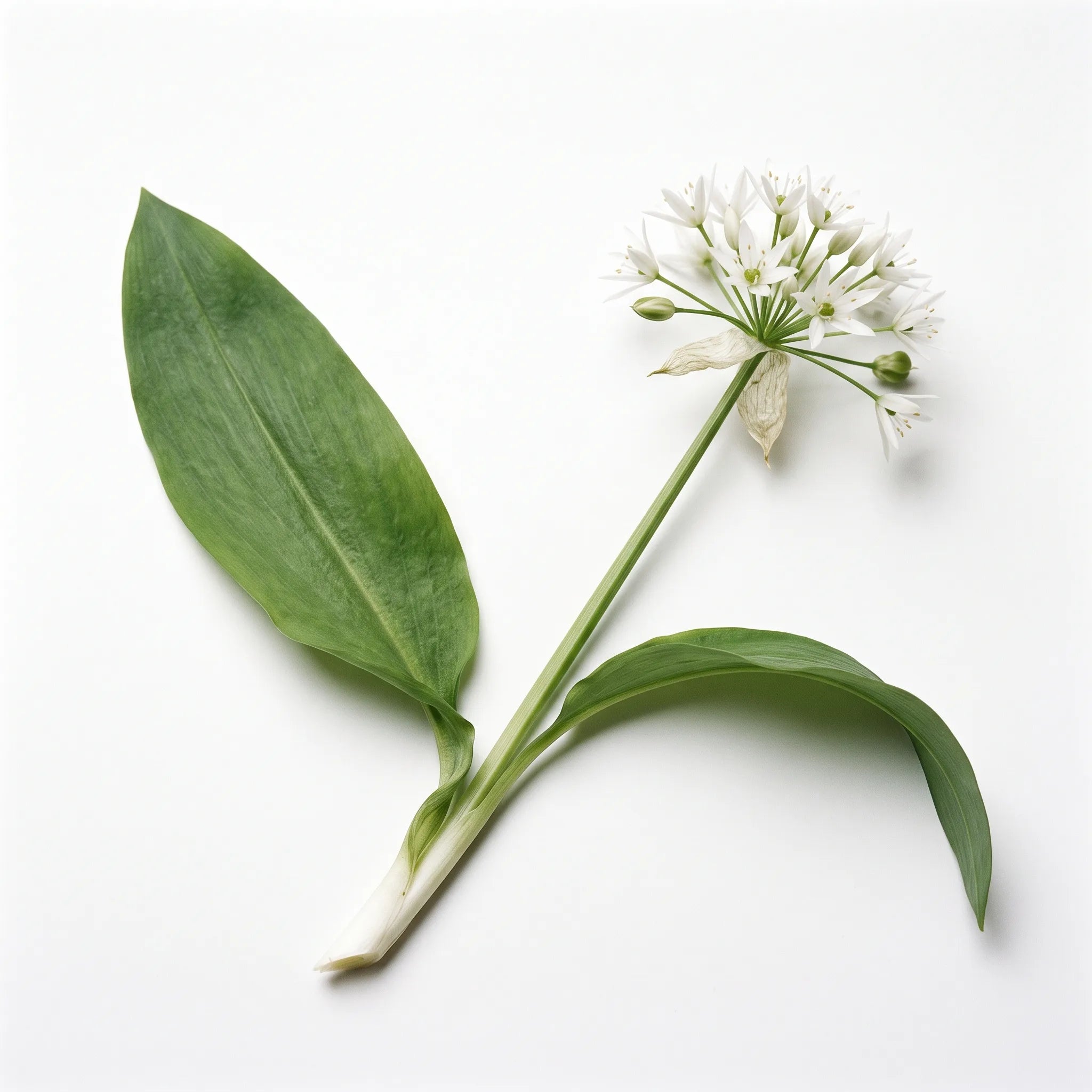
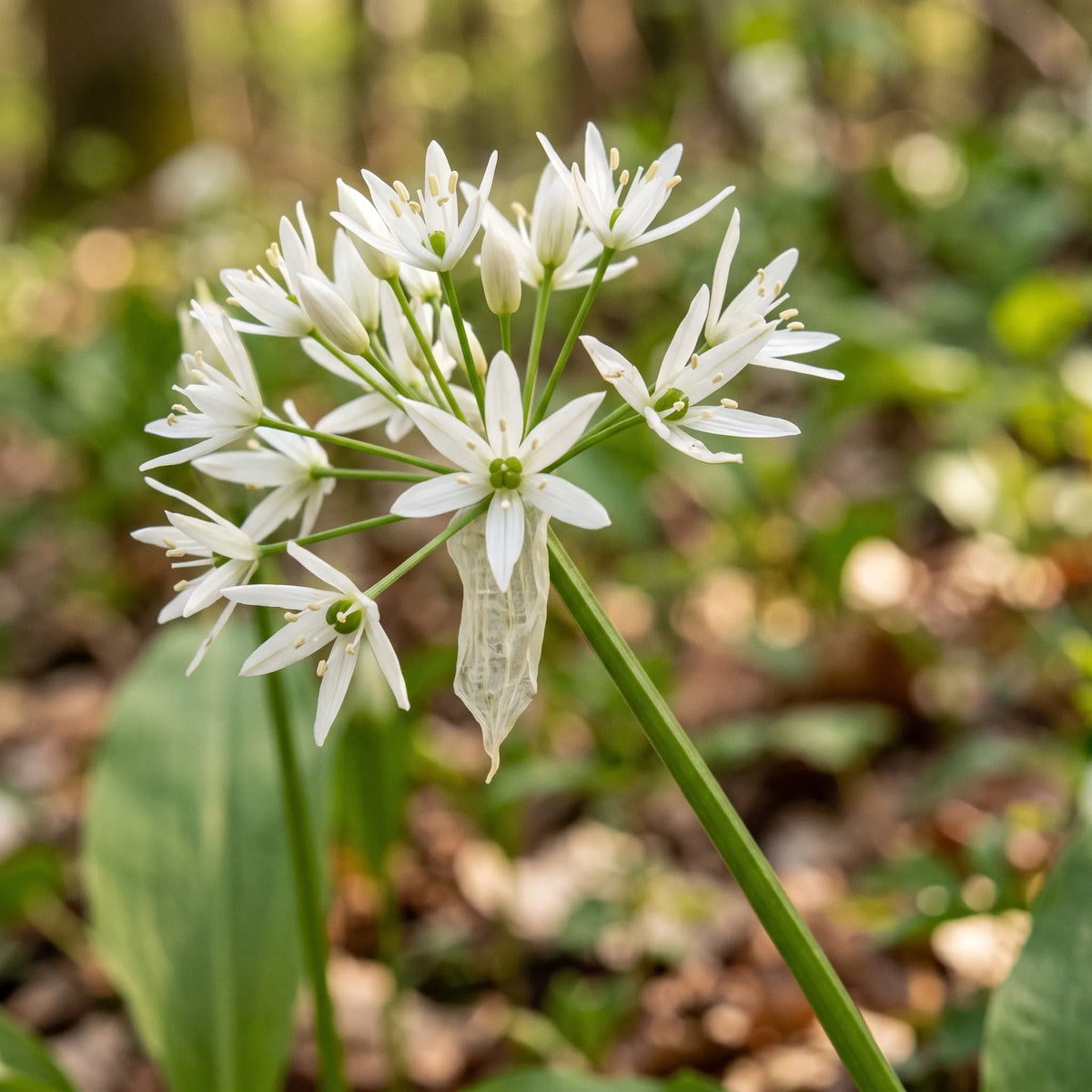
Allium ursinum
Wild garlic, ramsons, bear’s garlic, broad-leaved garlic: its name comes from an ancient belief that bears, upon emerging from hibernation, gorged themselves on it to regain their strength. In spring, it carpets cool woodland floors in vast, fragrant colonies—you can often smell it long before you see it.
Characteristics:
-
Distinctive garlic scent: the entire foliage smells strongly of garlic when crushed, which is its distinguishing feature.
-
Entirely edible: the leaves, buds, flowers, and bulbs can all be eaten.
-
Shade-loving plant: one of the few edible plants to thrive in cool, shaded woodland.
-
Naturalizes readily: over time, it forms vast colonies and can become invasive.
Precautions — must be read:
-
Risk of fatal confusion. Wild garlic leaves resemble those of autumn crocus and lily of the valley, two highly toxic plants that sometimes grow in the same places. These mix-ups cause serious poisonings in France every year.
-
The lifesaving test: always crush a leaf between your fingers before picking it. Wild garlic gives off a strong, immediate garlic smell. Autumn crocus and lily of the valley have no smell at all. If in doubt, do not pick it.
- Another difference: each wild garlic leaf emerges directly from the ground on its own petiole, whereas lily of the valley has two sheathed leaves growing from the same stem.
- When grown in a dedicated garden bed, the risk disappears: this is the great advantage of sowing it yourself rather than gathering it in the wild.
Sowing advice:
-
Exposure: shade or partial shade, beneath deciduous trees that let light through in spring.
-
Soil: cool, humus-rich, deep soil enriched with leaf mold or compost. Recreate woodland conditions: it should never dry out in summer or become waterlogged in winter.
-
Method: sow in July, very thinly, covering with one centimeter of potting soil and watering with a fine rose. The seeds require cold stratification: summer sowing lets winter do the work naturally. Be patient; germination may take two winters.
Care advice:
- None. Keep the soil cool and let it naturalize. However, be aware that it can become invasive—limit its growing area if necessary.
Harvesting advice:
- Pick the leaves in spring, before flowering, when they are at their most tender and aromatic. Take only part of each clump so the colony can become stronger.
- The flower buds can be pickled like capers, and the flowers add decoration to salads.
Beneficial combinations:
Benefits for biodiversity:
- Its early white flowers feed the first pollinators of spring, at a time when resources are scarce.
- Its seeds bear an elaiosome, a small fatty reserve coveted by ants: they are responsible for dispersing the seeds through the woodland.
- Its spring carpet protects the soil and shelters the woodland’s microfauna.
Uses:
- Fresh leaves in pesto, soups, salads, or compound butter. They are best eaten raw or just warmed through, as cooking destroys their aroma. See our medicinal plants to sow.
Harvesting your own seeds:
Leave a few flower heads to form capsules, then harvest the black, shiny seeds as soon as they appear, before the ants carry them away. Sow them quickly: their germination capacity declines rapidly. See saving your seeds.
Commitment to Quality: at SemiSauvage - Permaculture, we grow and select our seeds with respect for living things as our guiding principle. Based near the Auvergne Volcanoes, we choose reproducible, non-hybrid varieties, tested for their germination rate, carefully sorted and packaged, with no chemical treatment. Our belief: to give gardeners back the ability to resow, year after year, seeds that truly belong to them.
Grow your own wild garlic: the best way to enjoy it with no risk of confusion.