

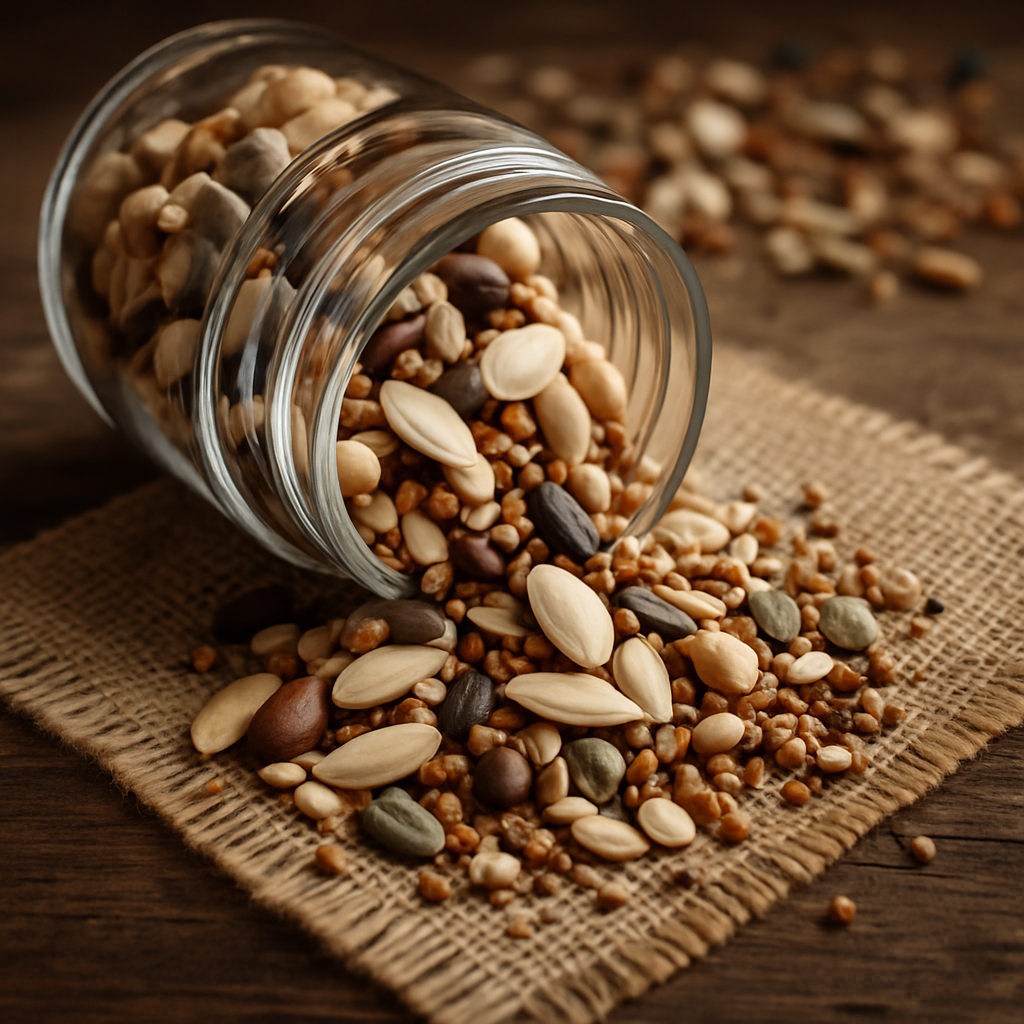
In front of a seed-packet display, three labels keep appearing: F1, hybrid, and reproducible. They do not mean the same thing, and the confusion between the first two is reinforced by a convenient shortcut. Understanding the difference has a concrete impact on what you can do with your harvests.
This guide explains what really distinguishes these three categories, how an F1 is produced, what happens if you resow it, and what the choice entails beyond your vegetable garden.
The terminology, clarified
The three concepts partially overlap. The simplest approach is to start with the question that matters: what happens if I resow the seeds I have harvested?
A stable (or population) variety
It is a variety whose traits are passed on faithfully from one generation to the next. It has been stabilized through selection over many generations—sometimes centuries. When resown, it produces the same plant again, apart from a degree of natural variability.
This residual variability is not a defect: it is what allows the variety to adapt gradually to your soil and climate, season after season. That is the exact meaning of the word “population”: a group of slightly different individuals, not clones.
A hybrid
It is the product of crossing two genetically different parents. The term is not inherently derogatory: hybridization occurs naturally, through wind or insects, in gardens all over the world. A spontaneous hybridization, resown and selected over several generations, eventually gives rise to a new stable variety. This is how most of the heirloom varieties we grow today came about.
An F1 hybrid
This is a specific type of hybrid, produced industrially. F1 means “first filial generation”: two lines made homozygous through several generations of self-pollination are crossed, and the first generation resulting from this cross is harvested.
This first generation benefits from hybrid vigor, or heterosis: uniform, vigorous, consistent plants. The phenomenon is very real, has been known since the beginning of the 20th century, and is what explains the method's success in agriculture.
Remember the rule: all F1s are hybrids, but not all hybrids are F1s. Hybridization is not the problem; the issue is that F1s cannot be reproduced faithfully.
How an F1 is made
Understanding the process sheds light on many things, including why these seeds are expensive.
Creating an F1 first requires producing two pure lines: a variety is self-pollinated for six to eight generations until plants that are nearly genetically identical are obtained. These lines are often weak as well—repeated self-pollination causes inbreeding depression. It is precisely their crossing that produces renewed vigor.
The remaining challenge is to prevent each line from self-pollinating during the cross. Three solutions are used:
- Manual emasculation—the stamens are removed flower by flower. This is practiced with tomatoes and explains the price of these seeds.
- Genetic male sterility—lines whose stamens are naturally nonfunctional are used.
- Cytoplasmic male sterility—the trait is carried by the mitochondria and transmitted through the mother. This is the most widely used method for cruciferous and allium crops, and the most debated, as some production techniques involve cell fusion.
This work explains the cost: an F1 is an industrial product that can be protected, whose value rests on the fact that it must be purchased again.
What happens in the second generation
This is where everything is decided, and it is rarely explained correctly.
Seeds harvested from an F1 plant produce the F2 generation. At this stage, the traits inherited from the two parental lines are randomly redistributed—this is segregation, a phenomenon described by Mendel in the 19th century. The result is heterogeneous offspring, with some plants resembling the F1, others resembling one parent or the other, and others resembling nothing familiar. Hybrid vigor dissipates by half with each generation.
Two clarifications that correct persistent misconceptions:
- F1s are not sterile. Their seeds germinate very well. What is lost is fidelity, not fertility. The widespread expression “sterile seeds” is simply false.
- F2s are not necessarily bad. They are unpredictable. Some gardeners deliberately sow F2 seeds again and select the individuals they like over six to eight years until they obtain a new stable variety. This is exactly the work of plant breeding, accessible to a patient amateur with a little space.
Summary table
| Type | Can it be faithfully resown? | Origin | Main benefit |
|---|---|---|---|
| Fixed variety / population | Yes | Selection over many generations | Self-sufficiency, local adaptation, diversity |
| Unfixed natural hybrid | Partially | Spontaneous crossing in the garden | Starting point for creating a variety |
| F1 hybrid | No | Industrial crossing of pure lines | Uniformity, yield, grading |
What the choice changes in the garden
Progressive adaptation
This is the most concrete and least-known argument. An open-pollinated variety resown every year in the same place undergoes natural selection: the individuals best adapted to your soil, climate, and way of growing are the ones that produce the most seeds. After a few cycles, you are growing a strain that exists nowhere else.
An identical F1 repurchased every spring will never benefit from this mechanism, by design. This is a decisive point in an unstable climate.
Uniformity: advantage or disadvantage?
An F1 produces fruit that all ripens at the same time and is uniform in size. This is valuable for a market gardener who harvests in one pass and delivers to a purchasing center. It is often a disadvantage in a family garden, where people prefer to spread the harvest over several weeks rather than have thirty kilos of zucchini in ten days.
Disease resistance
This is the strongest argument in favor of F1s, and it deserves recognition: modern breeding incorporates targeted resistance to specific pathogens, often with great effectiveness. Open-pollinated varieties rely on general tolerance and diversity: less spectacular against a given disease, but more robust over time, since single-gene resistances eventually get overcome.
Flavor and texture
F1 breeding has long prioritized yield, transportability, and shelf life—criteria that sometimes conflict with flavor. This is not a technical inevitability, and some modern F1 varieties are excellent; but heirloom varieties were selected by people who ate them, which directs selection differently.
Dependence
An F1 requires repurchasing every year. In a family vegetable garden, the financial stakes are modest; on an agricultural scale, it structures an entire sector and raises the question of who controls access to seeds. This is where the choice goes beyond the garden.
The biodiversity challenge
The number of vegetable varieties actually cultivated declined sharply during the 20the century, as production became concentrated on a small number of types meeting distribution requirements. Many local varieties disappeared from commercial catalogs and survive only thanks to gardeners, seed associations, and conservatories that continue to resow them.
This erosion poses a practical as well as a heritage-related problem: a narrow genetic base does not withstand change well — new diseases, repeated droughts, mild winters that disrupt cycles. The diversity preserved in gardens forms a reserve of adaptability, and it cannot be restored once lost.
Every gardener who harvests their own seeds contributes to this network, even on a very small scale. We explain this in detail in How to store your seeds from one year to the next.
Where to start if you want to save seeds
Not all species are equally difficult. The logical order is:
- Easy self-pollinating plants — tomatoes, beans, peas, lettuce. They fertilize themselves even before the flower opens: accidental crosses are rare, and one or two seed-bearing plants are enough. This is where you should start, and a single season is enough to see that it works.
- Autogamous plants requiring monitoring — bell peppers, chili peppers, eggplants. Crosses are possible through insects: keep three to five plants and space the varieties a few meters apart.
- Cross-pollinated plants — squash, cabbages, carrots, onions, beets. Cross-fertilization is mandatory: you need a sufficient number of plants (ten to twenty, depending on the species, to avoid inbreeding) and only one variety of each botanical species flowering at the same time. This is the advanced level, and this is where seed-sharing networks between gardeners become truly meaningful.
Our catalog consists entirely of heirloom and reproducible varieties, without exception.
Frequently asked questions
F1 hybrid and GMO: are they the same thing?
No, they are two completely distinct techniques. An F1 is obtained through conventional sexual crossing, even if the process is industrialized; a GMO results from directly modifying the genome in a laboratory. GMO cultivation is also highly regulated in Europe, and organic seeds exclude GMOs as a matter of principle.
Are F1s less healthy?
Nothing allows you to assert that. The debate concerns the gardener’s autonomy, cultivated diversity, and sometimes taste — not a health risk. Beware of oversimplifications on this point; they undermine the real argument.
How can you tell whether a packet contains F1s?
The designation “F1” or “F1 hybrid” must appear on the packaging. If it does not, there are two clues: the price, which is noticeably higher for what is often a smaller number of seeds, and the variety name, which is frequently commercial and has no geographical reference.
Can you resow an F1 anyway?
Yes, nothing prevents it biologically, and it is even an instructive experience: you will see segregation at work, with plants that differ greatly from one another. Just do not rely on it for your main production.
Is an heirloom variety necessarily reproducible?
In practice, yes: a variety described as heirloom is, by definition, older than the widespread adoption of F1s and has been stabilized through selection. However, beware of vague commercial labels: it is the term “reproducible” or “population variety” that carries weight, not the word “heirloom.”
Can you create your own variety?
Yes, and it is within reach of a methodical amateur. Start with a cross — spontaneous or induced — then resow and select each year the plants that display the desired traits. Allow six to eight generations to obtain a stable offspring. Self-pollinating, short-cycle species such as lettuce and beans are the most accessible.
Key takeaway
All F1s are hybrids, but not all hybrids are F1s, and hybridization itself has never been the problem — it occurs in nature — but rather the loss of consistency in the second generation. Choosing reproducible seeds means giving yourself the ability to harvest, resow, adapt, and pass them on.
Going further
- Heirloom seeds: what are they? Why grow them?
- How to store your seeds from one year to the next
- Organic seeds vs. conventional seeds
- Which seeds should you choose to start a permaculture vegetable garden?
Discover our open-pollinated heirloom varieties and our vegetable seeds — all harvestable and suitable for saving and resowing from one year to the next.

Yorum yazın
Bu site hCaptcha ile korunuyor. Ayrıca bu site için hCaptcha Gizlilik Politikası ve Hizmet Şartları geçerlidir.