

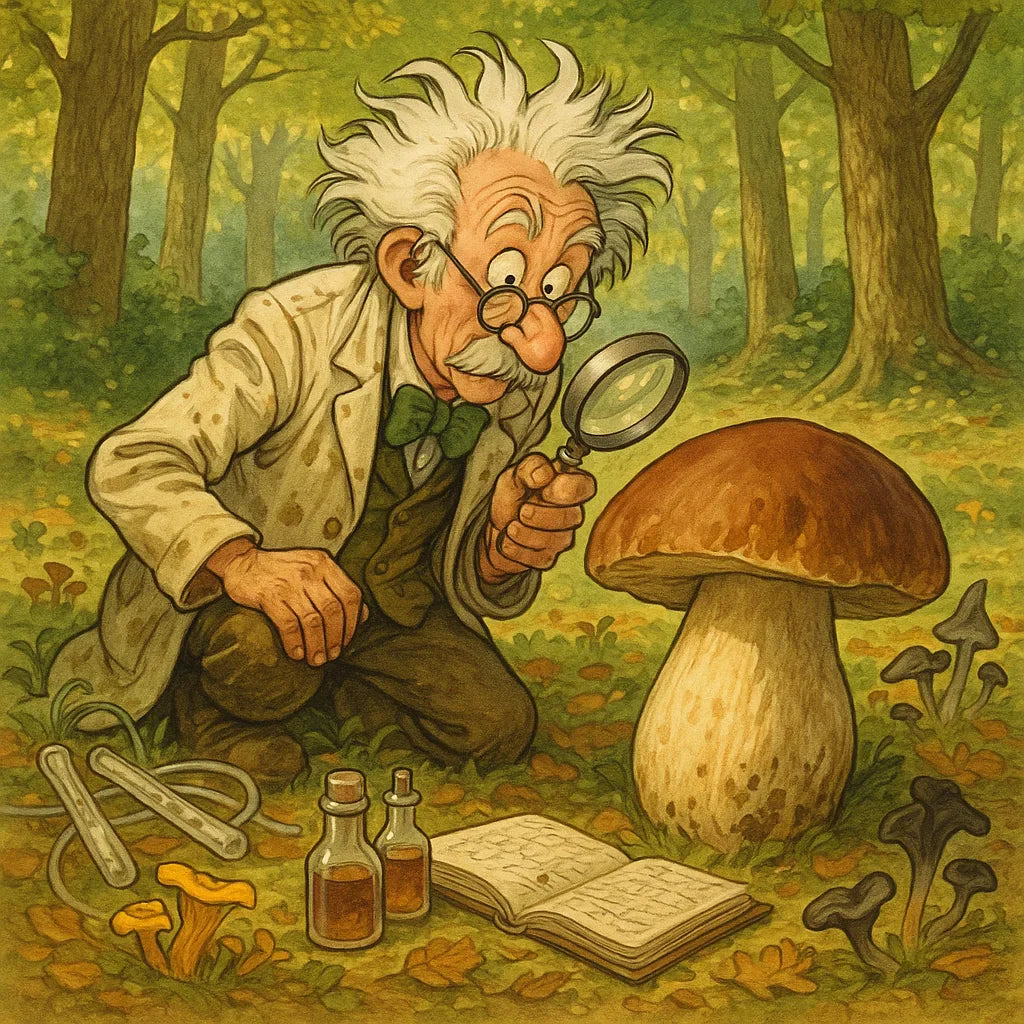
You have a copse, a deciduous hedge, a few trees at the back of your property, or a forest edge. This space, often left to itself, is the only place where forest mushrooms can grow—and it can become a sustainable harvesting area.
The approach is not cultivation but landscaping: you do not manufacture a substrate; you improve an environment and introduce a strain into it. This guide explains how to read your woodland understory, which species belong there, and how to proceed.
For details on high-value species—morels, truffles, and porcini—and their specific requirements, see Growing rare mushrooms at home. This article covers the woodland understory as a whole.
Reading your woodland understory before inoculating
Before buying anything, spend an hour beneath your trees. Four observations determine what is possible.
- Which tree species? This is the number-one criterion, because each mycorrhizal mushroom associates with specific trees. Oaks and beeches offer the most possibilities; conifers point toward other species; land planted with poplars or fruit trees will have different options.
- How old are the trees? Young trees, between two and ten years old, become mycorrhizal much more easily. An old oak has already been colonized by an established fungal community that will compete with your inoculated strain.
- What kind of soil? Do the vinegar test—put a few drops on a dry clod: if it foams, your soil is calcareous. This points toward certain species and rules out others. See The different types of soil.
- What is already growing? If mushrooms appear spontaneously beneath your trees in autumn, that is an excellent sign: the environment is functioning. Also look at what foragers in your area bring home—it is the most reliable indication of what can thrive where you live.
Which species for which tree
| Mushroom | Partner trees | Soil | Timeframe |
|---|---|---|---|
| Chanterelle (Cantharellus cibarius) | Oak, beech, chestnut, pine, spruce, birch | Acidic, humus-rich, moist, rather mossy | 4 to 7 years |
| Black trumpet mushroom (Craterellus cornucopioides) | Mostly beech, oak, hornbeam | Cool, shaded, rich in decomposed leaves | 3 to 6 years |
| Hedgehog mushroom (Hydnum repandum) | Broadleaf and coniferous trees, highly tolerant | Fairly adaptable, moss preferred | 3 to 5 years |
| Bordeaux porcini (Boletus edulis) | Oak, beech, chestnut, pine, spruce | Acidic to neutral, humus-rich | 3 to 6 years |
| Fairy ring mushroom (Marasmius oreades) | None — grows in meadows | Grassy, lightly trafficked, sunny | 1 to 2 years |
The hedgehog mushroom and fairy ring mushroom are the easiest to grow: the former because it is undemanding about its partner, and the latter because it requires no tree and fruits from the second year onward. They are good choices for a first attempt.
The chanterelle has a well-deserved reputation for being difficult: it requires acidic, cool soil with a well-established layer of moss and humus. In calcareous soil or dry terrain, there is no point trying.
Prepare the growing medium
This is the step most people skip, and it is the one that makes the difference. An understory poor in organic matter will not support mycelium, regardless of the quality of the strain.
- Rebuild the leaf litter. If the soil is bare or compacted, add dead leaves from broadleaf trees, chipped branches (BRF), or untreated sawdust. Spread a 5 to 10 cm layer without compacting it.
- Never turn the soil. The existing fungal network is your ally, not an obstacle. At most, lightly scratch the surface.
- Control herbaceous competition around the base of the trees by mowing rather than pulling it out.
- Check the moisture. Most of these species require a cool woodland understory. On dry land, a slight depression or a thick mulch layer helps retain water.
- Eliminate all treatments. No fungicides, chemical fertilizers, or weedkillers — even from a distance, drift is enough to compromise everything.
If your land is bare, plant trees first: oaks, beech trees, hazelnut trees, or birch trees. You will inoculate them three or four years later, once the roots are established. It is a long-term project, but a grove offers other benefits in the meantime.
Inoculate
The protocol for preparing liquid mycelium is identical to that used for our other strains, detailed in Successful cultivation from liquid mycelium: unchlorinated water, preservative-free syrup, and ten days of incubation at 20 °C.
For a woodland, a few adaptations:
- Inoculate in spring or autumn, when the soil is cool and moist. Avoid summer.
- Distribute it around several trees rather than concentrating it on one. Three or four points significantly increase the likelihood that at least one will take hold.
- Aim for the shallow root zone, 30–50 cm from the trunk, beneath the leaf litter after moving it aside and then putting it back in place.
- Water beforehand before pouring, and cover with leaves afterward.
- Mark the locations. In four years, you will not remember where you inoculated—and you may risk trampling the area.
Maintaining and harvesting
During the waiting years
- Replenish the leaf litter every autumn with leaves or wood chips.
- Water during prolonged droughts, especially during the first two years.
- Do not trample the inoculated areas—the compacted soil suffocates the mycelium.
- Be patient. Nothing visible happens for three to four years. This is normal.
When it starts producing
- Cut with a knife at ground level, or twist gently. Never pull it out with the soil: you would damage the mycelium that remains in place.
- Fill in the hole with leaf litter to prevent the exposed mycelium from drying out.
- Do not harvest everything. Leave some specimens to mature and release their spores.
- Record the dates. Over several years, you will identify the link between rainy periods and growth spurts—generally ten to fifteen days after late-summer rain followed by a drop in temperature.
The safety rule
One non-negotiable rule: never eat a mushroom unless you are absolutely certain of its identification. Having inoculated a strain does not guarantee that what grows afterward comes from it—your woodland may host other species, some of them toxic or deadly.
Two confusions ranked among the most dangerous:
- The chanterelle and the olive tree clitocybe, which is toxic, with true gills rather than thick folds.
- Edible young boletes and the Satan's bolete or certain bitter species.
If in doubt, have it checked by a pharmacist or a local mycological society. It is free, quick, and remains the only reliable method—photo-recognition apps are not.
Frequently asked questions
How many trees do you need?
Three or four are enough to try the experiment. The more there are, the better the chances that at least one inoculation point will take—and the more consistent the harvest will be afterward.
Can you inoculate beneath trees you did not plant?
Yes, if you own the land. Be aware that mature trees are already colonized by an established fungal community, which reduces the chances of success. On public or forest land, inoculation is not permitted without the owner’s or land manager’s consent.
Several species on the same plot?
Yes, but not on the same tree or in the same area—they would compete with one another. Space them about ten meters apart, and group those with the same soil requirements.
How can you tell whether the mycelium has become established?
Before fruiting, there is no reliable visible sign. You may sometimes see white filaments beneath the leaf litter when gently lifting the leaves—but they may belong to another species. The only confirmation is the first flush.
Do you need a large plot of land?
No. A few trees are enough, and fairy ring mushrooms only need a lawn that is not heavily trampled. However, without trees or grassland, these species are out of reach: opt for saprotrophs, which can be grown indoors.
Key points
Start with what you have: the tree species present and the nature of the soil determine the species, not the other way around. Rebuild the leaf litter before inoculating, spread it across several trees, and start with hedgehog mushrooms or fairy ring mushrooms if you want your first results within two or three years. And never consume anything without certain identification.
Taking it further
- Growing rare mushrooms: morels, truffles, and porcini
- How to grow mushrooms at home
- Everything you need to know about mycelium
- The foundations of living soil
Discover our mushroom and mycelium collection — chanterelles, black trumpets, hedgehog mushrooms, porcini, and fairy ring mushrooms.

Leave a comment
This site is protected by hCaptcha and the hCaptcha Privacy Policy and Terms of Service apply.