
In this article 8
Morels, truffles, and porcini are the most sought-after mushrooms—and the most difficult to cultivate. Not because they are temperamental, but because they do not function like oyster mushrooms: they do not decompose a substrate; they live in symbiosis with a tree.
This difference determines everything: it is not a matter of preparing a bag of straw but of establishing an ecosystem and giving it time to become established. This guide explains what it really requires, what you can hope for, and how to improve your chances.
If you are new to mushroom cultivation, start instead with a saprophytic species—see How to grow mushrooms at home. You will understand the complete cycle within a few weeks, which is valuable before embarking on a process that takes several years.
Mycorrhiza, or why it is different
A mycorrhizal fungus envelops and penetrates the rootlets of a living tree. The exchange is ongoing: the tree provides the sugars produced through photosynthesis, while the fungus provides the water and minerals it obtains from well beyond the root zone.
Three direct consequences:
- Without a partner tree, there is no fruiting. Never. No substrate or technique can replace the symbiosis—which is why these species still resist industrial production.
- The time frame is long. The mycelium must colonize the soil, encounter the roots, establish the symbiosis, and then accumulate enough reserves to fruit. Expect years, not months.
- But the establishment is long-lasting. Once established, a symbiosis produces for decades without requiring anything. This reverses the effort-to-result ratio compared with an oyster mushroom kit.
The three species, and what they require
Morels — the special case
Morels are not strictly mycorrhizal: they have an intermediate behavior, able to live saprophytically on organic matter while benefiting from the presence of nearby trees. This makes them more accessible than truffles, yet unpredictable.
- Blonde morel (Morchella esculenta) and conical morel (Morchella conica).
- Soil — sandy or loamy, well-drained, and rather calcareous. They thrive in disturbed soils, along riverbanks, in orchards, and in areas where ash or burned wood has been incorporated.
- Environment — light partial shade, beneath ash, elm, apple, or poplar trees.
- Inoculation — spring or autumn.
- Timeframe — typically 2 to 3 years, with spring fruiting, often in March–April.
- Distinctive feature — production is irregular from one year to the next, even at an established site. This is normal species behavior, not a failure.
Truffles — the long-term commitment
- Périgord black truffle (Tuber melanosporum) and summer white truffle (Tuber aestivum).
- Partner trees — holm oak, downy oak, hazel, lime, hornbeam. Hazel is the quickest to begin producing.
- Soil — this is the decisive criterion: calcareous, very well-drained, pH between 7.5 and 8.3. A truffle will not establish itself in acidic soil, whatever your efforts. Have your soil tested before investing.
- Exposure — bright and well-ventilated, without dense grass competition at the base of the tree.
- Timeframe — 5 to 10 years for the black truffle, often 4 to 7 for the summer white truffle, which is earlier and more tolerant.
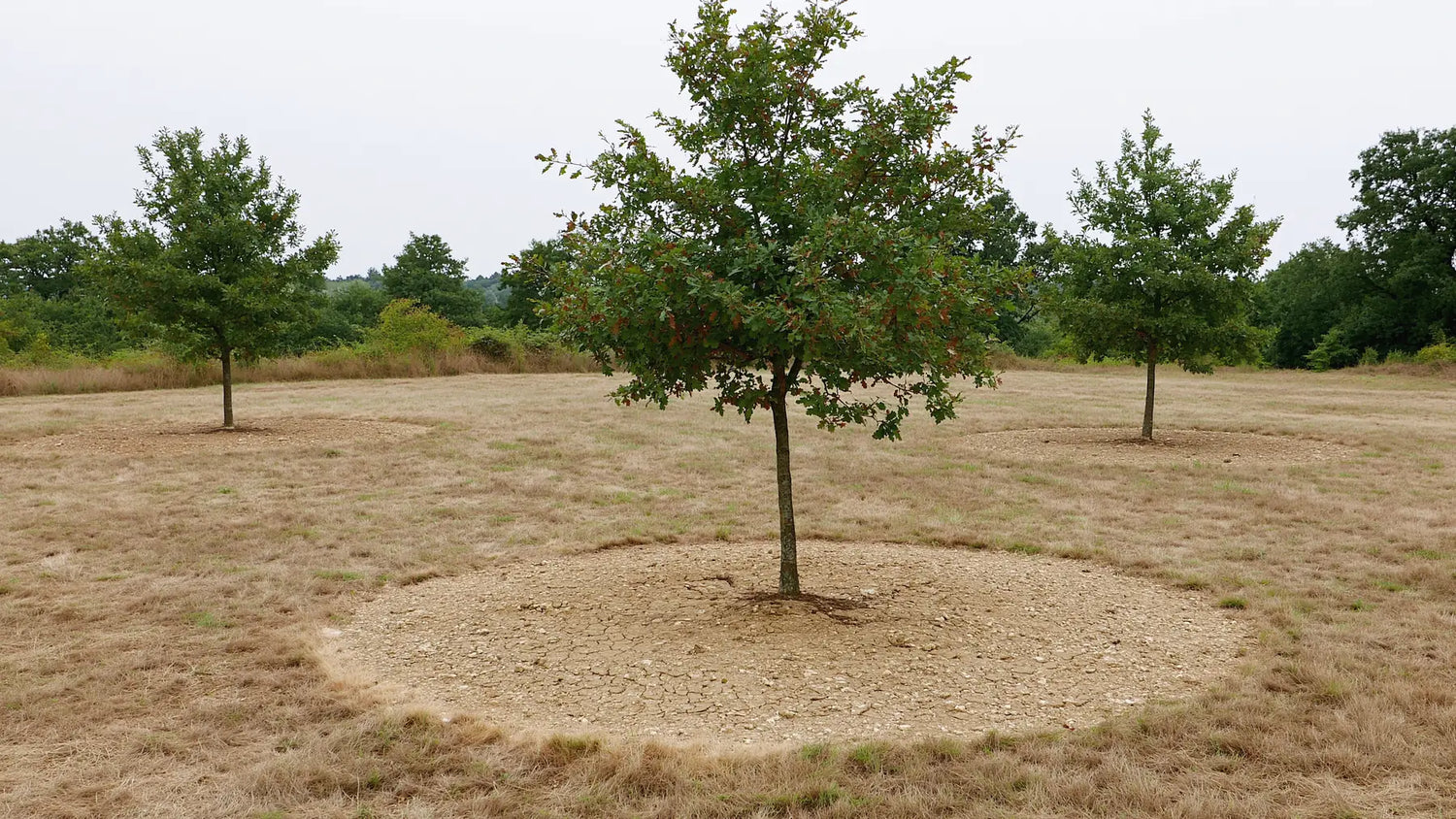
- Encouraging sign — the appearance of the burnt area, a zone where grass disappears around the tree. It generally precedes the first truffles by two to three years.
Bordeaux porcini
- Bordeaux porcini (Boletus edulis).
- Partner trees — oak, beech, chestnut, pine, spruce, birch.
- Soil — rather acidic to neutral, cool, and rich in forest humus. This is the exact opposite of the truffle's requirements.
- Timeframe — 3 to 6 years, fruiting from late summer to autumn, after rainfall.
- Critical condition — fruiting is triggered by a temperature shock: rainfall followed by a drop in temperature. This is why porcini appear in waves, ten to fifteen days after a late-summer rainy spell.
Note the incompatibility: truffles and porcini do not require the same soil. One requires alkaline soil, the other acidic soil. Choose according to what you have, not what you prefer — this is the costliest mistake in this article.
Inoculating: the method
The liquid mycelium protocol is the same as for our other strains — medium preparation, ten-day incubation, then inoculation. It is detailed in Successfully Growing from Liquid Mycelium.
What changes here is the inoculation site:
- Choose a young tree — young roots mycorrhize much more easily. A tree between two and five years old is ideal; an older tree is already colonized by other fungi that will compete.
- Clear the superficial root zone, 30–50 cm from the trunk, without damaging the roots. Lightly scratch the soil.
- Moisten the soil generously before pouring.
- Pour the mixture in several spots around the tree, not in a single place.
- Cover with dead leaves or forest humus to maintain moisture and darkness.
- Monitor moisture during the first few weeks, then during the first summer droughts of the first two years.
Strict prohibitions throughout the establishment period: chemical fertilizer, fungicide, tilling, and compaction from repeated passage. Any of these actions can ruin years of waiting.
Maintaining things while you wait
This is the most thankless part: for years, nothing visible happens. What you must do anyway:
- Water in the event of prolonged drought, especially during the first two years and for summer truffles—this is when the truffles harvested the following winter form.
- Do not use chemical weed killers. Mow, or let the brûlé form naturally.
- Maintain a light layer of leaves or mulch, without overdoing it: a layer that is too thick hinders fruiting.
- Protect against wild boar if you are in an affected area. They detect truffles long before you do.
- Record the inoculation date, species, tree, and observations. Over ten years, memory is not enough.
Let's speak frankly about the chances of success
These crops are not guaranteed, and no serious person should claim otherwise. Success depends on factors you can control only partly: the exact nature of the soil, the year's climate, competition from other fungi already present, and the tree's health.
What really increases your chances:
- Soil that is already suitable. This is by far the most important factor. Do not attempt truffles in acidic soil.
- Several inoculation points. Three or four trees rather than just one—the likelihood that at least one takes hold increases significantly.
- An already favorable environment. If the species grows naturally in your region, your chances are much better. Look at what local foragers bring back.
- Patience. Many people give up or rework the land in the third year, just before it starts to take hold.
Approach this as a ten-year garden project, just like an orchard. Not as a kit that will produce results in six weeks.
Summary table
| Species | Soil | Trees | Time frame | Season |
|---|---|---|---|---|
| Morel | Sandy, well-drained, rather calcareous | Ash, elm, apple, poplar | 2 to 3 years | Spring |
| Summer white truffle | Calcareous, well-drained | Oak, hazel, hornbeam | 4 to 7 years | Summer – autumn |
| Black truffle | Calcareous, well-drained, pH 7.5–8.3 | Holm oak, downy oak, hazel | 5 to 10 years | Winter |
| Bordeaux porcini | Acidic to neutral, humus-rich, moist | Oak, beech, chestnut, pine | 3 to 6 years | Late summer – autumn |
Frequently asked questions
Can these species be grown in pots or indoors?
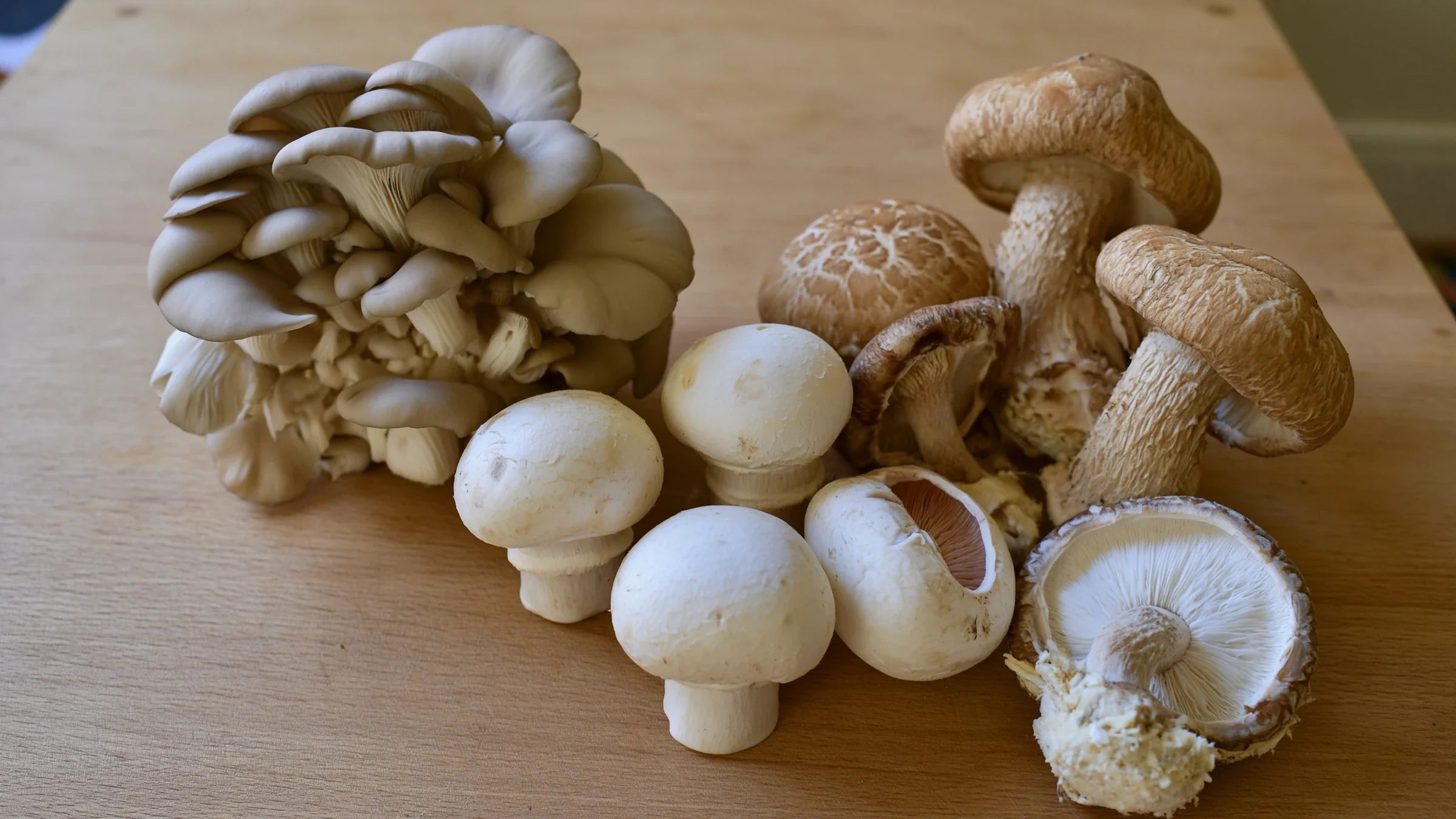
No. The symbiosis requires a living tree established in the ground, with a developed root system. If you do not have land, turn to saprophytes — oyster mushrooms, shiitakes, and button mushrooms — which can be grown indoors.
Should I buy trees that are already mycorrhized?
This is a different approach, more expensive and generally more reliable for truffles. Inoculating existing trees with mycelium costs much less and lets you try the experiment on land you already have — with a more variable success rate. Both approaches are valid depending on your budget and ambitions.
How can I tell whether my soil is calcareous?
Quick test: pour a few drops of white vinegar onto a clod of dry soil. If it fizzes, there is limestone. For truffles, this is not enough — a laboratory analysis is justified given the time commitment. See The different soil types.
How long before knowing whether it has failed?
Do not draw any conclusions before the upper end of the expected timeframe. For truffles, the appearance of the brûlé is the first reliable signal; if it is absent after six or seven years, the chances become low.
Can several species be inoculated on the same land?
Yes, but not on the same tree or in the same area: they would compete with each other. Leave at least about ten meters between them, and respect each species’ soil requirements.
Are morels really easier?
Relatively, yes: a shorter timeline, less demanding requirements, and tolerance for disturbed soils. But their production remains irregular from one year to the next — that is the trade-off.
Key takeaway
These mushrooms are not cultivated; they become established. The soil determines everything — limestone for truffles, acidic soil for porcini — and the timeline is measured in years. Start with morels if you want a first result, inoculate several trees rather than just one, and consider this a long-term land project. Once established, a symbiosis can produce for decades.
Going further
- How to grow mushrooms at home
- Growing forest mushrooms: porcini, chanterelles, and black trumpet mushrooms
- Everything you need to know about mycelium
- The basics of living soil
Discover our mushroom and mycelium collection — morels, truffles, porcini, and easy species for beginners.

Leave a comment
This site is protected by hCaptcha and the hCaptcha Privacy Policy and Terms of Service apply.