

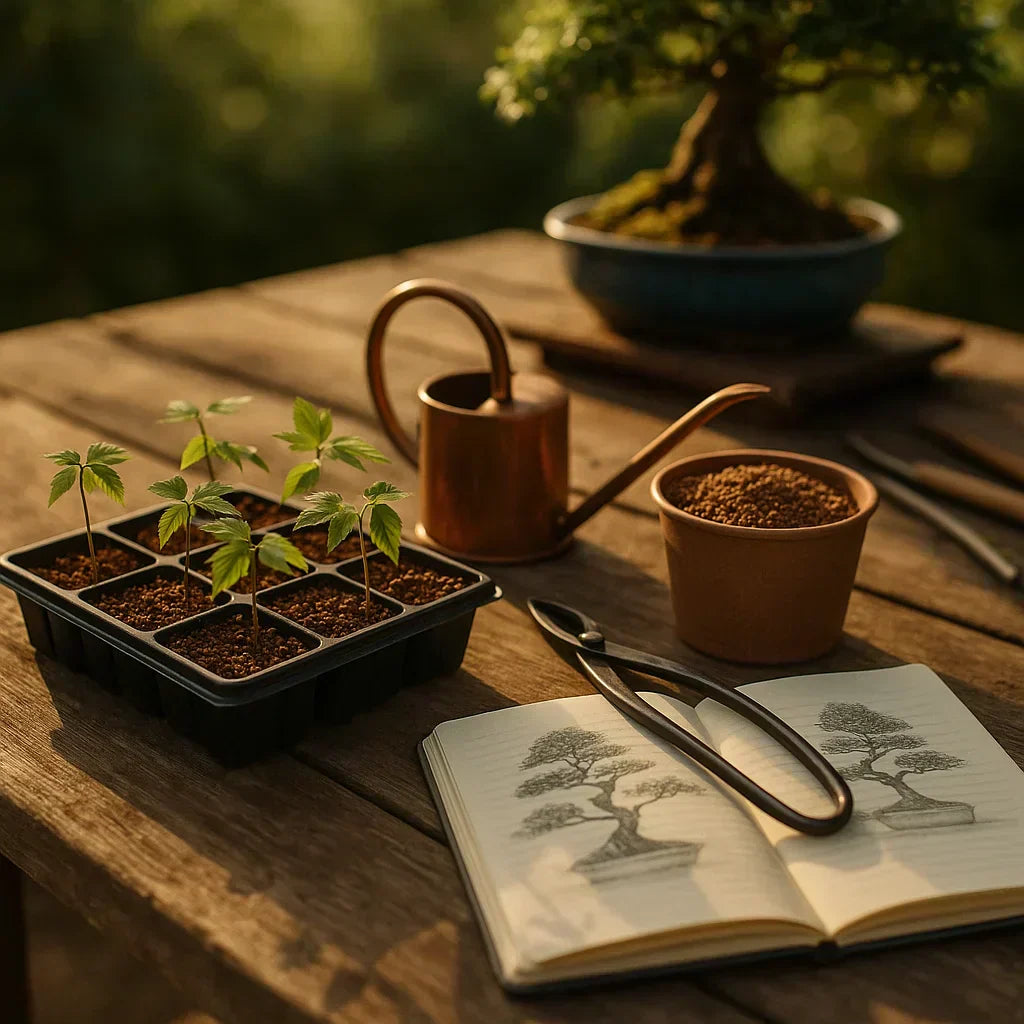
A bonsai is not a dwarf species. It is an ordinary tree — the same tree that would reach twenty meters in a forest — kept small through continuous work on its roots and branches. What miniaturizes it is constraint, not genetics.
Starting from a seed rather than an already trained specimen changes everything: you control the shape from day one, the cost is negligible, and the tree adapts to your conditions from germination onward. In return, you must accept a timeline measured in years.
Choosing a species
The key factor is not the appearance of the mature tree but the size of its leaves: they become smaller with training, but never enough to make naturally large foliage look proportionate.
Reliable choices for beginners
- Japanese maple (Acer palmatum) — the great classic. Delicate foliage, spectacular autumn colors, and abundant branching. Requires cold stratification for 8 to 12 weeks.
- Japanese privet (Ligustrum japonicum) — probably the most tolerant of all. Fast-growing, and tolerant of pruning and watering mistakes. The best choice for a first attempt.
- Wild olive (Olea europaea sylvestris) — small leaves, a trunk that quickly develops character, and drought tolerance. Excellent in mild climates.
- Barberry (Berberis vulgaris) — hardy, small foliage, interesting bark.
To learn more
- Aleppo pine and Atlas cedar — conifers require a different technique (pinching rather than pruning), but produce the most evocative silhouettes.
- Italian cypress and bald cypress — the latter tolerates waterlogged soil remarkably well, which is rare.
- Ginkgo biloba — unique foliage, turning golden yellow in autumn. Difficult to densify its branching: this is a bonsai best trained in a simple upright style.
- Chinese redbud — spectacular pink blooms on old wood. Seeds should be scarified before stratification.
- Pomegranate — small leaves, bright red flowers, and miniature fruit. One of the most accessible fruiting bonsai.
- Albizia, jacaranda, royal poinciana — tropical species to grow indoors, with very fine compound foliage.
Avoid at the beginning: large-leaved species (magnolia, persimmon, guava) and those with very long germination times. They are still interesting, but not for a first bonsai.
Step 1 — germination
This is where most attempts fail, and almost always for the same reason: dormancy has not been broken.
- Cold stratification — essential for most temperate species: maple, pine, cedar, rosehip, Chinese redbud. Allow 4 to 12 weeks at 1 to 5 °C in a moist substrate. The complete method is in Cold stratification.
- Scarification — for hard-coated seeds: Chinese redbud, albizia, royal poinciana. Lightly file them or soak them for 24 hours in lukewarm water.
- Constant warmth — for tropical species: jacaranda, royal poinciana, guava. At least 25 °C.
Sow in deep pots, not shallow trays: these species develop a taproot within the first few weeks, and a shallow container will make it spiral permanently. Use a well-draining substrate — seed-starting mix lightened with one-third sand or perlite.
Germination is often irregular and spread over several weeks. Never throw away a pot after one month: some species germinate in their second spring.
Step 2 — letting it grow thicker (years 1 to 3)
This is the most common mistake: trying to miniaturize the tree right away. In reality, a thick trunk can only be achieved by allowing the tree to grow freely. A plant restricted from its first year will remain a twig for life.
During these three years:
- Grow it in a generous pot, or even in the ground — this produces the finest trunks by far.
- Let the shoots grow freely. You can cut them back later; each leaf contributes to thickening.
- One useful intervention: at the end of the first year, cut the taproot during the first repotting. This forces the development of fine lateral roots, the foundation of the future nebari — the visible root spread at the surface, which makes the tree look anchored.
- Outdoors for all temperate species, including in winter. A maple kept in an apartment will decline — it needs its dormant period.
Step 3 — shaping (from year 3 onward)
Once the trunk has reached the desired thickness, the work changes: reduce and structure.
Structural pruning
At the end of winter, when there is no frost, before bud break. Remove anything that conflicts with the desired silhouette: crossing branches, branches parallel to the trunk, shoots growing inward, and one of two branches emerging from the same point.
Maintenance pruning
During the growing season, let a shoot develop five or six leaves, then cut it back to two. Repeated, this practice densifies the branching and gradually reduces leaf size. It is what makes a bonsai, more than anything else.
Wiring
Aluminum wire wrapped in a 45° spiral, without tightening it. It guides branches and the trunk while the wood lignifies. Check every month: forgotten wire permanently marks the bark. Remove it by cutting it, never by unwinding it.
Repotting
Every two or three years for a young tree, at the end of winter. Loosen the root ball, prune one-third of the roots, and replant in a well-draining substrate. This repeated root pruning keeps the tree small — and forces it to produce the fine feeder roots it depends on.
Routine care
- Watering — this is the critical point. A bonsai pot is shallow and dries out quickly: in summer, often once a day. Water until it runs out through the drainage holes, then let the top centimeter dry before watering again.
- Substrate — very well-draining, never potting soil alone. Use a mix of akadama, pumice, and bark, or, failing that, potting soil lightened with half coarse sand and pumice.
- Fertilizer — little and often, during the growing season only. A well-draining substrate retains little: small, regular applications are better than one heavy dose.
- Exposure — outdoors for temperate species, with protection for the pot in case of severe frost: roots freeze much faster in a pot than in the ground.
- Do not bring a temperate tree indoors in winter. This is the mistake that kills the most gifted bonsai trees.
The actual timeline
| Period | What happens |
|---|---|
| Year 0 | Stratification followed by sowing. Irregular germination |
| Year 1 | Unrestricted growth. First repotting at the end of the year, with taproot pruning |
| Years 2–3 | Unrestricted growth to thicken the trunk. No shaping |
| Years 3–5 | First structural pruning, beginning of wiring |
| Years 5–10 | Refining the branching, reducing the foliage, moving into a bonsai pot |
| Beyond | Care, and the tree continues to improve for decades |
Let's be clear: a bonsai grown from seed takes five to ten years to look like something. If you want quick results, buy an already-trained specimen. If you want a long-term project and a tree that will be entirely your own, sow the seeds.
Frequently asked questions
Can you make a bonsai from any species?
Technically, almost, but not all species produce a harmonious result. Large-leaved species remain disproportionate, even after years of defoliation. Choose small foliage from the outset.
Do you need an indoor or outdoor bonsai?
Nearly all temperate species are outdoor trees: they need winter cold. Only tropical species — jacaranda, flamboyant, guava, neem — can be grown indoors, and they require plenty of light there.
Why aren't my seeds germinating?
Nine times out of ten, dormancy has not been broken. Check whether the species requires stratification, scarification, or both. Only then should you investigate the temperature and freshness of the batch.
When should you move it into a bonsai pot?
Not before the trunk has reached the desired thickness — generally in year five or later. A shallow pot considerably slows thickening: it is an end result, not a starting point.
Can you collect seeds from a tree in the garden?
Yes, and it is an excellent way to begin: maple, hornbeam, elm, dog rose. Harvest when ripe, then sow or stratify promptly. See How to store your seeds.
How many seeds should you sow?
Several, systematically. The germination rate of these species is often low, and above all: out of ten seedlings, two or three will have an interesting form or trunk movement. Selection is part of the work.
Key takeaway
First break dormancy, then let the tree grow freely for three years — advice that goes against intuition and makes all the difference. Miniaturization comes later, through repeated pruning and repotting. Start with Japanese privet or maple, sow several seeds, and accept the timeline: it is a ten-year project, and that is what makes it worthwhile.
To learn more
- Cold stratification: why and how to germinate seeds?
- How to sow your seeds in cotton, pots, or directly in the ground
- Rare and unusual seeds to grow at home
- How to store your seeds from one year to the next
Discover our collection of trees, shrubs, and bonsai — species requiring stratification are indicated on each product page.


Leave a comment
This site is protected by hCaptcha and the hCaptcha Privacy Policy and Terms of Service apply.