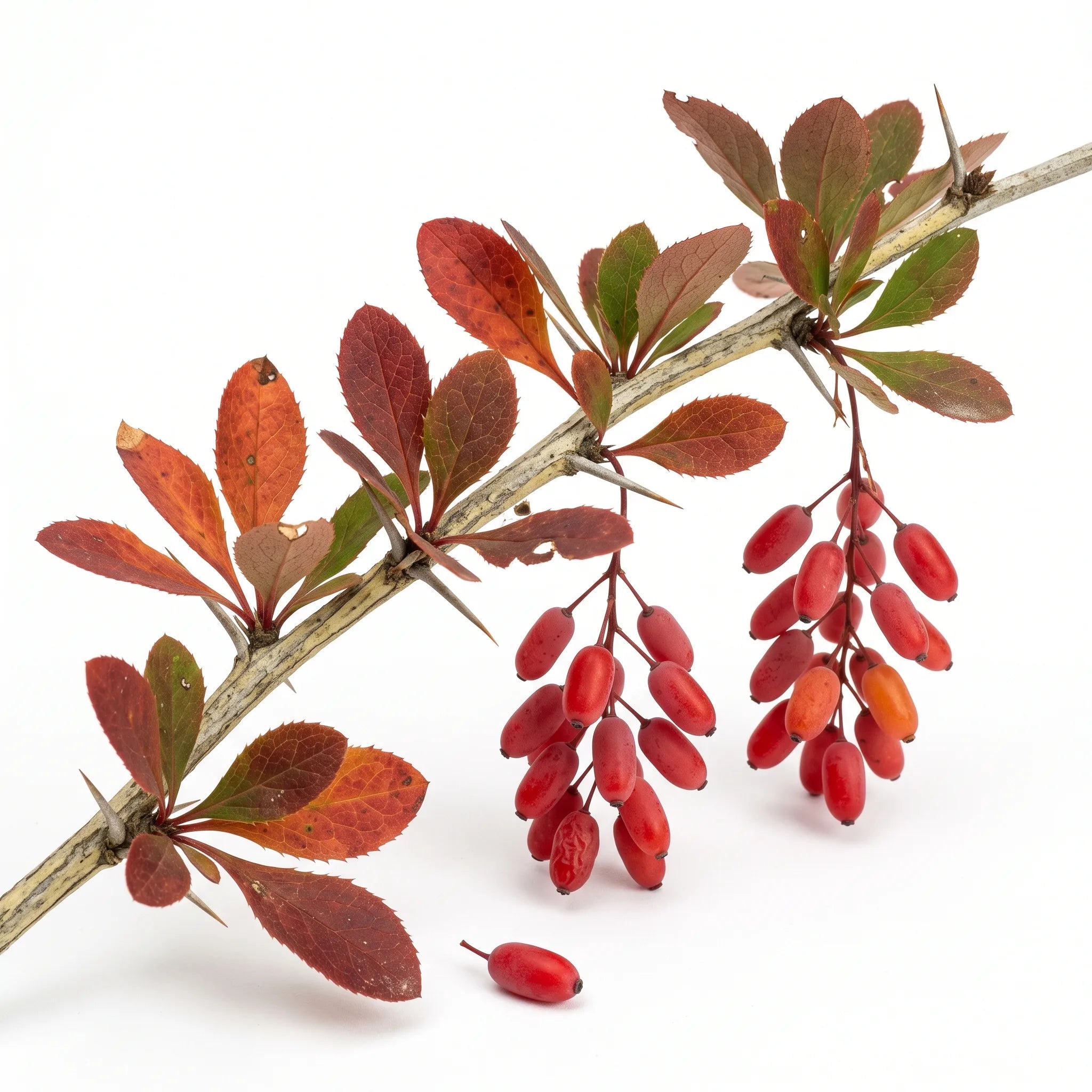
Berberis vulgaris subsp. hispanica
Barberry, common barberry, Spanish barberry: its elongated, very tart red berries were once the basis of a sought-after jam and a refreshing syrup. In Iran, this same dried fruit (known as zereshk) still flavors one of the country’s national dishes today: rice with barberries.
Characteristics:
-
Thorny shrub: branches armed with three-pronged thorns, forming a dense, defensive thicket.
-
Dual ornamental appeal: clusters of yellow flowers in spring, followed by bright red berries in autumn, against foliage that turns red.
-
Very hardy: it withstands harsh winters without protection and tolerates pruning well.
Precautions:
- Its three-pronged thorns are sharp: wear thick gloves when pruning and harvesting, and avoid planting it beside a narrow path.
- Only ripe berries are edible; the bark and roots contain alkaloids and must not be ingested.
-
Important point for cereal-growing areas: barberry is the intermediate host of wheat stem rust. Avoid planting it in the immediate vicinity of cereal fields.
Sowing advice:
-
Exposure: full sun or partial shade.
-
Soil: light to calcareous, well-drained, even poor and stony. Once established, it tolerates drought remarkably well and is particularly sensitive to stagnant moisture. No fertilization needed.
-
Method: 2 to 3 months of cold stratification in the refrigerator is necessary to break dormancy. Then sow in autumn or spring, in pots or directly in the ground.
Care advice:
- Water moderately during the first few years; the shrub then becomes self-sufficient. It tolerates pruning very well, which should be carried out in late winter while wearing gloves.
Harvesting advice:
- Harvest the fully red berries after the first frosts: the cold tempers their acidity. They dry very well and can then be stored for months.
Beneficial associations:
Benefits for biodiversity:
- Its thorny thicket provides small songbirds with an impregnable nesting refuge, protected from predators.
- Its spring flowering is highly attractive to bees, and its berries feed blackbirds and thrushes throughout winter.
- Its stamens have a remarkable sensitive mechanism: when touched by an insect, they suddenly fold toward the pistil, dusting it with pollen.
Uses:
- Tart berries for jams, syrups, jellies, or drying in the style of Persian zereshk. In permaculture: defensive hedge, forest garden edge, biodiversity refuge.
- Traditional medicinal plant. See our medicinal plants to sow.
Symbolism:
A protective plant of country hedges, barberry symbolizes defense and resilience—a shrub that provides both thorns and fruit.
Harvesting your own seeds:
Crush a few fully ripe berries in a little water, rinse to separate the seeds from the pulp, then dry them before winter stratification. See saving your seeds.
Commitment to Quality: at SemiSauvage - Permaculture, we grow and select our seeds with respect for all living things as our guiding principle. Based near the Auvergne Volcanoes, we choose open-pollinated, non-hybrid varieties, tested for their germination rate, carefully sorted and packaged, with no chemical treatment whatsoever. Our conviction: to give gardeners back the ability to resow, year after year, seeds that truly belong to them.
Plant a hedge that is both defensive and nourishing with these barberry seeds.