

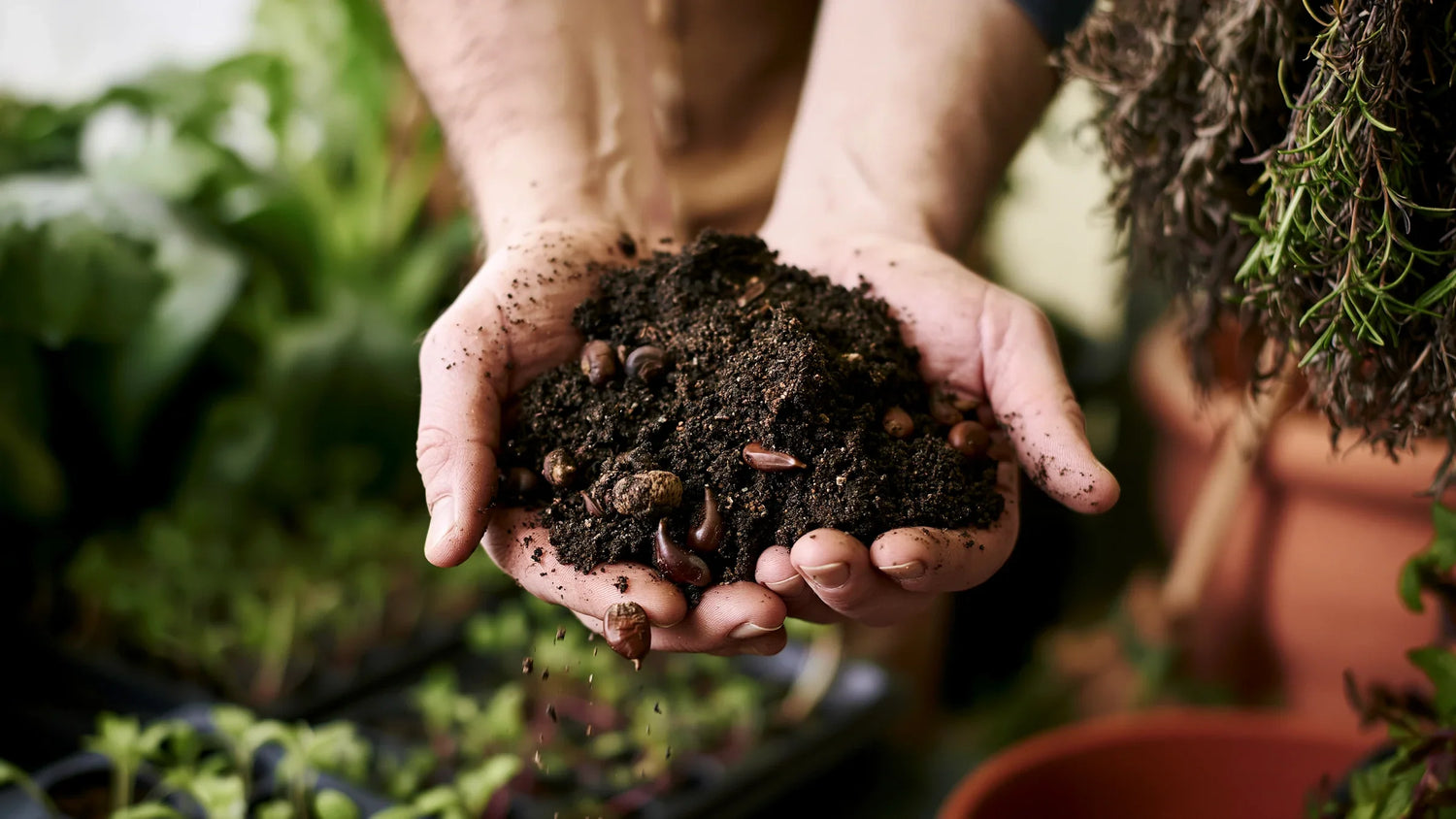
You sow plum pits, acorns, lavender seeds, or gentian seeds. Nothing emerges. Yet the batch is not dead: it is waiting for a signal it has not received. These seeds are in dormancy, and only a period of cold, moist conditions can end it.
It is not a botanical whim, but a survival mechanism. This guide explains what happens inside the seed, how to reproduce winter in practice, and how long it takes depending on the species.
Why some seeds refuse to germinate
A seed that falls to the ground in September faces a problem: if it germinates immediately, the seedling will face winter and die. Temperate-region species have therefore developed a lock: they cannot germinate until they have gone through a winter. This ensures that emergence takes place in spring, with the entire growing season ahead.

In practical terms, the embryo is kept dormant by chemical inhibitors, mainly abscisic acid. Prolonged exposure to cold, moist conditions gradually breaks down these inhibitors and increases the hormones that trigger germination, the gibberellins. When the balance shifts, the seed becomes capable of germinating as soon as the temperature rises.
Cold alone is not enough. You need cold and moisture. A packet of seeds forgotten in the freezer, dry, will not be stratified — it will simply be stored. This is the most common misconception about the subject.
Other forms of dormancy
Physiological dormancy ended by cold is not the only type. Two other cases occur, sometimes in combination:
- Physical dormancy — an impermeable seed coat prevents water from entering. It is overcome through scarification: rubbing the seed with sandpaper, lightly nicking it, or soaking it for 24 hours in lukewarm water. Typical examples include black locust, broom, morning glory, nasturtium, and Judas tree.
- Double dormancy — it first requires a warm period, followed by a cold period. This is the case with hawthorn, ash, yew, and Solomon's seal. These species may require two winters before dormancy ends, which discourages many people — even though the batch is perfectly viable.
The parameters that matter
- The temperature — between 1 and 5 °C is the effective range. Below 0 °C, biochemical processes stop: freezing does not stratify the seeds; it puts them on hold. Above 8 °C, dormancy does not end either. The vegetable drawer of a refrigerator is exactly within the right range.
- Moisture—the substrate should be as damp as a wrung-out sponge, never waterlogged. Too much water deprives the seed of oxygen and causes it to rot.
- Oxygen—the seed respires throughout stratification. That is why you should never use an airtight container without ventilation.
- Duration—from 3 weeks to 6 months, depending on the species. This is the most variable parameter and the one to check before beginning.
Method 1: refrigerator stratification
The most reliable, the most controllable, and the only possible option if you want to sow in spring seeds received in February.

- Rehydrate the seeds for 12 to 24 hours in room-temperature water. Discard those that are still floating after soaking.
- Prepare the substrate—river sand, vermiculite, peat, or plain paper towel. Moisten it, then wring it out by hand: it should not drip.
- Mix the seeds with the substrate, approximately one part seeds to three parts substrate.
- Place in a zip bag or container, punctured with a few holes for ventilation.
- Label with the species and the date placed in cold storage—you will not remember four months from now.
- Store in the vegetable drawer, between 1 and 5 °C.
- Check every two weeks: remove any mold, maintain moisture, and above all watch for early germination. Some seeds germinate in the refrigerator before the planned period is over: sow them immediately; do not let them become etiolated in the bag.


When they emerge, sow immediately and without thermal shock: first move them to a cool room for a few days before exposing them to warmth. A stratified seed moved back and forth between warmth and cold may enter secondary dormancy again—and you will have to start all over.
Method 2: natural stratification outdoors
Simpler, free, and often more effective for species with long or double dormancy—because the natural alternation of freezing and thawing also works on the seed coat.

- Sow in autumn, from October to December, in pots or a seed tray filled with well-draining potting soil.
- Put them outside, against a north-facing wall, protected from direct sunlight and drying winds.
- Protect them from rodents — this is the main risk. Place fine-mesh wire over them, or use an improvised cage. Mice and squirrels can locate acorns and stones within a few days.
- Let the rain do the work — just check that the medium does not dry out during rainless periods.
- Wait until spring. And if nothing emerges, don't throw them away: species with double dormancy will emerge in the second spring.
This is also the method we recommend for trees, shrubs, and bonsai: it exactly replicates what happens in the forest.
How long, depending on the species
Indicative durations for moist cold stratification, between 1 and 5°C.
| Duration | Species |
|---|---|
| 3 to 4 weeks | Lavender, thyme, clary sage, yarrow, primrose |
| 4 to 8 weeks | Pine, spruce, larch, bellflower, columbine, delphinium |
| 8 to 12 weeks | Oak, beech, chestnut, maple, linden, gentian, hellebore |
| 3 to 4 months | Apple, pear, plum, cherry, peach, almond, medlar |
| Double dormancy (2 winters) | Hawthorn, ash, yew, Solomon's seal, some species of wild rose |
| Scarification followed by cold | Black locust, broom, honey locust, California lilac |
These durations vary depending on the batch's origin and harvest year. When in doubt, extend rather than shorten the period: stratification that is too long has no adverse effects, while stratification that is too short will not break dormancy.
Common problems

| Symptom | Cause | Correction |
|---|---|---|
| White mold in the bag | Medium too wet, insufficient aeration | Remove affected seeds, rinse the others, prepare a drier medium, and make more holes |
| Seeds germinated too early | Dormancy ended earlier than expected | Sow them immediately; that is a good sign |
| No emergence after stratification | Insufficient duration, or double dormancy | Put them back in the cold, or wait until the following spring |
| Soft, brown seeds | Rot caused by excess water | Batch lost; reduce moisture next time |
| Missing seeds (outdoor sowing) | Rodents | Fine-mesh wire from the moment of planting |
After stratification

- Sow in deep pots — most of these species develop a taproot within the first few weeks. A shallow pot makes it spiral, and the tree will bear the mark.
- Well-draining substrate — seed-starting mix lightened with sand or perlite.
- Patience during germination — it is often irregular and spread over several weeks. Do not throw away a pot because only one seed has sprouted.
- Do not repot too early — wait until the second year for trees, when the root system is established.
Frequently asked questions
Does the freezer work?
No. Below 0°C, the biochemical reactions that break dormancy stop. Worse, freezing can damage a rehydrated seed through crystal formation. The refrigerator, between 1 and 5°C, is the appropriate tool.
Can vegetable seeds be stratified?
This is unnecessary in the vast majority of cases: annual vegetables do not have cold dormancy. Stratification mainly concerns trees, shrubs, perennials, and certain woody herbs.
How long does a seed remain stratified?
Sow promptly after removing them from the cold. A stratified seed that is then returned to dry, warm conditions may enter secondary dormancy, which is more difficult to break than the first.
Do pits from store-bought fruit need stratification?
Yes, they have the same dormancy. But be aware that store-bought fruit almost always comes from grafted trees: sowing will produce a seedling tree, with fruit different from that of the parent, often mediocre. The experiment remains fascinating, and the resulting tree will make an excellent rootstock.
How can you tell whether a seed needs stratification?
General rule: if the species originates from a region with a pronounced winter and its seeds ripen in autumn, there is a strong chance. The details are provided on our packets, and the species concerned are listed among our trees and shrubs.
Key points
Cold and damp, between 1 and 5°C, for a period specific to each species. If you are not constrained by a schedule, sow outdoors in autumn and let winter do the work — it is the simplest method, and the one nature uses. Above all: never throw away a pot that has not sprouted by the first spring.
Going further
- How to sow your seeds in cotton, pots, or directly in the ground
- How to store your seeds from one year to the next
- The month-by-month sowing calendar
- Growing a bonsai from a seed
Discover our tree, shrub, and bonsai seeds and our perennial plants — species requiring stratification are indicated on each product page.

Jätä kommentti
Tämä sivu on suojattu hCaptcha-tunnistuksella, ja hCaptchan tietosuojakäytäntöjä ja käyttöehtoja sovelletaan.