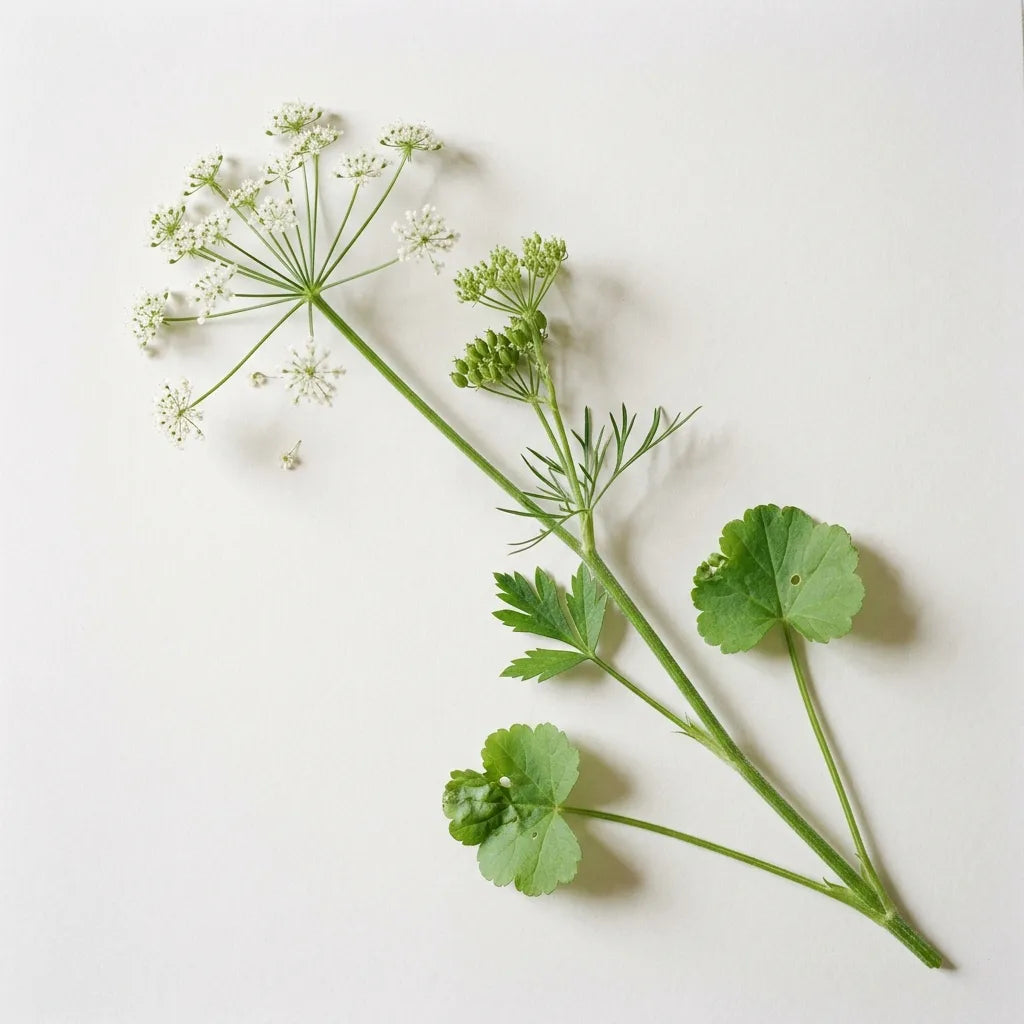
Pimpinella anisum
Green anise, official anise, anise pimpinella: this is the original anise, the one used in gingerbread and anisette, not to be confused with star anise (Illicium verum) or fennel. Cultivated since ancient Egypt, it is one of the oldest spices of the Mediterranean basin.
Characteristics:
-
Distinct anise flavor: its seeds flavor pastries, breads, and infusions.
-
Usable leaves: the young leaves also flavor raw vegetables and salads.
-
Small annual: 40 to 60 cm tall, with decorative white umbels.
-
Short growing cycle: about four months from sowing to seed harvest.
Sowing advice:
-
Exposure: sunny and warm — essential for the seeds to reach maturity.
-
Soil: light, warm, humus-rich, and well drained. It does not appreciate heavy soil or standing moisture.
-
Method: sow from March to May, once the risk of frost has passed, directly in the ground — its taproot does not tolerate transplanting well. Sow 1 cm deep. See how to sow your seeds.
Care advice:
- Thin to 20 cm apart. Water moderately during growth, reducing watering as the seeds form.
- Hoe regularly, as its delicate foliage does not tolerate competition from weeds well.
Harvesting advice:
- Pick the young leaves as needed. For the seeds, cut the umbels when they turn brown, before the seeds fall, and dry them upside down in a paper bag.
- In cool climates, seed maturation may be incomplete: choose a very warm location, against a south-facing wall.
Beneficial companion planting:
Benefits for biodiversity:
- Its white umbels are true landing platforms for hoverflies and beneficial micro-wasps, whose larvae devour aphids.
- Like all umbellifers, it is a host plant for Swallowtail caterpillars.
Uses:
- Seeds in gingerbread, biscuits, breads, confectionery, and infusions; they also traditionally flavor pastis, ouzo, and anisette. Finely chopped young leaves can be sprinkled over raw vegetables.
- A traditional medicinal plant, used in herbal medicine since antiquity. See our medicinal plants to sow.
Harvesting your own seeds:
This is the harvest itself: keep some for cooking and some for the next sowing. Let a few umbels ripen completely and dry them in a sheltered place. See how to store your seeds.
Commitment to Quality: at SemiSauvage - Permaculture, we grow and select our seeds with respect for living things as our guiding principle. Based near the Volcanoes of Auvergne, we choose reproducible, non-hybrid varieties, tested for their germination rate, carefully sorted and packaged, without any chemical treatment. Our conviction: to give gardeners back the ability to resow, year after year, seeds that truly belong to them.
The gingerbread spice, grown in your own garden.