

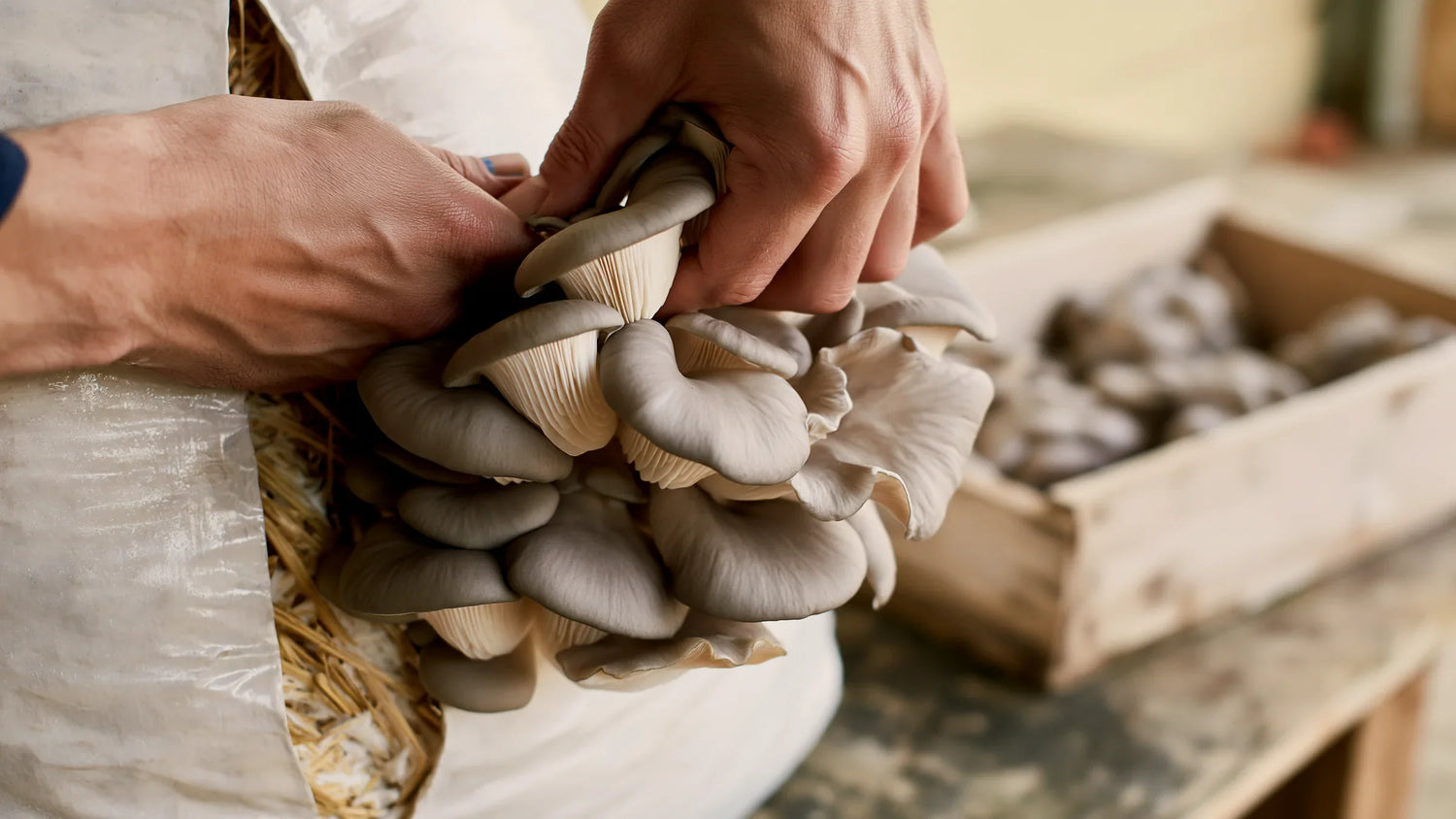
What is commonly called a “mushroom” is actually the fruiting body: the reproductive organ, equivalent to an apple on an apple tree. The organism itself is the mycelium, a network of white filaments that colonizes the substrate, feeds on it, and sometimes lives there for years.
Mycelium is therefore what we buy, preserve, and establish. Understanding what it is, the forms it takes, and what kills it prevents most failures.
What mycelium is
Mycelium consists of hyphae: microscopic filaments that lengthen at their tips, branch, and fuse together. As they spread, they secrete enzymes that break down the surrounding material and absorb the released nutrients.

Two implications that explain almost the entire process of growing:
- It is a living organism, not a seed. It breathes continuously, does not go dormant, and cannot tolerate complete desiccation or freezing. A seed forgotten in a drawer for three years may still germinate; mycelium will not.
- It fruits in response to a signal, not maturity. The transition to fruiting is triggered by a change in conditions—light, fresh air, humidity, or a drop in temperature. A perfectly established mycelium may never produce if this signal does not occur.
The conditions for colonization and fruiting are opposite. Darkness, warmth, and little air for colonization; indirect light, cool temperatures, and ventilation for fruiting. This explains why most substrates that are perfectly white never produce anything.
Available forms
| Form | Principle | What it enables |
|---|---|---|
| Colonized substrate block | Substrate already colonized, ready to fruit | Quick results, but one to three flushes followed by exhaustion |
| Mycelium on grain | Grown on rye, millet, or corn | Inoculate your own substrates. Requires strict cleanliness |
| Liquid mycelium | Live strain in sterile suspension | Long-term establishment in an ecosystem, rather than a single harvest. This is the form we offer |
| Spores | The fungal equivalent of seeds | For experimenters only: random genetics, high risk of contamination |
The fundamental difference between a block and liquid mycelium is not a matter of ease but of purpose: the former produces and then becomes exhausted, while the latter establishes itself. A properly inoculated log or woodland floor will produce for years.
Preserve your mycelium
This is the most frequently asked question, and the most misunderstood: mycelium is alive, so it ages.
- In the refrigerator, between 2 and 6 °C, in its original packaging and protected from light. Cold slows its metabolism without stopping it.
- Do not let it dry out. Unlike a seed, it does not survive desiccation.
- Realistic shelf life — a few weeks to three months for fresh grain spawn or a block, and longer for properly stored liquid mycelium. In all cases, the sooner you use it, the greater its vigor.
- Do not leave it in a car or near a heat source — above 35 °C, most strains weaken quickly.
Ice crystals rupture cell walls: the mycelium loses its vigor, often permanently. Freezer preservation exists in laboratories, but it requires cryoprotectants and specialized equipment.
How to tell whether it is still good
- Good sign — bright white or slightly cream-colored, with an earthy or fresh mushroom smell and a cottony or filamentous appearance.
- Bad sign — green, black, or pinkish spots, a sour or rotten smell, or a slimy appearance. These are contaminations: the batch is lost.
- Neutral sign — a yellowish tint or amber droplets on the surface of grain mycelium are common and generally harmless.
Varieties, ranked by accessibility
For beginners — saprophytes
They decompose dead organic matter: no partner tree is needed, cultivation is possible indoors, and the first harvests come within a few weeks to a few months.
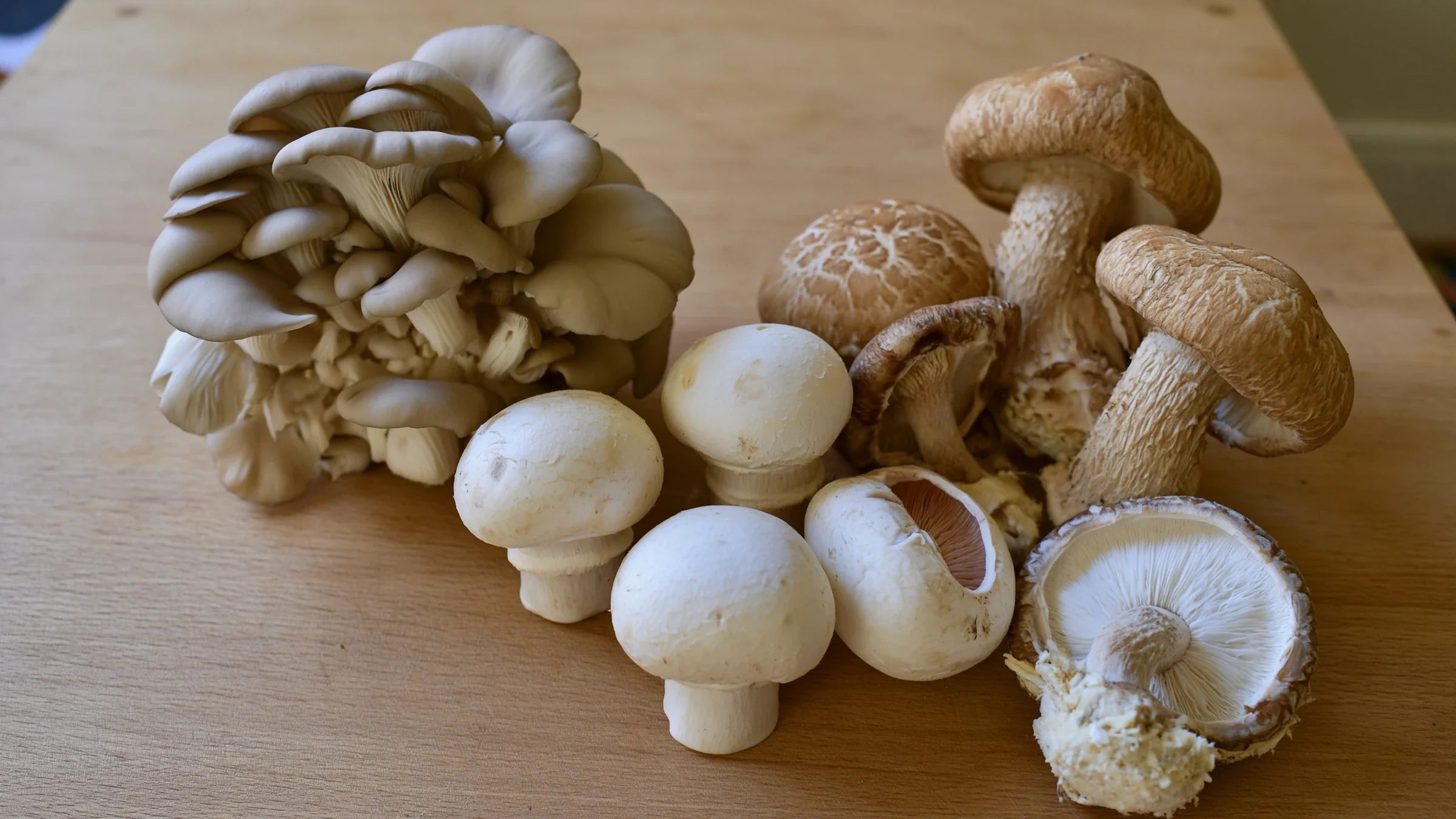
- Oyster mushroom — the gateway variety. Tolerant and fast-growing, it grows on straw, cardboard, coffee grounds, or logs.
- Shiitake — on oak or beech logs. Slower, but a log produces for several years.
- Button mushroom and its brown variety — on pasteurized compost, in complete darkness.
- Wood ear mushroom — highly productive on wood, excellent when dried.
 In our shop
Oyster mushroom mycelium (Pleurotus ostreatus)
In our shop
Oyster mushroom mycelium (Pleurotus ostreatus)
Intermediate
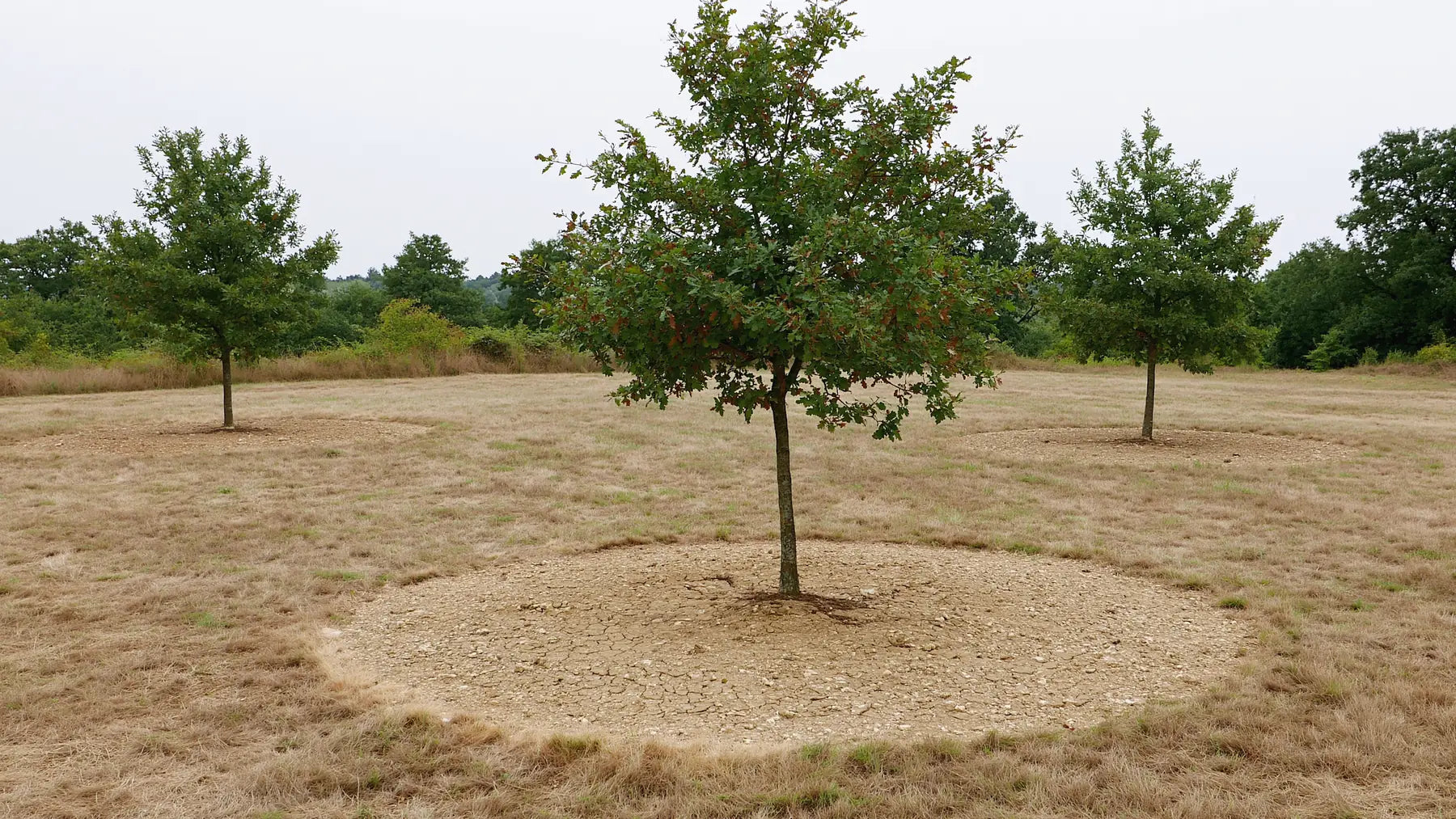
The fairy ring mushroom needs no tree: a lightly trampled meadow or clearing is enough, and it fruits from the first or second year. It is the best compromise between ease and outdoor cultivation.
For a long-term project — mycorrhizal species
They live in symbiosis with living trees and cannot fruit without a plant partner: chanterelles, black trumpets, hedgehog mushrooms, Bordeaux porcini, morels and truffles.
Allow three to ten years, depending on the species. See Growing woodland mushrooms and Growing rare mushrooms.
Harvesting without exhausting the mycelium
Harvesting is not the end: the mycelium remains alive in the substrate and will produce again if it is not damaged.
- Harvest before the cap flattens completely, while the edges are still slightly rolled under. Beyond that point, the massive release of spores unnecessarily exhausts the substrate.
- Gently twist and pull at the base rather than cutting. A stump left in place rots and becomes an entry point for contaminants.
- Harvest the entire flush, including the small specimens: they will not grow any larger once the flush is over, and their presence delays the next one.
- Between flushes, rehydrate the substrate and let it rest for a few days in the dark. Allow one to two weeks between each flush.
- In the wild, fill the hole back in with the leaf litter and leave a few specimens to mature in place.
An exhausted substrate is not waste: added to compost or used as mulch, it continues to nourish soil life. The residual mycelium may even continue its decomposition work there.
What kills mycelium
- Chlorine. Tap water is enough to compromise a preparation. Use mineral water, or let the water stand in the open air for 24 hours so the chlorine evaporates.
- Preservatives. It’s the same principle: a commercial syrup containing preservatives is literally an antifungal. Hence the requirement for preservative-free syrup when preparing liquid mycelium.
- Freezing. Definitive in most cases.
- Excessive heat. Above 35 °C, vigor drops rapidly.
- Contamination. Green or black molds, bacteria. They result from unclean handling, poorly pasteurized substrate, or excess moisture. Wash your hands, limit openings, and work in a draft-free place.
- Fertilizers and fungicides near an outdoor inoculation. A fungicide cannot distinguish your strain from a pathogen.
Frequently asked questions
Can you propagate your own mycelium?
Yes, by taking a fragment of well-colonized substrate to inoculate a new batch. The limit is senescence: after successive transfers, a strain gradually loses its vigor and fruiting capacity. Four or five generations is a reasonable guideline before starting again from a fresh strain.
Can mycelium escape into the garden?
Saprophytic species can indeed colonize surrounding dead wood — that is generally beneficial. Mycorrhizal species, on the other hand, remain associated with their partner trees. None of these species is invasive in the sense used for plants.
Why is my substrate white without producing anything?
Because the fruiting signal has not been given. Open it to indirect light, humidify the air, ventilate, and lower the temperature slightly. For shiitake on a log, soaking it in cold water serves as a trigger.
How long does established mycelium live?
A grow kit block, a few months. An inoculated log, three to six years. A successful outdoor establishment, potentially decades — as long as the source of organic matter or the partner tree remains.
Should you sterilize or pasteurize the substrate?
Pasteurization — one hour in water at 70–80 °C — is sufficient for straw and suitable for oyster mushrooms: it eliminates competitors without killing all the life in the substrate. Complete sterilization is reserved for nutrient-rich substrates, which are more sensitive to contamination.
Key points
Mycelium is a living organism: it breathes, ages, and cannot be stored like a seed. Refrigerate at 2–6 °C, never freeze, and use it promptly. Then remember that colonization and fruiting require opposite conditions — this explains why most white substrates produce nothing.
Going further
- How to grow mushrooms at home
- Succeeding with liquid mycelium cultivation
- Growing forest mushrooms
- Growing rare mushrooms: morels, truffles, and porcini
Discover our mushroom and mycelium collection — fifteen living strains, from oyster mushrooms for beginners to Périgord truffles.

Jätä kommentti
Tämä sivu on suojattu hCaptcha-tunnistuksella, ja hCaptchan tietosuojakäytäntöjä ja käyttöehtoja sovelletaan.