Bellis perennis
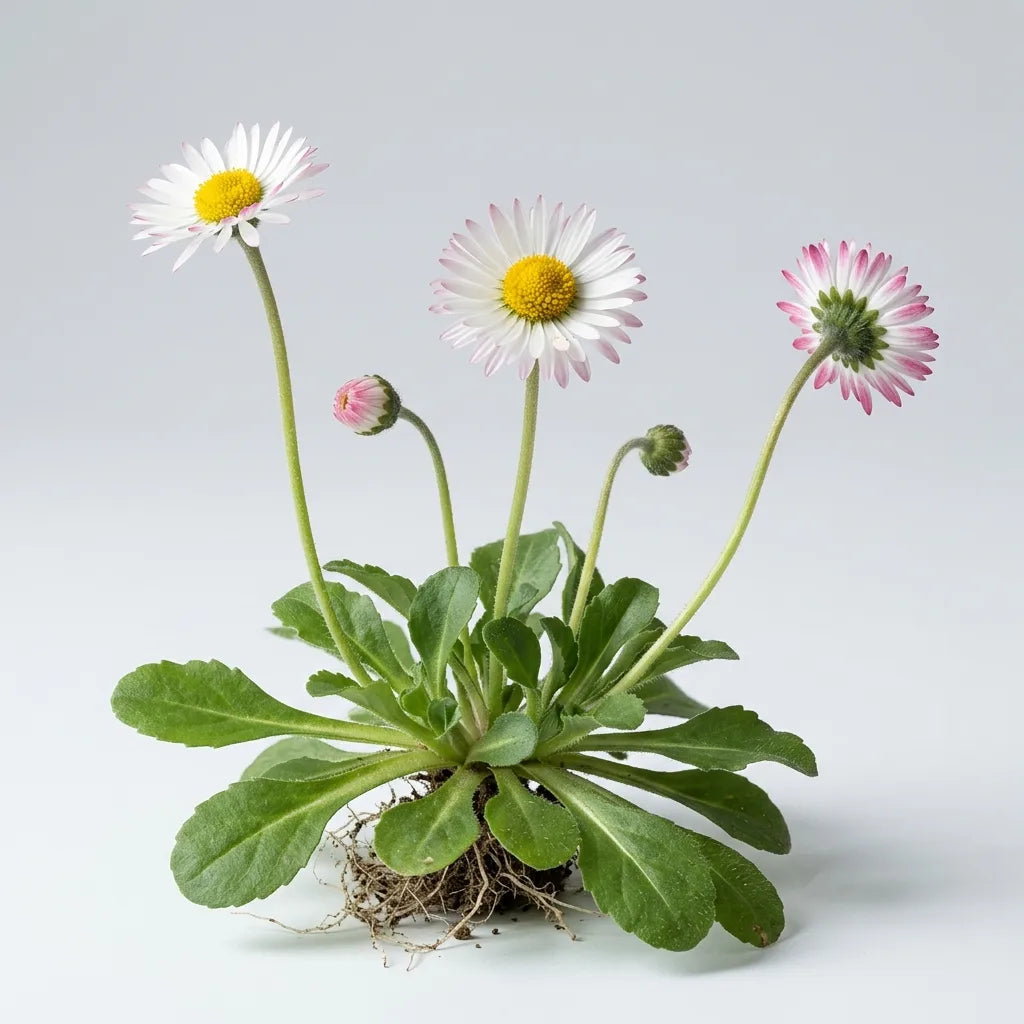
Perennial daisy, common daisy, Easter flower: its French name comes from its flowering period, which coincides with Easter, while its Latin name, perennis, reflects its remarkable longevity. It is the quintessential lawn flower, the one children use to make daisy chains, and is often pulled out even though it deserves to be left to establish itself.
Characteristics:
-
Very early flowering: white flower heads with yellow centers from the end of winter, often as early as February–March, and into autumn in cool conditions.
-
Ground-covering perennial: it spreads quickly through rosettes to form lovely flowering carpets.
-
Very hardy: it tolerates foot traffic and mowing, making it ideal for a flowering lawn.
Sowing advice:
-
Exposure: full sun to partial shade.
-
Soil: ordinary, moist, fairly rich, and well-drained. It appreciates soil that does not dry out completely in summer and tolerates somewhat heavy soils well—which is why it thrives in compacted lawns.
-
Method: sow directly in place in spring or autumn, on the surface, as the seeds need light to germinate: do not cover them; simply press them down. Neither soaking nor stratification is needed. See how to sow your seeds.
Care advice:
- Almost none. In a lawn, simply raise the mowing height and mow less frequently in spring to let it flower.
Benefits for biodiversity:
- Its very early flowering makes it a valuable resource for the first pollinators emerging from overwintering, at a time when almost nothing else is in bloom.
- Leaving daisies in a lawn transforms a sterile space into a refuge for wild bees and hoverflies—see the basics of permaculture.
Uses:
- The flowers are edible and make a lovely addition to salads, with a slight nutty flavor. See our edible flowers.
- As a border plant, in a flowering lawn, or in a meadow, it pairs well with other low-growing perennials.
Harvesting your own seeds:
Leave a few faded flower heads to dry on the plant, then rub them between your fingers over a container: the seeds are tiny. The daisy reseeds itself very generously and also spreads through its rosettes. See storing your seeds.
Commitment to Quality: at SemiSauvage - Permaculture, we grow and select our seeds with respect for living things as our guiding principle. Based near the Auvergne Volcanoes, we choose open-pollinated, non-hybrid varieties, tested for their germination rate, carefully sorted and packaged, without any chemical treatment. Our conviction: to give gardeners back the ability to resow, year after year, seeds that truly belong to them.
Sales reserved for home gardeners seeking quality and authenticity.