Raphanus sativus var. campestris
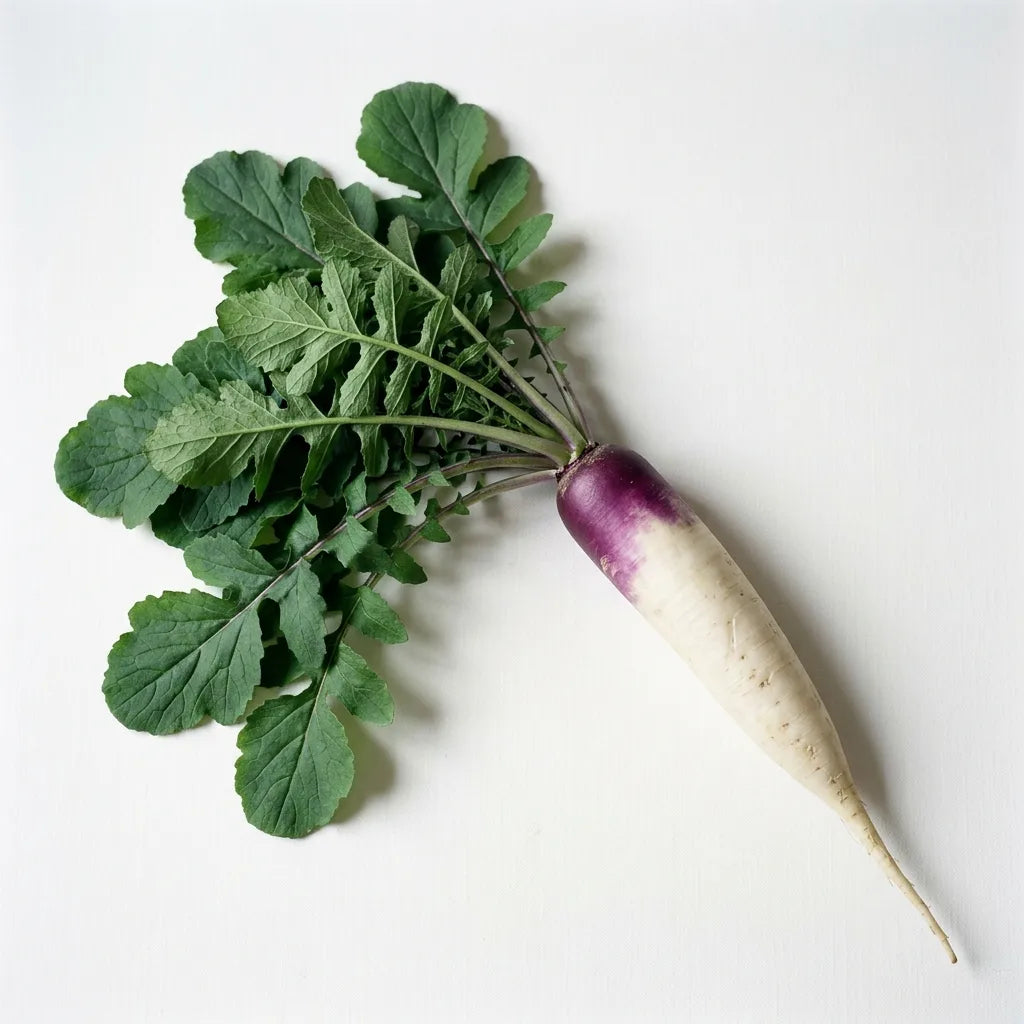
Field horseradish, Ardèche horseradish, winter radish with a purple shoulder: despite its name, this is not true horseradish (Armoracia rusticana), a sterile perennial propagated only by root cuttings and which almost never produces seeds. Field horseradish is an old-bred biennial radish, cultivated for over a century, that develops a long white root topped with a broad purple shoulder. When grated, it releases a distinctly mustardy heat that rises to the nose—shorter-lasting and rounder than that of true horseradish, but definitely present.
Characteristics:
-
Long white root with a purple shoulder: 25 to 30 cm, clearly marked purple shoulder, white, dense and crisp flesh.
-
Mustardy heat: the pungency develops only when grated, never beforehand.
-
Generous rosette: up to 50 cm, with the lyrate, rough leaves typical of radishes.
-
Biennial: the root grows in the first year, flowering and seed production take place in the second.
-
Undemanding: it emerges quickly, grows on its own and tolerates cold very well.
Precautions:
- Freshly grated root releases vapors that irritate the eyes and respiratory tract, stronger than those from onions: grate it in a well-ventilated area.
- Three plants not to be confused: field horseradish (Raphanus sativus var. campestris), true horseradish (Armoracia rusticana) and Japanese wasabi (Eutrema japonicum) are entirely different species.
- If you want to produce your own seeds, isolate it from other radishes: it crosses freely with them.
Sowing advice:
-
Position: sunny.
-
Soil: deep, loose and cool. Important point: the root grows straight down and deep, so work the soil thoroughly. Rocky or compacted soil produces forked roots.
-
Method: sow directly in place in July-August for an autumn and winter root harvest. It can also be sown from March to June, and in September-October as green manure. Do not transplant it: like all radishes, it does not like its root to be disturbed. See how to sow your seeds.
- Thin to 15 or 20 cm apart in the row as soon as the first true leaves appear.
Care advice:
- Water regularly: steady growth produces tender roots, while a dry spell makes them hollow and fibrous. Hoe occasionally, and nothing more.
Harvest advice:
- Harvest the roots from autumn through midwinter, starting after the first frosts, which refine their pungency. Dig them up to remove them whole; they grow deep.
- Store them in sand, somewhere cool and dark: they keep throughout the winter.
- Tip: the pungency develops only when the root is grated. Grate it at the last moment and add a splash of vinegar to preserve the aroma.
Beneficial associations:
- Sown along the edge of a potato or eggplant plot, its sulfurous smell is reputed to disrupt Colorado potato beetles. Its rapid growth and taproot also make it an excellent autumn green manure that loosens and cleanses the soil. See companion planting in the vegetable garden.
Benefits for biodiversity:
- In its second year, its large white flowers veined with purple, borne up to one metre high, are heavily visited by bees and hoverflies in spring.
- Like all brassicas, it is a host plant for cabbage white caterpillars.
- Its broad rosettes cover the soil and shelter ground beetles and beneficial insects close to the ground.
Uses:
- Grated root used as a condiment, alone or mixed with cream, with boiled meats, smoked fish and cured meats. The young spring leaves can be finely chopped into salads.
- The roots and tops are also highly valued by livestock and rabbits: its use as fodder is what earned it the name field radish.
Harvesting your own seeds:
It is biennial: leave a few plants in the ground over winter, and they will flower the following spring. Harvest the swollen, bead-like pods, ending in a long beak, when they have turned brown and hardened, then shell them. Isolate them from other radishes to keep the variety pure. See how to save your seeds.
Commitment to Quality: at SemiSauvage - Permaculture, we grow and select our seeds with respect for all living things as our guiding principle. Based near the Volcanoes of Auvergne, we choose open-pollinated, non-hybrid varieties, tested for their germination rate, carefully sorted and packaged, with no chemical treatment. Our conviction: to give gardeners back the ability to resow, year after year, seeds that truly belong to them.
A pungent root and an undemanding plant, to sow in midsummer for enjoyment all winter.