Papaver orientale
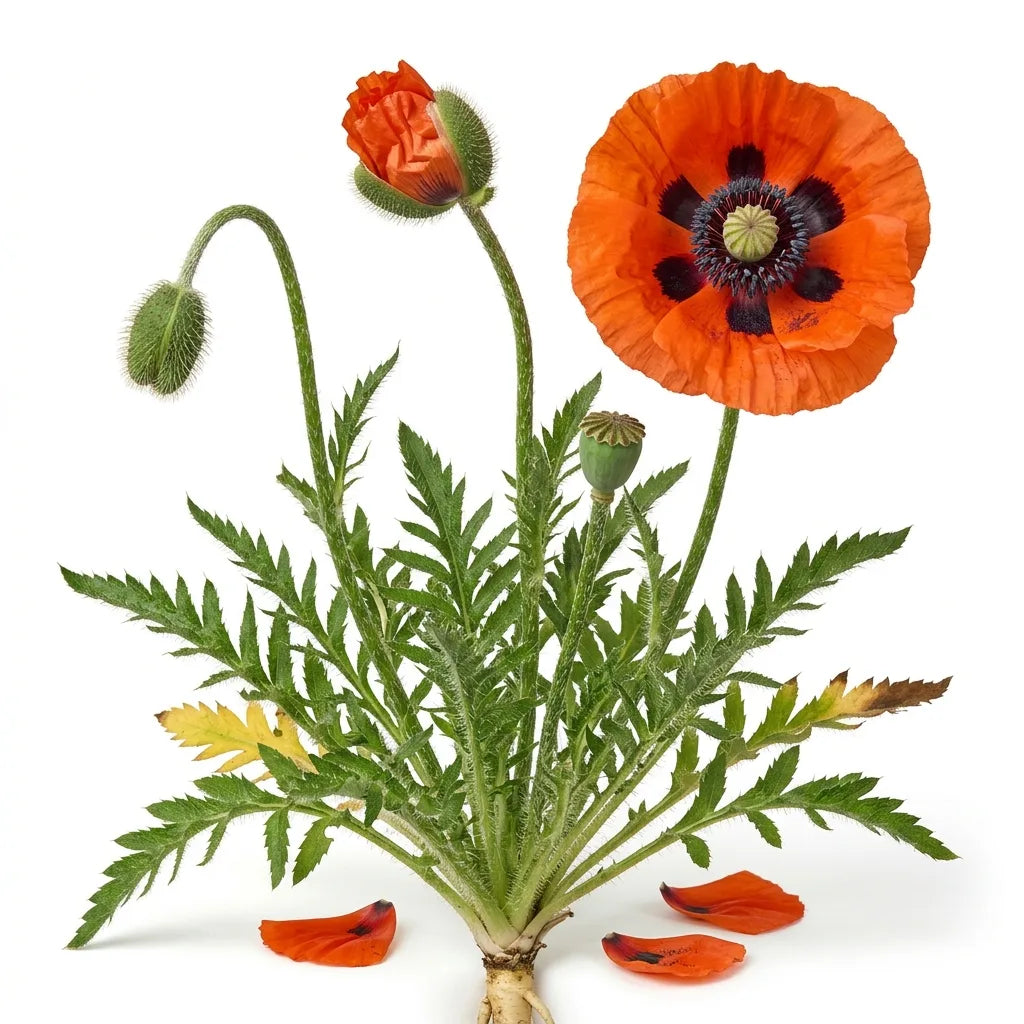
Oriental poppy, large perennial poppy, Turkish poppy: native to the mountains of the Caucasus and Anatolia, it bears the largest flowers of the entire poppy family—up to 15 cm in diameter. Its distinctive feature: after its spectacular May–June flowering, its foliage disappears completely in summer before returning in autumn. It is a puzzling cycle that is best understood before you assume it has died.
Characteristics:
-
Giant flowers: the most imposing in the genus, with petals crumpled like tissue paper, often marked with black at the base.
-
Very hardy perennial: it withstands temperatures from -20 to -30 °C and becomes permanently established, reaching up to 1 metre in height.
-
Summer dormancy: its foliage yellows and disappears after flowering, then returns in autumn.
Precautions:
- Like all poppies, the plant contains alkaloids: avoid ingesting it, especially by young children and pets.
Sowing advice:
-
Exposure: sunny and open, essential for abundant flowering.
-
Soil: poor, stony and chalky soil suits it perfectly, but it also tolerates richer soils provided they are very well drained and deep. Absolutely avoid: wet winter soil, which causes its taproot to rot.
-
Method: cold stratification improves germination. Then sow directly in the ground in autumn or early spring, barely covering the seeds. Its taproot tolerates transplanting very poorly: avoid pots.
Care advice:
- Water very sparingly: it prefers slightly dry soil and suffers from excess water.
- Cut back the yellowing foliage after flowering and plan for a neighbouring plant to fill the summer gap it leaves in the flower bed.
Beneficial pairings:
- Pair it with summer-flowering perennials such as the purple coneflower or yarrow, which will take over when its foliage disappears.
Benefits for biodiversity:
- Its enormous flowers provide very abundant pollen, literally swarmed by bees and bumblebees from dawn onwards.
- Its early flowering, in May–June, occurs during a key period for colony development.
Harvesting your own seeds:
Leave the large capsules to turn brown and dry on the plant until they open into small slits beneath their crown, then turn them upside down over a bag like a salt shaker. The dry capsules also make very attractive dried bouquets. See how to store your seeds.
Commitment to Quality: at SemiSauvage - Permaculture, we grow and select our seeds with respect for living things as our guiding principle. Based near the Volcanoes of Auvergne, we choose reproducible, non-hybrid varieties, tested for their germination rate, carefully sorted and packaged, with no chemical treatment. Our conviction: to give gardeners back the ability to resow, year after year, seeds that truly belong to them.
Give your flower beds the largest poppy flowers there are, every spring.