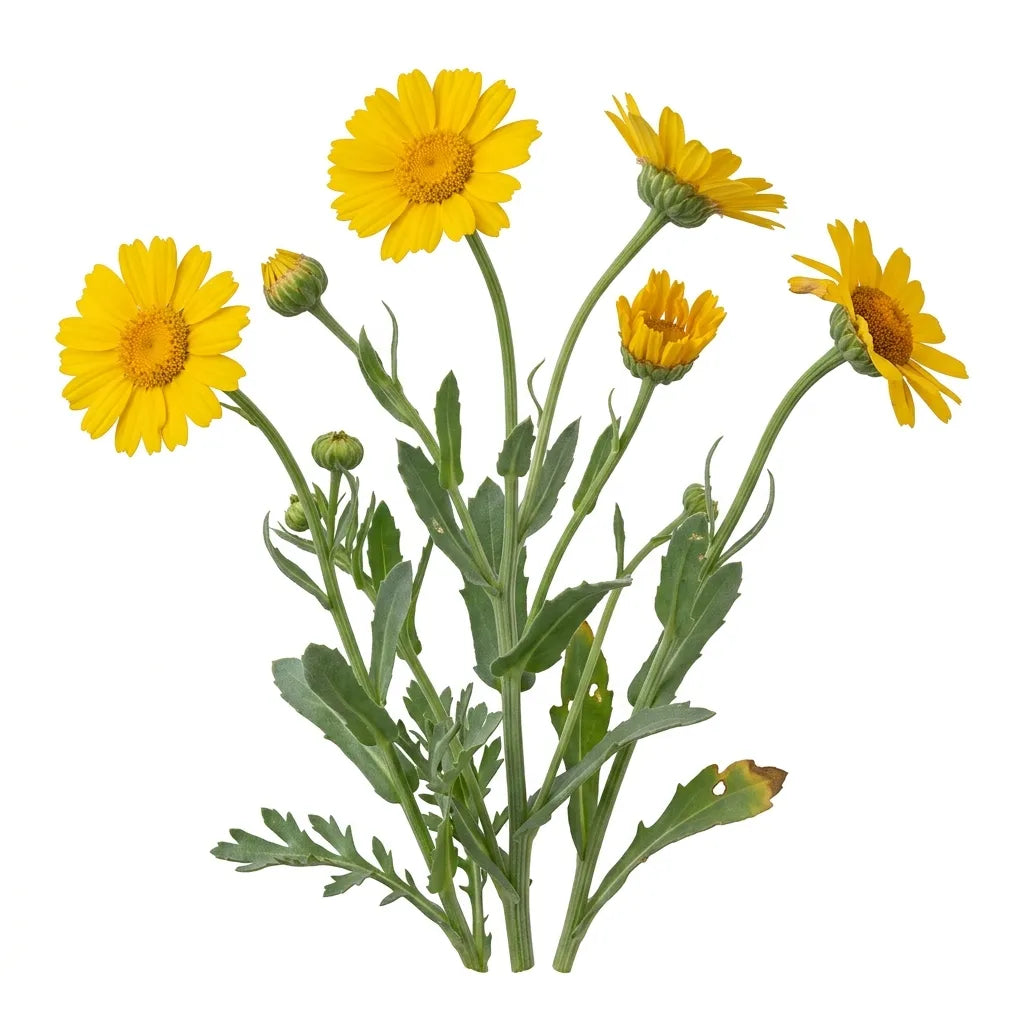
Glebionis segetum (syn. Chrysanthemum segetum)
Golden marguerite, corn marigold, yellow marguerite: once a familiar part of cereal fields, alongside the poppy and cornflower. Herbicides have almost wiped it out, but it is returning to gardens for what it is: a sunny, generous annual that is remarkably easy to grow.
Characteristics:
-
Bright yellow: large, single daisy-like flowers in a clear golden yellow, from June to September.
-
Compact growth: clumps 30 to 60 cm tall, highly floriferous.
-
Self-seeding: let it go to seed and it will return year after year.
Sowing advice:
-
Exposure: full sun.
-
Soil: light and well drained, even poor soil — it is an arable-field annual accustomed to ordinary cultivated soils. It needs no fertilization; excess nitrogen causes it to flop.
-
Method: no stratification required. Sow directly in the ground from March to June, or in pots from February under cover, at a depth of 0.5 cm, lightly covering with potting soil. Fast germination, in 7 to 14 days at 15–20 °C. See how to sow your seeds.
Care advice:
- Remove faded flowers to extend flowering, while keeping a few heads for natural self-seeding.
Beneficial combinations:
Benefits for biodiversity:
- Its broad, flat flower heads are highly accessible: bees, hoverflies and butterflies can land on them easily, including short-tongued species.
- It belongs to the group of arable-field flowers, which are now in sharp decline: sowing it helps preserve them.
- Its seeds feed granivorous birds in autumn.
Uses:
- Flowering fallows, borders, pollinator-friendly beds and meadows. An excellent cut flower for bright, country-style bouquets.
Symbolism:
The golden marguerite symbolizes light, simplicity and sunny joy. In the language of flowers, it evokes liveliness and warmth.
Harvesting your own seeds:
Leave a few faded flower heads to turn completely brown on the plant, then rub them between your fingers over a container: the seeds detach easily from the receptacle. See how to store your seeds.
Commitment to Quality: at SemiSauvage - Permaculture, we grow and select our seeds with respect for all living things as our guiding principle. Based near the Auvergne Volcanoes, we choose reproducible, non-hybrid varieties, tested for their germination rate, carefully sorted and packaged, with no chemical treatment. Our conviction: to give gardeners back the ability to resow, year after year, seeds that truly belong to them.
Sales reserved for amateur gardeners seeking quality and authenticity.